
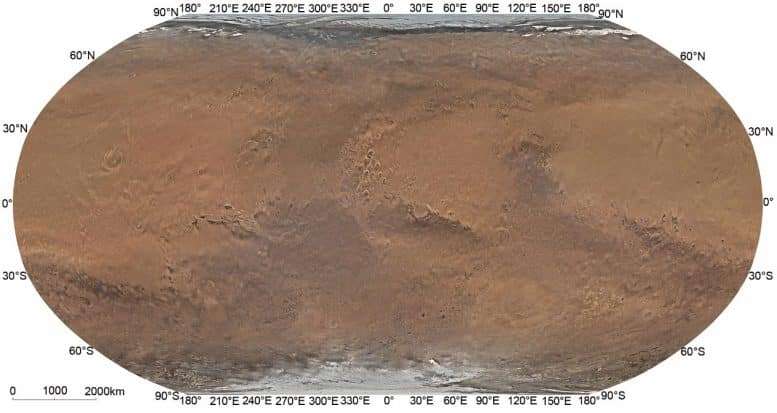
Chinese researchers have reached a new milestone in Martian exploration by releasing a detailed, true-color global map of Mars at remarkably high resolution.
Utilizing data obtained from the Tianwen-1 spacecraft, this map achieves a resolution of 76 meters per pixel, revealing intricate surface details previously unseen.
This global visualization offers scientists a strikingly clear perspective on Mars’ terrain, geological features, and atmospheric conditions, opening new avenues for planetary research.

Innovative Remote Sensing Techniques Drive Mars Mapping
The comprehensive map was produced based on information gathered by two primary instruments aboard the Tianwen-1 orbiter: the Moderate Resolution Imaging Camera (MoRIC) and the Mars Mineralogical Spectrometer (MMS).
The MoRIC captures high-fidelity color images of the Martian surface, while the MMS collects spectral data spanning visible to near-infrared wavelengths, crucial for comprehending the planet’s mineral makeup and structure. Together, these instruments amassed extensive data covering the entire Martian globe.
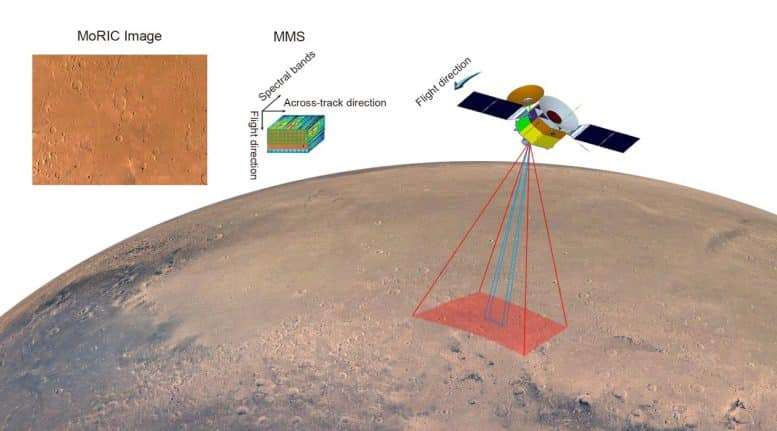
Over the course of the mission, Tianwen-1 completed more than 284 orbits around Mars, collecting 14,757 images with pixel resolutions ranging from 57 to 197 meters. This extensive dataset proved essential for constructing an accurate, high-detail portrayal of the planet’s surface.
The imaging capabilities enabled the generation of the most precise Mars global map to date, delivering clearer insights into its canyons, craters, and ancient fluvial formations.
Previous global Mars maps, such as the Viking Colorized Global Mosaic, offered a spatial resolution of approximately 232 meters per pixel. Tianwen-1’s enhanced resolution of 76 meters per pixel represents a more than threefold improvement, significantly advancing the clarity of Martian surface observations.
Advanced Image Processing Techniques Reveal Martian Landscape
The high-resolution map was made possible through sophisticated image processing carried out by the Tianwen-1 science team, led by Professor Li Chunlai at the National Astronomical Observatory of the Chinese Academy of Sciences and Professor Zhang Rongqiao from the Lunar Exploration and Space Engineering Center. Their approach employed bundle adjustment technology to refine the orbiter’s measurement data and correct positional errors.
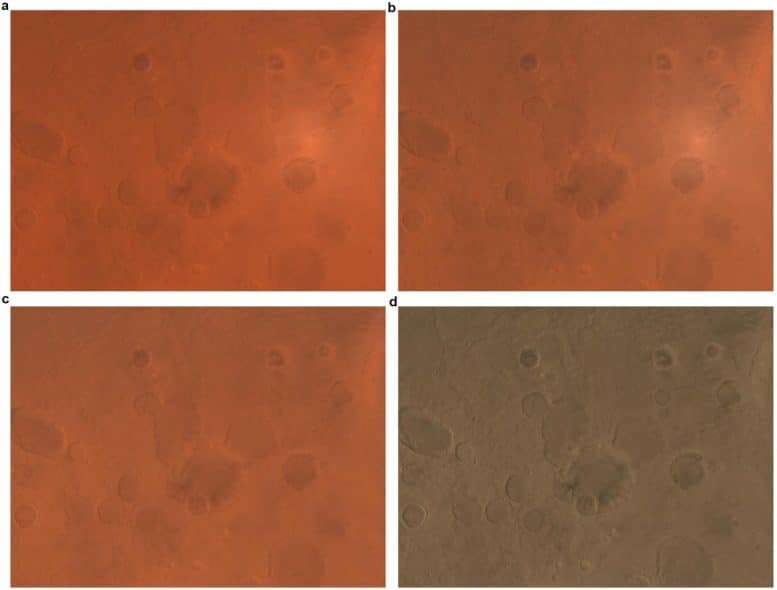
Applying this technique treated Mars as a unified adjustment model, achieving extremely precise pixel-level alignment to produce a flawless global mosaic. The team performed color calibration and maintained uniform brightness and color balance across the map, ensuring a true-color rendition of the Martian surface. This resulted in a map that visually represents Mars as the human eye would perceive it.
Li Chunlai highlighted the significance of the map for future Mars studies: “The authentic colors of Mars’ terrain were meticulously calibrated using our spectrometer data. This represents the most accurate visual representation of Mars so far and will be invaluable for ongoing and upcoming missions.”
A Groundbreaking Tool for Future Mars Missions
This latest Mars map from Tianwen-1 signifies a pivotal achievement in planetary research and exploration. As the clearest global image of the Red Planet to date, it provides a vital resource for examining Mars’ geology, atmosphere, and potential habitability. Scientists worldwide will benefit from this comprehensive data, improving their ability to analyze geological features, assess optimal landing zones, and plan exploration strategies with heightened precision.
The map is also critical for advancing human spaceflight plans to Mars. With its remarkable detail, researchers can identify specific sites of interest that could hold insights into Mars’ ancient climate history or potential signs of past life. “This global map establishes a new benchmark for Mars exploration,” stated Professor Zhang Rongqiao, “and it will undoubtedly be instrumental for future Mars endeavors.”
By delivering a detailed, true-color portrayal of Mars, the Tianwen-1 mission has greatly enhanced scientific understanding of the Red Planet and set a solid foundation for more ambitious exploration in the years ahead.
- Categories:
- Astronomy ,
- News ,
- Space









0 comments
Sign in to Comment