

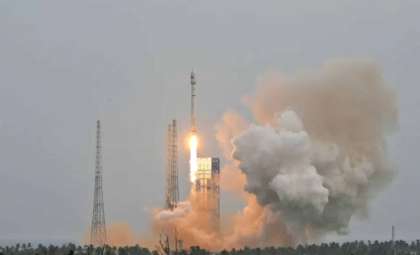
Earlier this year, a dozen satellites were discreetly launched into low Earth orbit from the Jiuquan Satellite Launch Center situated in the Gobi Desert. Unlike typical payloads such as weather sensors or communication relays, these satellites each carry sophisticated artificial intelligence frameworks, ultra-fast laser communication systems, and robust computing hardware, signaling a transformative shift in satellite data management.
Supported by Zhijiang Laboratory, a government research establishment, alongside ADA Space, a Chinese aerospace startup, this project is titled the Three-Body Computing Constellation, an homage to Liu Cixin’s acclaimed science fiction novel. Early coverage by the South China Morning Post and Guangming Daily indicates the plan aims to deploy as many as 2,800 satellites forming an immense, interconnected computational network in orbit.
Upon completion, the system is expected to deliver up to 1,000 peta operations per second (POPS), a processing capacity that could eclipse existing terrestrial supercomputers.

Reimagining Data Processing Beyond Earth
Conventionally, satellites gather data—such as environmental metrics, radar images, and photographs—and relay it back to Earth for computation and analysis. This workflow faces challenges like limited bandwidth, restricted transmission periods, and enormous data quantities that slow down processing times.
This new satellite network overturns this paradigm. As Wang Jian, director of Zhijiang Lab and Chinese Academy of Engineering member, remarked at Macau's Beyond Expo, “Artificial intelligence should not be absent from space due to a lack of computing power,” emphasizing the importance of onboard processing.
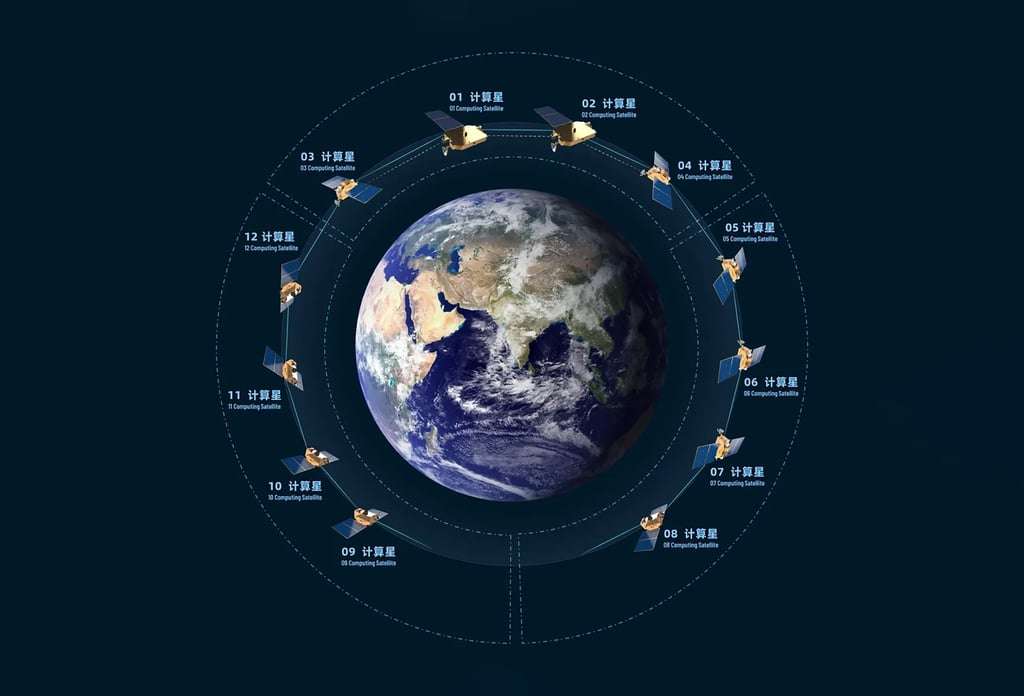
Satellites in orbit avoid heat dissipation and energy limitations that challenge Earth-based data centers. They reject heat directly into the vacuum and continuously harness solar power independent of ground grids. Featuring laser connections transferring data at 100 gigabits per second and 30 terabytes of onboard memory per satellite, each node integrates into a wide-ranging, self-governing AI computational framework.
Though NASA and the European Space Agency have tested edge computing in orbit on smaller scales, China’s deployment is the first extensive operational network of this kind, aligning with a strategic thrust to lead in advanced technologies that connect space infrastructure with artificial intelligence capabilities.
Beyond Computation: Multifaceted Scientific Tools in Orbit
This constellation extends beyond raw computing power. The satellites carry various scientific devices including Earth monitoring cameras, advanced 3D mapping systems, and sensors detecting X-ray polarisation. These instruments enable immediate observation of natural disasters, weather phenomena, and energetic astronomical occurrences like gamma-ray bursts.
One notable objective is creating digital twins of Earth’s landscapes—AI-constructed, real-time replicas of topography useful in sectors like agriculture, urban planning, defense, and climate analysis.
On a regional level, the project supports local development strategies. Areas such as Sichuan’s Neijiang high-tech zone aim to develop AI-enhanced smart service centers leveraging the satellite-derived data.
A Strategic Milestone with Global Implications
The timing of this ambitious rollout coincides with intensifying international competition in AI advancements, especially amid challenges involving semiconductor supply and data control. By decentralizing computational resources and reducing reliance on terrestrial infrastructure or restricted technologies, China secures a strategic technological edge.
Experts highlight the consortium’s declared focus on worldwide collaboration. ADA Space depicts the constellation as a “low-carbon, sustainable, and internationally accessible” orbital network, specifically interested in partnerships with nations in the Global South. While this inclusive positioning has merit, it also draws attention given the dual-use potential of the technology for both civilian and military purposes.
As Harvard astronomer Jonathan McDowell observes, “Orbital data centres make a lot of sense. They’re energy-efficient, they’re scalable, and they offer strategic independence from national infrastructure.”










0 comments
Sign in to Comment