
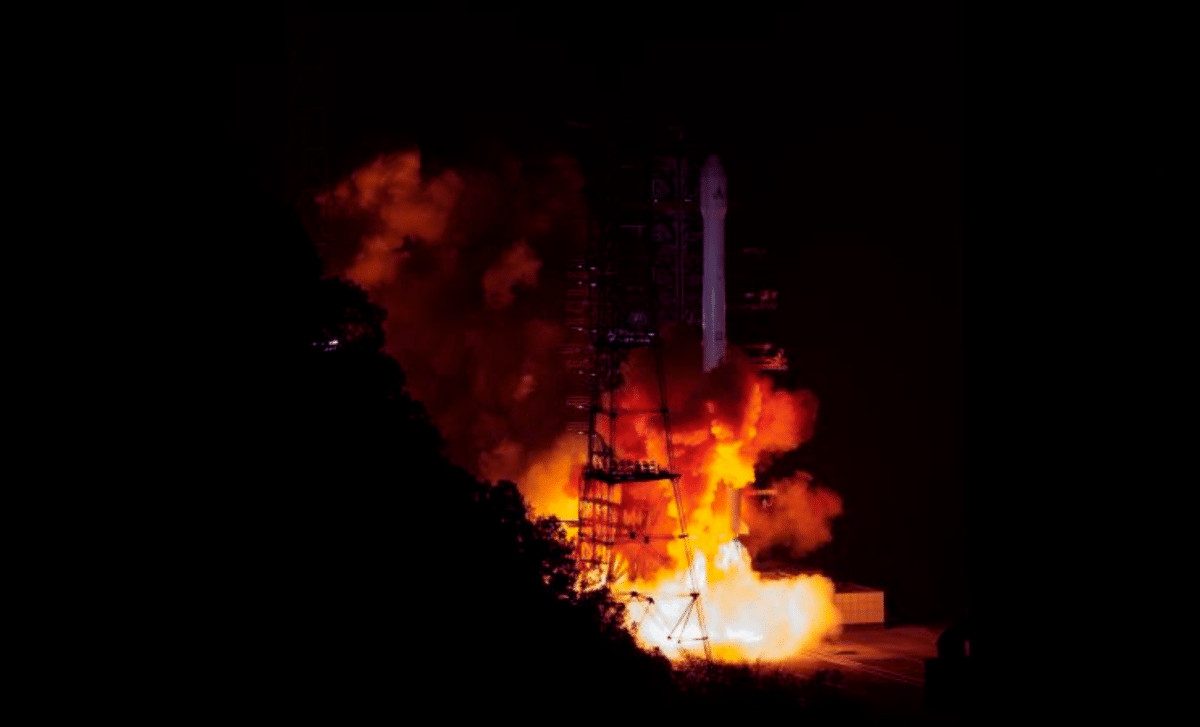
China recently launched the state-of-the-art Fengyun-4C meteorological satellite to advance its capacity for tracking extreme weather events and climate patterns. The mission, initiated from the Xichang Satellite Launch Center in Sichuan, signifies a notable enhancement to China's expanding constellation of space-based environmental monitoring assets.
Advancing China’s Geostationary Weather Observation Fleet
At 12:07 a.m. local time on December 27, 2025, a Long March-3B launcher lifted the Fengyun-4C satellite into a geostationary orbit. According to China Daily, this deployment is part of a strategic plan to enhance China’s meteorological capabilities across both national and regional scales. Fengyun-4C will supplant its predecessor Fengyun-4A and join Fengyun-4B, together creating a trio of sophisticated observational satellites.
Cao Xiaozhong, the deputy director of the China Meteorological Administration (CMA), underscored the importance of this milestone:

“The Fengyun 4C represents a comprehensive leap in observational performance,” Cao said. It offers high stability observation, high-precision remote sensing products, and high-efficiency data processing, he added.
These advanced capabilities enable researchers to monitor evolving storm systems with greater detail than ever before, improving early warnings and disaster mitigation efforts.
The satellite’s suite of instruments targets small to medium atmospheric events that often lead to sudden storms, intense rainfall, and typhoons. Its onboard geostationary radiation imager can scan the entirety of China and surrounding regions every five minutes, with the capability to provide rapid one-minute updates over critical areas during severe weather conditions.
Cutting-Edge Tools for Continuous Weather Surveillance
The Fengyun-4C carries six sophisticated scientific payloads that meet or surpass global benchmarks in meteorological observation. Its interferometric vertical atmospheric sounder has been upgraded, improving spatial resolution from 12 kilometers down to 8 kilometers for enhanced tracking of dynamic atmospheric processes.
These instruments perform hourly scans along with intensified monitoring at 15-minute intervals, generating a nearly continuous flow of detailed weather data. This contributes significantly to numerical weather forecasting models, providing improved predictions for typhoons and storm trajectories.
The China Meteorological Administration also emphasized that the satellite’s lightning detection operates uninterrupted across the full observation domain. This real-time lightning data feeds into CMA’s AI-driven weather platform, MAZU, elevating forecast accuracy for severe convective storms.
Extending Reach Into Space Weather Monitoring
In addition to terrestrial weather tracking, Fengyun-4C is equipped with advanced instruments to observe space weather phenomena, such as solar proton events and geomagnetic fluctuations. These can disrupt satellite communications, navigation, and even terrestrial power networks. Positioned at 133 degrees east longitude, Fengyun-4C’s vantage point extends across the central Pacific Ocean, broadening China’s surveillance over vital typhoon formation zones.
Lu Feng, lead designer for the Fengyun-4 series’ optical ground systems, remarked that the satellite will act as “the first line of defense for meteorological disaster prevention” once fully operational. This enhanced coverage improves monitoring of typhoon origins in the western Pacific, offering earlier alerts to users both within China and internationally.
- Categories:
- News












0 comments
Sign in to Comment