

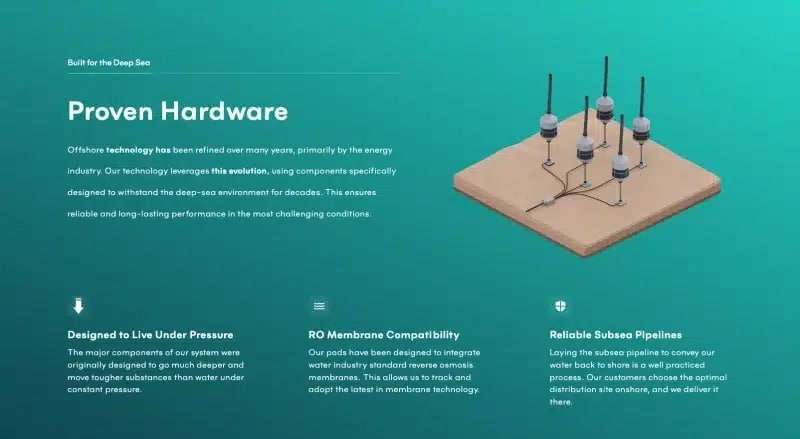
Near the shores of Malibu, California, an underwater array of pods is set to accomplish a U.S. first: converting deep ocean water into potable water solely powered by natural ocean pressure.
Known as Water Farm 1, this initiative is led by OceanWell, a water innovation company headquartered in Santa Monica, working alongside the Las Virgenes Municipal Water District (LVMWD). By 2030, the project targets a daily output of up to 60 million gallons of fresh water, adequate for about 450,000 residents, roughly equivalent to Long Beach’s population.
The need for water diversification is critical. Over the last 15 years, California has declared droughts in 10 instances, with 2022 among the driest recorded years, reports the California Department of Water Resources. Shrinking snowpacks, drained aquifers, and increasing demand on the Colorado River have pushed officials to explore alternative water solutions.

Revolutionizing Deep-Sea Desalination with Natural Ocean Pressure
Differing from standard coastal desalination plants that demand extensive infrastructure and high energy use, Water Farm 1 exploits hydrostatic pressure found 400 meters (1,300 feet) beneath the ocean surface to facilitate its reverse osmosis process. Each modular unit converts seawater to drinking water without emitting concentrated brine, a frequent ecological issue with older desalination technologies.
“Water Farm 1 demonstrates a cost-efficient, environmentally mindful way to extract fresh water from the ocean,” stated Robert Bergstrom, CEO of OceanWell, in August 2025. “This infrastructure is designed to endure climate challenges and provide sustainable water security.”
Initial pilot installations began in March 2025 within the Las Virgenes Reservoir, revealing that the company’s LifeSafe™ intake system effectively operates in biologically active waters while safeguarding ocean ecology. Individual pods can produce about 1 million gallons daily, with many scheduled for deployment off Malibu’s coast.
OceanWell asserts the technology's energy needs to be up to 40% less than traditional desalination operations and avoids construction of large coastal plants, which often face opposition due to environmental concerns.
Coordinated Efforts for Distributing Water Inland
Water Farm 1 is more than just an innovation; it represents a cooperative effort by seven California water authorities working to deliver water beyond coastal regions. While seaside municipalities gain direct supply, inland cities such as Calabasas and Burbank encounter more logistical hurdles.
Burbank, lacking direct ocean pipeline access, collaborates with the Metropolitan Water District of Southern California to establish a water-sharing network across the region.
“Delivering water from 400 meters beneath the sea to inland locations without coast-connected pipelines poses challenges,” explained Ian Prichard, Deputy General Manager of the Calleguas Municipal Water District. “Only through partnership can we achieve this.”
A third-party feasibility analysis is in progress to evaluate integration into existing water infrastructure and to estimate necessary upgrades. These results will influence the extent and feasibility of inland distribution.
Scientific Caution and Environmental Review
While excitement grows, environmental vigilance remains strong. OceanWell has established Tribal and Environmental Working Groups to oversee the environmental effects of the submerged pods and inform the project’s final design. These groups will scrutinize pilot results to ensure marine ecosystems stay protected.
“I’m keen to observe if this approach holds up under large-scale, deep ocean conditions,” commented Dr. Mark Gold, UCLA adjunct professor at the Institute of the Environment and Sustainability. “We require solutions that balance cost, durability, and ecological impact.”
A crucial benefit is the absence of brine discharge, a typical desalination byproduct that can impact local salinity and temperature. Research from 2023 by University of California Santa Cruz highlights how brine outflow can harm benthic and larval fish populations over time.
By preventing such discharge, Water Farm 1 may offer a distinct environmental advantage. Yet, as Professor Gold notes, “The true test lies in operational success beyond pilot stages.”
- Categories:
- News







0 comments
Sign in to Comment