
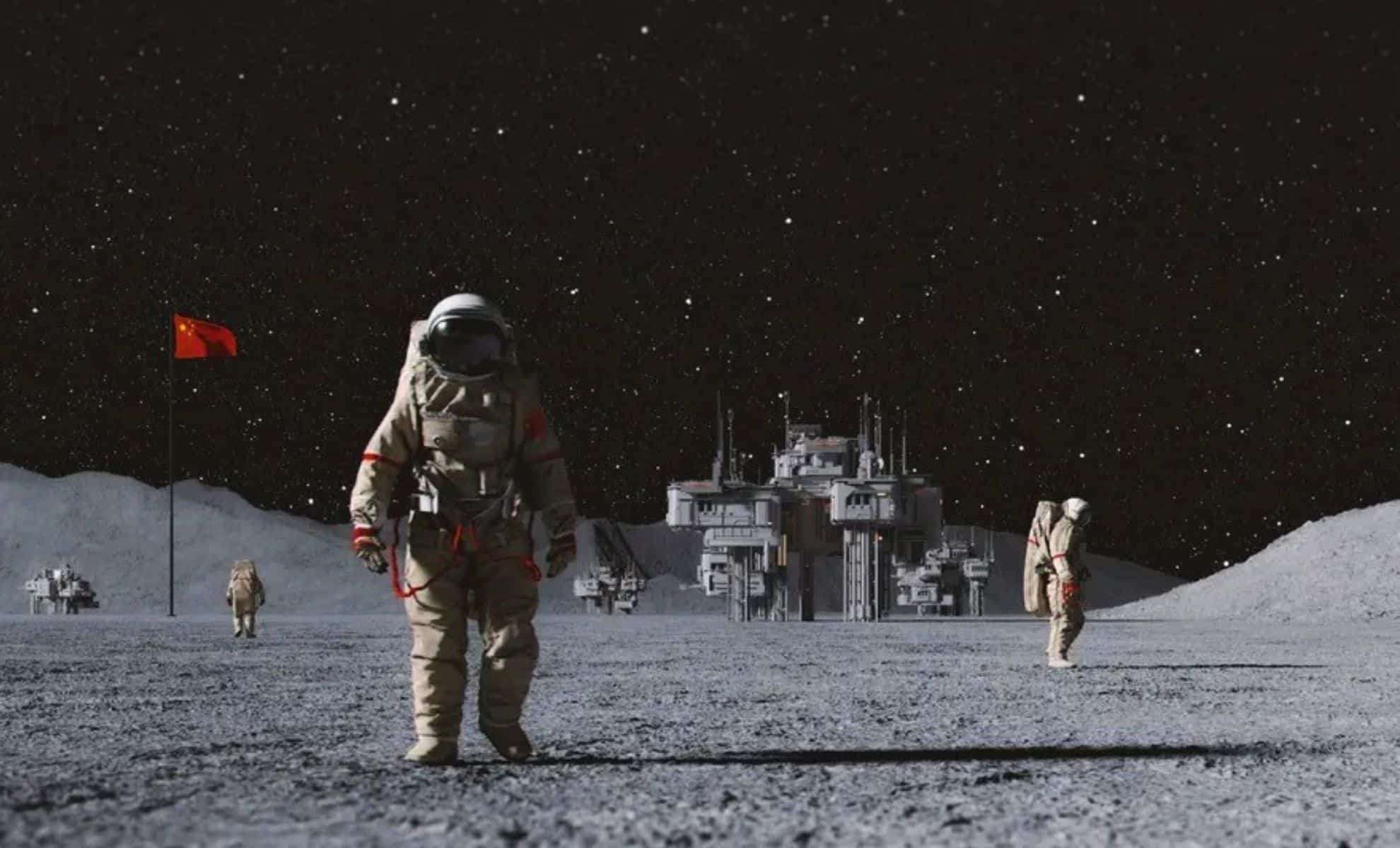
China and Russia have announced a collaborative effort to build a nuclear reactor on the Moon, designed to power a permanent lunar installation near the Moon’s south pole by the year 2035.
This project is a key element of the International Lunar Research Station (ILRS), a joint venture between the two nations that has been under development for several years.
Chang’E-8 Mission to Advance Lunar Power Capabilities
The Chang’e-8 mission, anticipated for launch in 2028, will be instrumental in preparing the groundwork for the lunar base.

Pei Zhaoyu, the lead engineer for the mission, explained that the endeavor aims to test new technologies for lunar habitation and investigate energy generation methods on the Moon, according to Interesting Engineering.
During a briefing attended by representatives from 17 countries and organisations collaborating on the ILRS, Pei confirmed that nuclear energy is one of the primary power sources being evaluated.
Although several energy options were discussed, nuclear power stands out as the front-runner due to the Moon’s harsh conditions, including prolonged darkness and severe temperature swings, which necessitate a steady and dependable power supply.
The Chang’e-8 mission will help establish whether nuclear power solutions are both practical and sustainable in the lunar environment.
Leveraging Russia’s Nuclear Space Technology Experience
China is relying heavily on Russia’s expertise in space-based nuclear technologies to realize this initiative.
Wu Weiren, chief architect of China’s lunar exploration efforts, pointed out that “Russia holds a significant advantage” in crafting nuclear systems for extraterrestrial use.
He asserted that Russia “is at the forefront globally” and maintains a lead over the United States in developing nuclear power facilities beyond Earth.
In 2024, Roscosmos, the Russian space agency, announced plans to partner with China to deploy a nuclear reactor on the Moon by 2035.
While there has been no formal confirmation from Beijing, the inclusion of this concept in Pei’s official remarks indicates strong consideration at senior levels.
ILRS Progress Coordinates With Worldwide Lunar Projects
The International Lunar Research Station fits within a wider strategy by China and Russia for lunar expansion, aiming to finalize a preliminary ILRS model by 2035, focused on the Moon’s south pole.
This area draws attention due to its relatively stable temperatures and the discovery of water ice in permanently shadowed craters.
China’s schedule closely mirrors that of the NASA-led Artemis initiative, which also targets the creation of a enduring lunar settlement.
The Artemis program plans for a crewed Moon return in 2027 with a base predominantly powered by solar power.
Extensive solar arrays will be installed across the lunar surface and connected via infrastructure to distribute electricity throughout the facility.
Nonetheless, NASA is investigating nuclear power options as a complementary or alternative energy source.
Harnessing Lunar Resources Through Worldwide Partnership
Beyond energizing human presence, the lunar nuclear plant could support ongoing scientific experiments and future industrial activities.
Among the Moon’s valuable materials, helium-3 is highly significant. Chinese researcher Ouyang Ziyuan noted that helium-3 has the potential to “satisfy global energy needs for approximately 10,000 years” if it can be exploited for nuclear fusion.
China has also introduced the “555 Project”, an ambitious effort to engage 50 countries, 500 research institutions, and 5,000 scientists abroad, aiming to make the ILRS a diverse, international hub for lunar science and exploration.
- Categories:
- Space










0 comments
Sign in to Comment