
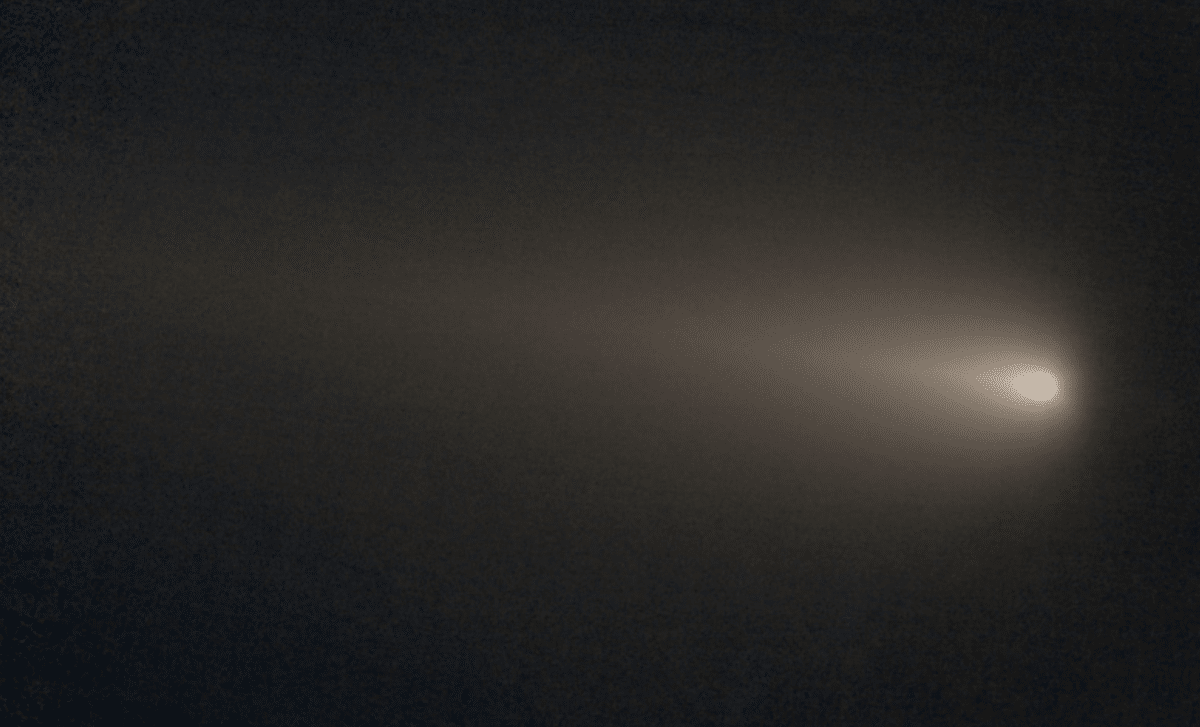
An intriguing new sungrazer, C/2026 A1 MAPS, is forecasted to closely approach the Sun in early April 2026. Should it endure the scorching heat and powerful gravitational forces during this near-Sun passage, observers on Earth might witness a spectacular celestial event. Universe Today reports that specialists are tracking this comet’s path closely, anticipating a bright display while noting its survival remains uncertain. The comet’s journey toward the Sun promises to be both thrilling and unpredictable.
Comet C/2026 A1 MAPS: Nearing the Sun’s Fiery Edge
Comets captivate scientists and stargazers due to their dynamic nature and breathtaking appearances. Among them, sungrazers are remarkable for their perilously close approaches to the Sun, sometimes skimming just above its surface. Usually, these encounters lead to the comet’s disintegration, but some manage to survive, producing stunning shows. Discovered in January 2026, C/2026 A1 MAPS joins this unique category of comets.
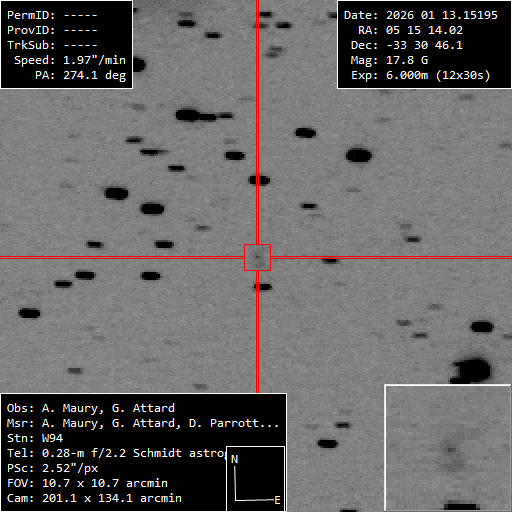
At its discovery, the comet was an astounding 2.056 astronomical units (AU) from the Sun—quite distant for a sungrazer—paired with a faint brightness estimated at +17.8 magnitude. These factors suggested a relatively large nucleus, thought to measure around 2.4 kilometers across. The upcoming closest approach on April 4th will see it pass just 160,000 kilometers from the Sun’s surface—less than half the distance separating Earth from the Moon.

The Intense Solar Environment: Challenges for Sungrazers
Sungrazing comets face extreme conditions as they approach the Sun, subjected to intense heat and overwhelming gravitational forces that often lead to their destruction. In particular, C/2026 A1 MAPS will transit through the Sun’s corona, the outer atmosphere where temperatures can soar to millions of degrees, making its fate uncertain.
Nonetheless, history records sungrazers like Comet C/2011 W3 Lovejoy, which survived a similarly close encounter in 2011 at 140,000 kilometers from the Sun’s surface and treated observers to a stunning tail after perihelion. Survival depends on several variables, especially the nucleus size and composition.
The Sun’s gravitational pull and the frictional effects from moving through the solar atmosphere cause rapid sublimation of the comet’s icy core. This process often produces an impressive plume of gas and dust that forms the comet’s iconic tail. Such dramatic phenomena motivate astronomers to watch these comets despite the frequent disintegration events.
The Discovery of C/2026 A1 MAPS: A Chilean Team’s Triumph
Spotted in January 2026 as the year’s first comet, C/2026 A1 MAPS was identified by the MAPS team in Chile. Located remotely during discovery, this team operates a series of telescopes in the Atacama Desert and has a track record of finding significant celestial bodies, including near-Earth asteroids.
Initially labeled 6AC4721, the comet was renamed in honor of its discoverers: Alain Maury, Georges Attard, Daniel Parrott, and Florian Signoret—the acronym MAPS representing them. This marks the seventh comet credited to the team, which has also discovered various asteroids such as 2023 DW, a potential Earth-impact object. Their work continues to enhance our catalog of nearby and distant cosmic objects.
The Kreutz Family: A Historic Lineage of Sungrazers
C/2026 A1 MAPS belongs to the Kreutz group, a collection of sungrazing comets believed to originate from the breakup of a massive parent comet around 362 BC. Over time, this group has produced many notable comets, some spectacularly visible from Earth. Among them are Comets C/1965 Ikeya-Seki and the Great Comets of 1843 and 1882.
The Kreutz comets represent fragments of a once enormous comet. While many are faint and invisible to the naked eye, others have created awe-inspiring celestial events. C/2026 A1 MAPS adds a new chapter to this family’s legacy, with its solar approach eagerly anticipated by astronomers worldwide.
Will C/2026 A1 MAPS Withstand Its Solar Encounter?
As C/2026 A1 MAPS nears its perihelion, scientists are keenly observing its trajectory to predict its fate. Success in surviving the Sun’s close approach would allow it to proceed outward, eventually reaching around 220 AU from the Sun, venturing beyond the Kuiper Belt into the solar system’s outer stretches rarely visited by comets.
The comet’s survival largely hinges on its nucleus. Composed mainly of ice and dust, comets usually lose material rapidly when approaching the intense solar heat. However, a sizeable, robust nucleus might endure, enabling the comet to emerge with a magnificent tail of gas and particulate matter.
Tracking C/2026 A1 MAPS with SOHO
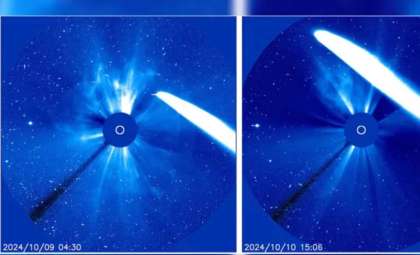
The Solar and Heliospheric Observatory (SOHO), operational since 1995, has been pivotal in detecting over 5,000 sungrazing comets. SOHO will monitor C/2026 A1 MAPS closely using its LASCO C2 and C3 instruments, providing vital information as the comet traverses the Sun’s corona.
With SOHO’s continuous observations, astronomers can track changes in the comet’s nucleus and tail as it passes behind the Sun and reappears, offering insights into its survival and any resulting visual phenomena. Successful survival would also enrich understanding of sungrazer behavior and their solar interactions.
The Potential Brilliance of C/2026 A1 MAPS’ Tail
One of the most captivating features of sungrazers is the chance to display extraordinary comet tails formed from vaporized material due to solar heat. If C/2026 A1 MAPS survives perihelion, it could develop a breathtaking tail visible against the night sky.
Historically, comet tails have amazed viewers worldwide, such as the spectacular tail of Comet C/1965 Ikeya-Seki. Should C/2026 A1 MAPS produce a similar marvel, it would be best observed from the southern hemisphere before and after its closest approach to the Sun.
Looking Beyond C/2026 A1 MAPS: Future Sungrazer Discoveries
Although C/2026 A1 MAPS currently garners much attention, sungrazing comets remain relatively common. SOHO continues to discover new sungrazers regularly. Some astronomers predict another prominent sungrazer might appear around 2050, promising more magnificent solar encounters.
The ongoing discovery and observation of sungrazers, aided by advancing technology, enhance our comprehension of these fascinating objects and their solar interactions. Alongside monitoring C/2026 A1 MAPS, scientists remain vigilant for future comets that could further illuminate cometary science.
- Categories:
- News







0 comments
Sign in to Comment