
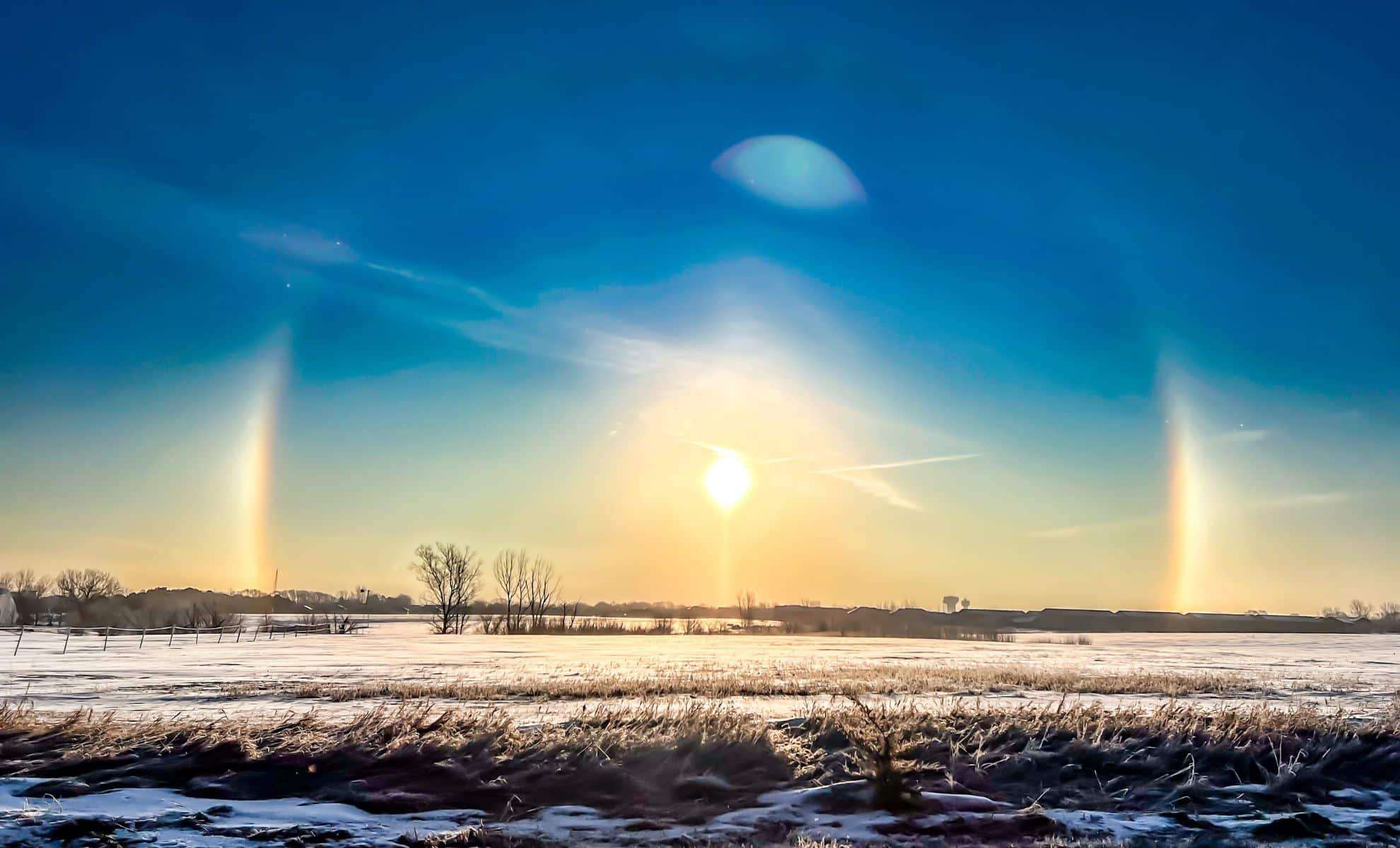
The James Webb Space Telescope (JWST) has discovered signs that planets beyond our solar system could display spectacular luminous effects akin to Earth's sun dogs. Recent research by Cornell University indicates that such optical wonders might light up the sky above WASP-17b, a sprawling gas giant located about 1,300 light-years from Earth. Should these findings hold true, the sunsets on alien worlds could surpass anything seen on our planet.
The Role of Intense Winds in Crystal Alignment
Classified as a “hot Jupiter,” WASP-17b orbits extremely close to its star, subjecting it to blistering temperatures and supersonic winds that can reach speeds as high as 10,000 miles per hour (16,000 kilometers per hour). The study suggests that these fierce atmospheric currents may organize microscopic quartz crystals suspended high in the planet’s atmosphere. Their alignment mimics the way ice crystals create halos and sun dogs in Earth's skies.
“If we could capture an optical image of WASP-17b’s disk in detail, we’d observe these sun dog-like phenomena,” said Nikole Lewis, an associate astronomy professor at Cornell University and co-author of the study. Despite each quartz crystal being tiny enough that around 10,000 could fit across a human hair’s breadth, their collective arrangement under severe wind conditions might produce an ethereal celestial spectacle.

James Webb’s Insights on Atmospheric Light Effects
Although direct imaging of these light phenomena at WASP-17b is beyond current technology, JWST can indirectly examine their presence. In 2023, the telescope identified signs of quartz nanocrystals in the upper clouds of WASP-17b. Lewis emphasized the novelty of this discovery, saying, “Finding quartz crystals in a hot Jupiter atmosphere was unanticipated and has major implications for exoplanet research.”
To better understand these effects, scientists developed comprehensive models simulating how different minerals—like quartz, enstatite, and forsterite—scatter and reflect light depending on their orientation. Even minor adjustments in crystal alignment could change the light patterns detected by JWST, revealing clues about how the atmosphere behaves.
“Considering the incredibly strong winds reaching 10,000 miles per hour on these dense planets, it’s logical that particles would become aligned,” Lewis noted.
Unraveling the Mysteries Behind Alien Light Displays
The fascinating atmospheric halos are thought to result from a process known as mechanical alignment. Originally introduced in 1952 by Cornell astronomer Tommy Gold to explain the alignment of cosmic dust with gas flows, this principle remains relevant under the extreme pressures of exoplanet atmospheres, according to scientists Elijah Mullens and Lewis.
Even if quartz grains don’t perfectly align with powerful winds, they may still orient themselves vertically or react to electric fields, producing stunning visual effects through starlight scattering. Mullens, the study’s lead, is spearheading new JWST observation campaigns to investigate these alignments more thoroughly. He remarked, “Beyond their beauty, these phenomena provide valuable information on crystal behavior in alien atmospheres.”
Exploring how light interacts with these fine particles could unlock deeper insights into the physical and chemical dynamics shaping the environment of worlds far beyond our own.
- Categories:
- News





0 comments
Sign in to Comment