
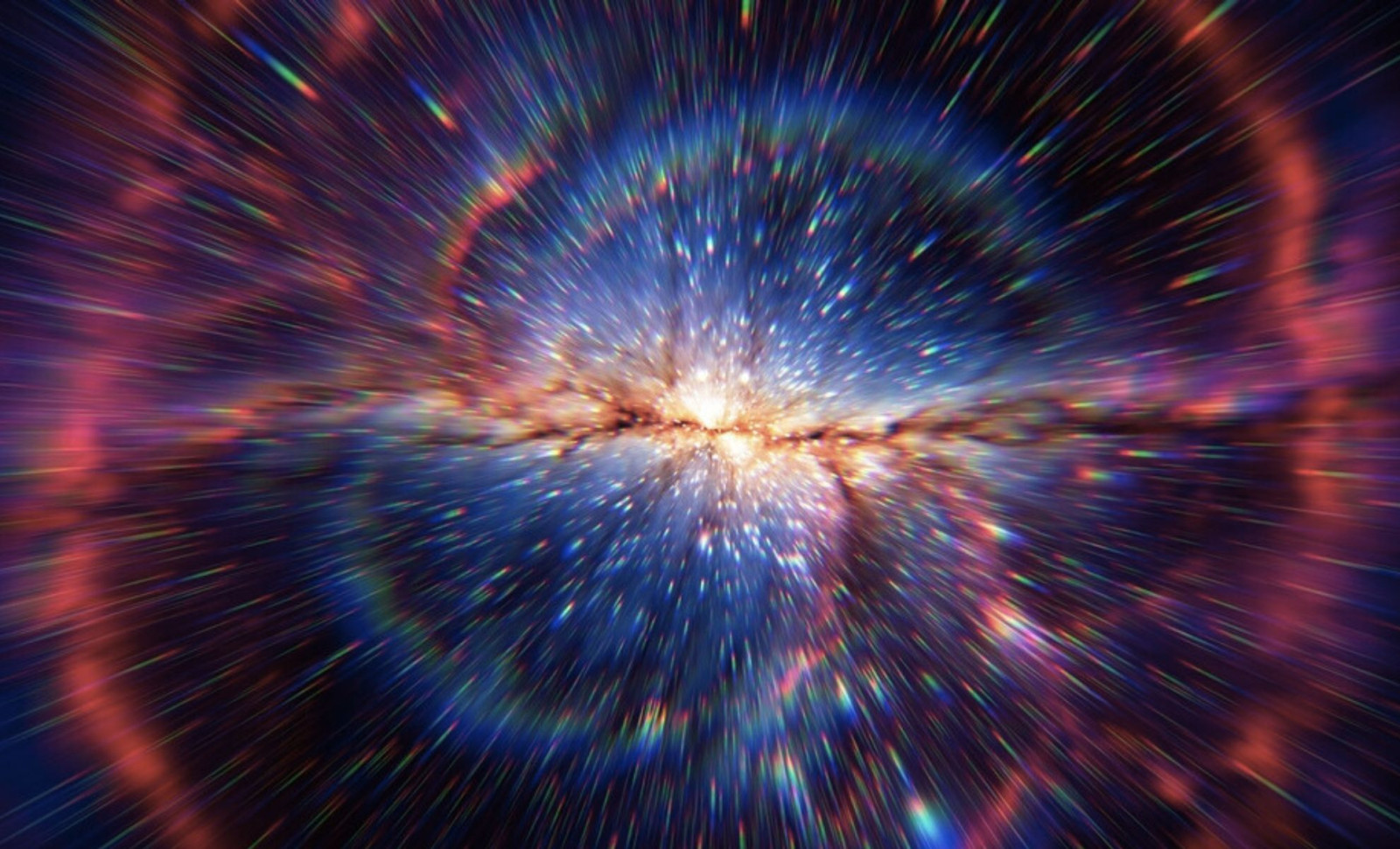
For years, a fascinating idea in theoretical physics has been quietly regaining traction: that primordial structures woven into the fabric of the cosmos might alter our grasp of time itself. Once sidelined as speculation, these theories are now being revisited thanks to new gravitational observations.
The resurgence of interest followed unexpected variations detected in radio emissions from far-flung pulsars, which current astrophysical models struggle to fully clarify. This has prompted scientists to reconsider if relics from the universe’s infancy might still be observable today.
Investigations into these anomalies have highlighted a few promising suspects. One leading contender involves one-dimensional topological defects called cosmic strings, which may persist throughout space and imprint detectable low-frequency gravitational waves.

Such findings could do more than confirm cosmological predictions. Some experts propose they hint at unusual space-time phenomena that might edge into the realm of time travel mechanisms.
Growing Support for Cosmic Strings and Gravitational Wave Evidence
In 2020, the North American Nanohertz Observatory for Gravitational Waves (NANOGrav) unveiled timing irregularities in multiple millisecond pulsars. The persistence of these deviations suggested influences beyond local disturbances or pulsar-internal dynamics. After 12.5 years of data collection, the evidence pointed toward a gravitational wave background at nanohertz frequencies, typically connected to massive cosmic phenomena.
Initial interpretations favored supermassive black hole collisions as the cause. Yet, a study in Physical Review Letters offered an alternative explanation. Researchers from CERN, King’s College London, and University of Warsaw modeled how cosmic strings, remnants from rapid early-universe inflation, could generate gravitational waves matching observed patterns.
Cosmic strings are theorized to emerge during symmetry-breaking phase transitions just after the Big Bang. These ultra-dense filaments, thinner than a proton yet stretching over immense distances, could produce gravitational wave signatures through their oscillations or collisions.
Physicist Ken Olum revisited a concept from 1991 by J. Richard Gott, which suggested that if two infinite cosmic strings pass each other near light speed, their gravitational effects could warp space-time into a closed time-like curve. This formation might theoretically enable backward time travel, though the infinite string length required makes practical realization unlikely.
Exploring Cosmic Superstrings Within String Theory
Adding depth to the classical cosmic string idea is the notion of cosmic superstrings arising from string theory. This theory proposes that fundamental particles are one-dimensional vibrating strings spanning ten or more dimensions. Rare conditions in the early cosmos might have stretched some quantum strings to macroscopic sizes, making them observable today.
Olum noted in a Popular Mechanics interview that while cosmic superstrings are less probable, their detection would be comparatively simpler. Confirming their existence could provide indirect proof for string theory, which remains unverified despite extensive theoretical development.
The distinctive signal NANOGrav found in 2020 did not match expected black hole signatures. Olum explained, "It doesn’t look all that much like the signal we’d expect from black holes," highlighting the exciting possibility that this pattern aligns well with cosmic superstring predictions. His comments, reflected in Popular Mechanics, suggest hopeful caution rather than definitive proof.
Confirming these phenomena would revolutionize gravitational wave research and support unified frameworks merging general relativity with quantum mechanics. Detecting or modeling closed time-like curves could challenge current perspectives on causality, time coherence, and the fundamental architecture of space-time.
Challenges and Future Prospects for Detection
Despite mounting theoretical arguments, direct cosmic string identification remains elusive. The lack of direct imagery or lab evidence limits current conclusions. Instruments like LIGO and VIRGO, though successful at recording gravitational waves from black holes and neutron stars, cannot isolate signals in the nanohertz range.
NANOGrav continues its work alongside initiatives such as the International Pulsar Timing Array, which use pulsars as precise cosmic clocks to detect minute disturbances in space-time. The unexpected collapse of the Arecibo Observatory in 2020 dealt a severe blow to observational capabilities in North America, spurring efforts to compensate through other research centers.
Looking forward, the upcoming Laser Interferometer Space Antenna (LISA) mission, due in 2034, promises to extend gravitational wave detection into the millihertz regime. This will allow scientists to compare different gravitational wave sources, such as black hole mergers and cosmic string activity, across a wider frequency spectrum.
Teams continue analyzing wave frequency, amplitude, and polarization data seeking signatures that favor one scenario over another. As pulsar timing arrays extend their monitoring timelines, subtle shifts in signal correlations across the sky could finally confirm or refute the cosmic string hypothesis.
- Categories:
- Space







0 comments
Sign in to Comment