
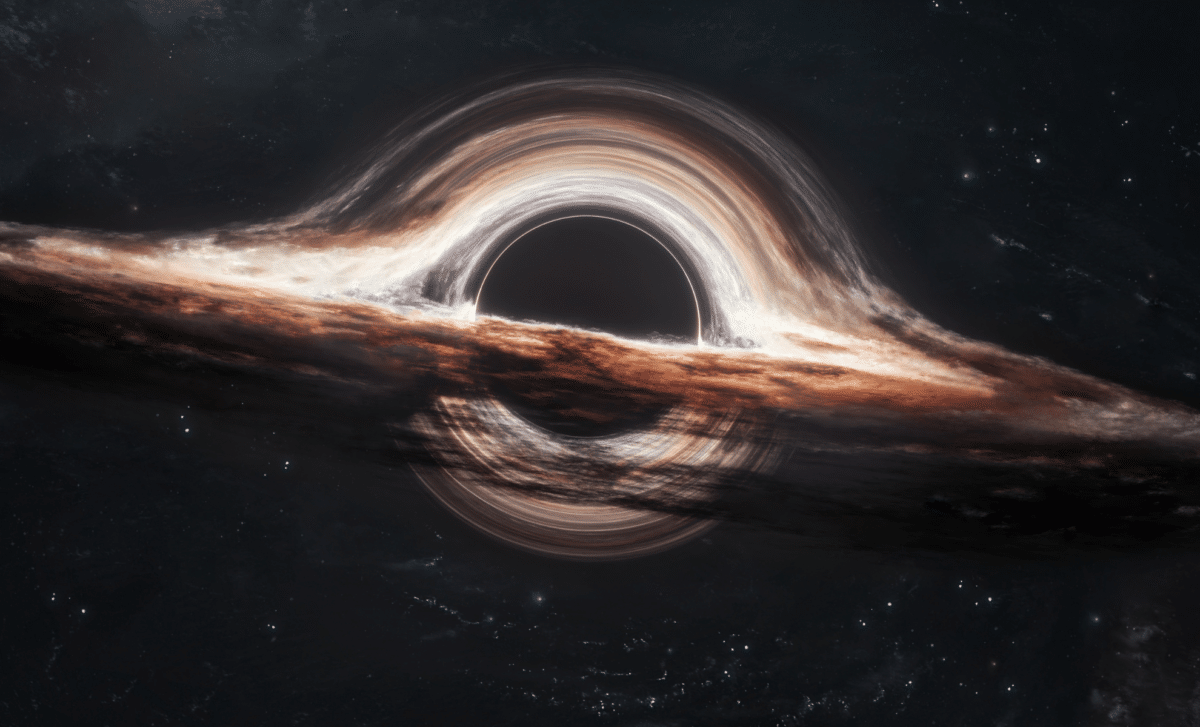
A recent publication in Classical and Quantum Gravity revisits the notion of Einstein-Rosen bridges, structures historically linked to wormholes. Highlighted in The Conversation, this new research challenges the idea of these bridges as mere shortcuts through spacetime, proposing instead that they reveal a fundamental duality in time itself. This fresh interpretation may reshape our grasp of spacetime and provide innovative insights into longstanding enigmas such as the black hole information paradox and the universe’s earliest moments.
Rethinking the Einstein-Rosen Bridge
The Einstein-Rosen bridge was originally introduced in 1935 by Albert Einstein and Nathan Rosen as a mathematical construct to explain particle behavior under intense gravitational forces, not as a portal for spatial travel. The popular image of these bridges as wormholes linking distant points arose later, primarily during the theoretical explorations of the 1980s.
The current analysis revisits Einstein and Rosen’s foundational work, proposing that these bridges embody a far richer concept. Instead of simple passageways across space, they may illustrate a profound symmetry within time, bridging forward and backward temporal directions. This perspective offers a new lens for understanding the interplay between quantum mechanics and general relativity, potentially altering how we conceptualize time and space in the cosmos.

Reassessing Wormholes: What Was the Original Intent?
The now-common equation between Einstein-Rosen bridges and wormholes arose well after the original research. Einstein and Rosen primarily aimed to reconcile quantum mechanics with gravitational theory, not to theorize space-time shortcuts. Their bridge symbolized a mirror-like relationship connecting two distinct spacetime states.
Applying contemporary physics, the study posits that the Einstein-Rosen bridge may unify two complementary quantum components: one progressing forward in time and the other flowing backward. This concept challenges simplistic wormhole interpretations and demands a deeper appreciation of spacetime’s quantum fabric.
The research, also discussed in The Conversation, invites a renewed examination of Einstein and Rosen’s insight. It presents bridges as representations of a bidirectional temporal structure, with potential to unravel physical paradoxes and enhance our understanding of the universe.
Exploring Time’s Dual Flow
A cornerstone of this research is the suggestion that time's progression isn’t one-way. Although everyday experience dictates a flow from past to future, at the quantum scale, physical laws do not inherently favor one temporal direction. This time-symmetry is key to reinterpreting Einstein-Rosen bridges.
The study argues that rather than a mere tunnel, the bridge embodies two opposite time flows simultaneously—forward and backward. Recognizing this duality could offer a more thorough comprehension of universal phenomena, especially near black holes, where both temporal directions might be essential for a coherent quantum framework.
Published in Classical and Quantum Gravity, the report proposes that this temporal two-sidedness is not only theoretical but manifests in the quantum realm, ensuring reversible and complete quantum evolution. Here, the Einstein-Rosen bridge effectively connects these dual time arrows.
A Novel Resolution to the Black Hole Information Paradox
The black hole information paradox, famously introduced by Stephen Hawking in 1974, highlights a conflict where information seemingly vanishes within black holes, defying quantum mechanics' principle of information conservation. This conundrum has puzzled physicists for decades.
The recent findings suggest that the Einstein-Rosen bridge might resolve this paradox. Viewing black holes quantumly with both time directions accounted for implies that information crossing the event horizon isn't lost but transitions into the reverse time component, safeguarding its preservation.
This explanation aligns all known physics without resorting to speculative theories, sustaining quantum consistency even in black holes’ extreme environments by ensuring information continues its existence in another temporal direction.
A Cyclical Universe? Revisiting Cosmic Beginnings
The implications extend well beyond black holes, touching on profound cosmological questions regarding the universe’s origin. The study hypothesizes that the Big Bang may represent not the absolute start but a transitional bounce between two time-reversed cosmic phases.
In this framework, black holes could act as conduits linking separate spatial regions and different cosmic epochs. Our present universe might be a rebirth from the collapse of a previous cosmos. This cyclical interpretation offers an alternative to the conventional Big Bang narrative, suggesting a perpetual cosmic evolution.
The concept that time flows in dual directions and that black holes connect various cosmological eras enriches our understanding of the universe's lifecycle, dovetailing with the novel interpretation of the Einstein-Rosen bridge.
- Categories:
- News







0 comments
Sign in to Comment