

New insights from XRISM have solved a long-standing puzzle involving the enigmatic Gamma Cassiopeiae. Published in Astronomy & Astrophysics, these results identify the precise origin of the star system’s mysterious X-ray output, transforming our comprehension of massive star interactions.
A Puzzling Star Challenges Scientists for Years
Gamma Cassiopeiae, a luminous Be-type star in the constellation Cassiopeia, has perplexed astronomers with its unusually powerful X-ray flux, far exceeding typical levels for its category. This distinctive behavior sparked numerous studies and competing theories about its source and nature.
“There has been an intense effort to solve the mystery of γ Cas across many research groups for many decades,” says astrophysicist Yaël Nazé of the University of Liège in Belgium. “And now, thanks to the high-precision observations of XRISM, we have finally done it.”
Add Cosmo Herald as a Preferred Source

Initially, scientists proposed that magnetic fields or processes within the star’s own disk caused the unusual X-rays. Another angle suggested there was an unseen companion star. However, none of these explanations fully accounted for the extreme plasma conditions or variability observed.
XRISM’s Precision Data Pinpoints the X-Ray Origin
The breakthrough emerged from the exceptional spectral detail provided by XRISM (X-ray Imaging and Spectroscopy Mission). Researchers detected delicate velocity changes in the emitting plasma, crucially linking the X-rays to a specific source.
“Several scenarios had been proposed to explain this emission,” Nazé says. “One of them involved local magnetic reconnection between the surface of the Be star and its disk. Others suggested X-rays to be linked to a companion, whether a star stripped of its outer layers, a neutron star, or an accreting white dwarf.”
They discovered the plasma’s motion corresponded with a compact companion’s orbit rather than with the Be star itself, shifting the prevailing understanding.
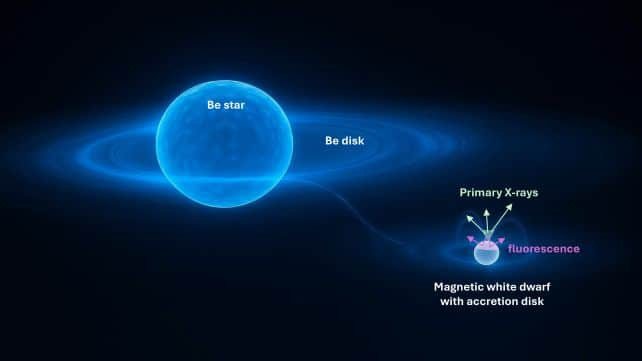
White Dwarf Confirmed as the Source
In-depth examination of the spectral signatures confirmed the X-rays come from gas associated with a white dwarf orbiting Gamma Cassiopeiae. The velocity shifts perfectly matched the compact object’s orbit, conclusively linking it to the high-energy phenomena.
“The spectra revealed that the signatures of the high-temperature plasma change velocity between the three observations, following the orbital motion of the white dwarf rather than that of the Be star,” Nazé says.
“This shift was measured with high statistical reliability. It is, in fact, the first direct evidence that the ultra-hot plasma responsible for the X-rays is associated with the compact companion, and not with the Be star itself.”
This discovery dismisses earlier interpretations and confirms a binary interaction model in which matter influenced by the white dwarf triggers the remarkable X-ray output.
Advancing Models of Binary Star Evolution
The ramifications go beyond just one star. Establishing the white dwarf’s role in Gamma Cassiopeiae offers a robust framework for studying other systems with peculiar X-ray traits.
“We think the key is in understanding how exactly the interactions take place between the two stars,” Nazé says. “Now that we know the true nature of gamma-Cas, we can create models specifically for this class of stellar systems, and update our understanding of binary evolution accordingly.”
This breakthrough will aid in refining theoretical models of stellar lifecycle processes, particularly where compact objects and mass transfer influence evolution. It also underscores the vital role advanced missions like XRISM play in unravelling complex cosmic phenomena.
Gamma Cassiopeiae serves as a powerful reminder that even stars studied extensively can reveal new and unexpected secrets with the right technology.
- Categories:
- Astronomy







0 comments
Sign in to Comment