
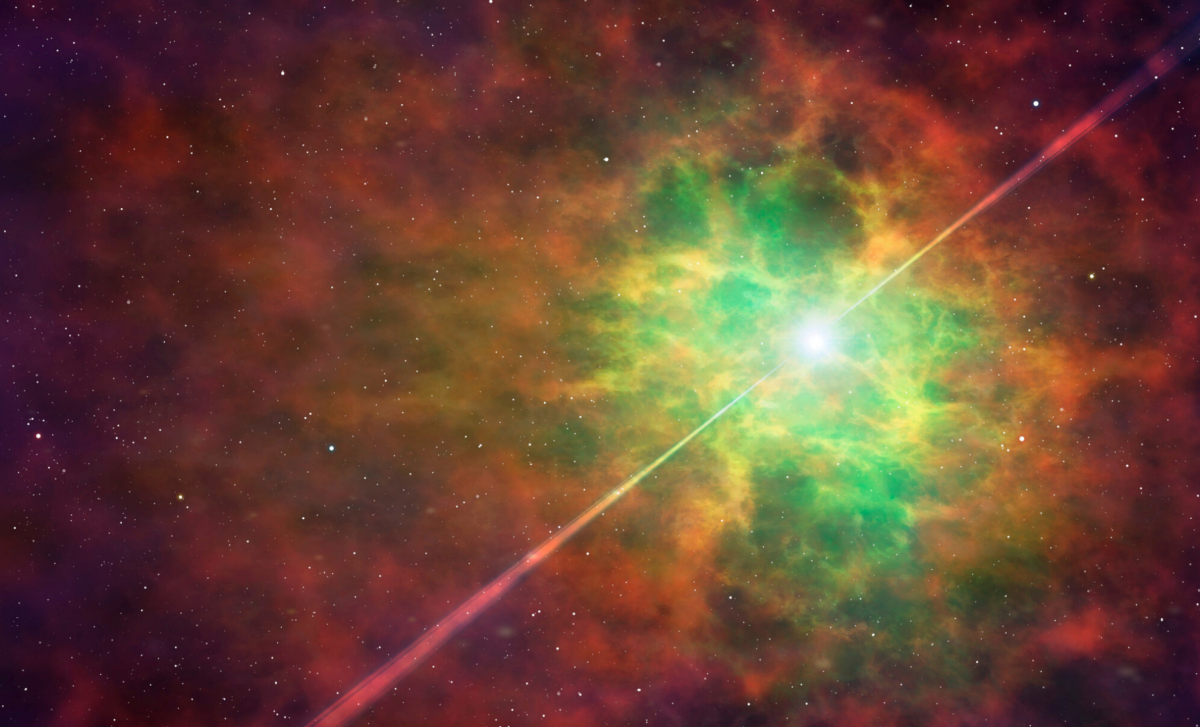
A recent study available on the pre-print platform arXiv offers new insights into one of the galaxy's most puzzling high-energy emitters. Utilizing the advanced VERITAS telescope system, astronomers have reexamined HESS J1857+026, a gamma-ray source first identified in 2008, revealing fresh details that move us closer to uncovering the origin of this mysterious cosmic signal.
Unraveling a Gamma-Ray Enigma from 2008
Initially detected by the High Energy Stereoscopic System (HESS) in 2008, HESS J1857+026 is part of a group of very high energy (VHE) gamma-ray sources whose nature remains elusive. Unlike many VHE sources linked to known phenomena such as blazars or compact-object binary systems, this gamma-ray emitter stands out. Although positioned close to the pulsar PSR J1856+0245, attempts have failed to detect any related supernova remnant (SNR) or extended structures in X-ray or other wavelength observations.
This absence of a clear counterpart has left astronomers uncertain for over 15 years. Is the pulsar itself the source of the gamma rays? Could an unseen nebula be responsible? Or is an entirely different mechanism at play? Without definitive evidence, HESS J1857+026 has remained a classified “unidentified” object—until these latest findings.

In-Depth VERITAS Observations Reveal Complexity
To delve deeper, a research team led by Yu Chen from UCLA utilized the Very Energetic Radiation Imaging Telescope Array System (VERITAS), a quartet of gamma-ray telescopes stationed at the Fred Lawrence Whipple Observatory in Arizona. VERITAS detects gamma rays with energies between 100 GeV and over 30 TeV, and it boasts a fine angular resolution surpassing 0.1 degrees at 1 TeV.
“VERITAS has observed the region of HESS J1857+026 from 2008 to 2016, including serendipitous observation of other targets, e.g., the supernova remnant W44, in the FOV [field-of-view]. After quality selection requiring good weather and a stable trigger rate, about 30 hours of data are used in this analysis,” the researchers explain.
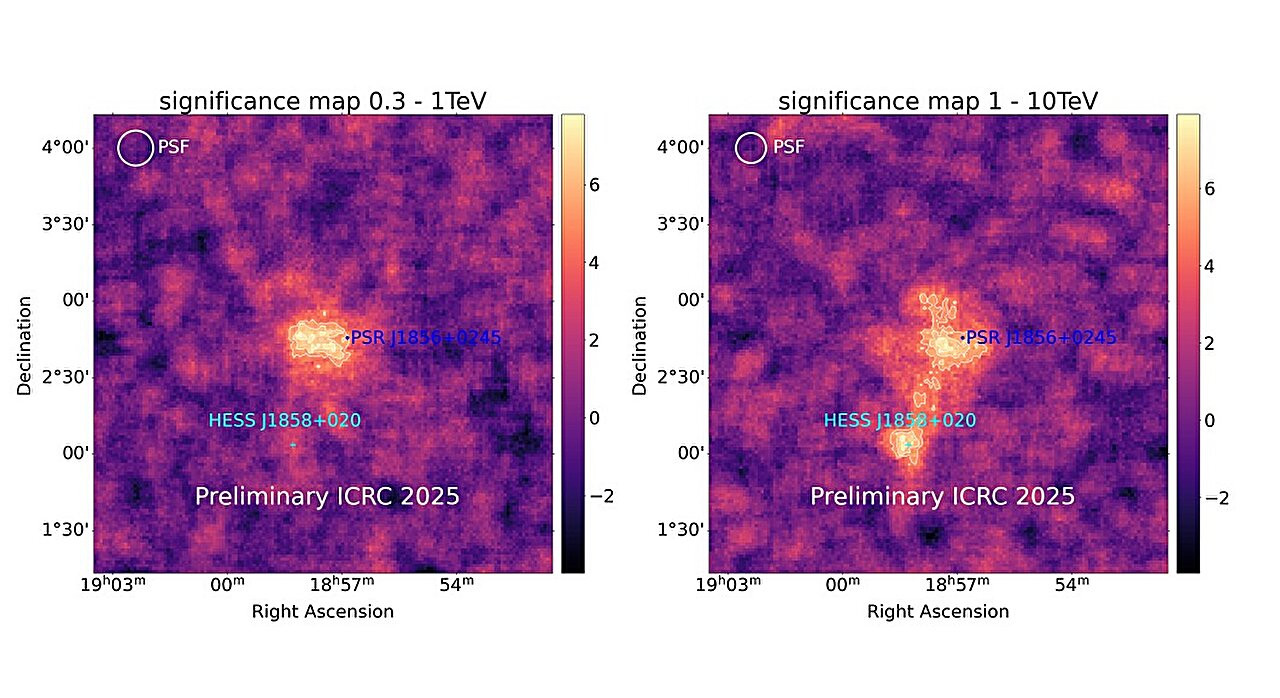
Results published on arXiv on December 19 feature a detailed gamma-ray significance map of this region. Notably, the peak gamma-ray emission does not coincide precisely with the nearby pulsar’s location. This spatial displacement supports a longstanding theory suggesting that these gamma rays originate not from the pulsar alone, but from a pulsar wind nebula (PWN), a cloud of energetic particles accelerated and pushed outward by the pulsar’s magnetic influence.
Discovery of a Northern Emission Feature Indicates Possible Multiple Sources
One of the more unexpected outcomes from the VERITAS data is identification of a northern emission component visible only at energies above 1 TeV. This could imply either the existence of a secondary gamma-ray source nearby or that HESS J1857+026 has a more extensive and intricate emission region than previously recognized.
The team estimated the diffusion length—the typical travel distance of high-energy electrons before energy loss—to be around 321 light-years. They also suggest that electron cooling occurs over tens of thousands of years. These significant figures imply that the energetic electrons have survived durations comparable to the pulsar’s age, and their propagation is much slower than typical galactic rates, hinting at environmental factors impeding their movement.
These findings reinforce the PWN interpretation, albeit indicating a nebula larger and evolving at a slower pace than conventional models predict.
New Questions Arise Even as Understanding Grows
Although this study marks progress, it does not definitively solve the puzzle of HESS J1857+026’s origin. While the pulsar wind nebula explanation currently dominates, anomalies such as the northern structure and emission offset raise fresh possibilities. Could this region host distinct overlapping gamma-ray sources? Might shock interactions in the ambient interstellar medium be shaping the emission? Or is there an unrecognized type of gamma-ray object yet to be classified?
The authors stress the necessity for further multi-wavelength observations. Upcoming measurements from instruments like the Cherenkov Telescope Array (CTA) and future X-ray observatories are expected to provide the improved resolution and sensitivity essential for distinguishing between these scenarios.
For the time being, HESS J1857+026 remains an intriguing mystery, but thanks to VERITAS’s contributions, its secrets are starting to emerge.
- Categories:
- Astronomy





0 comments
Sign in to Comment