
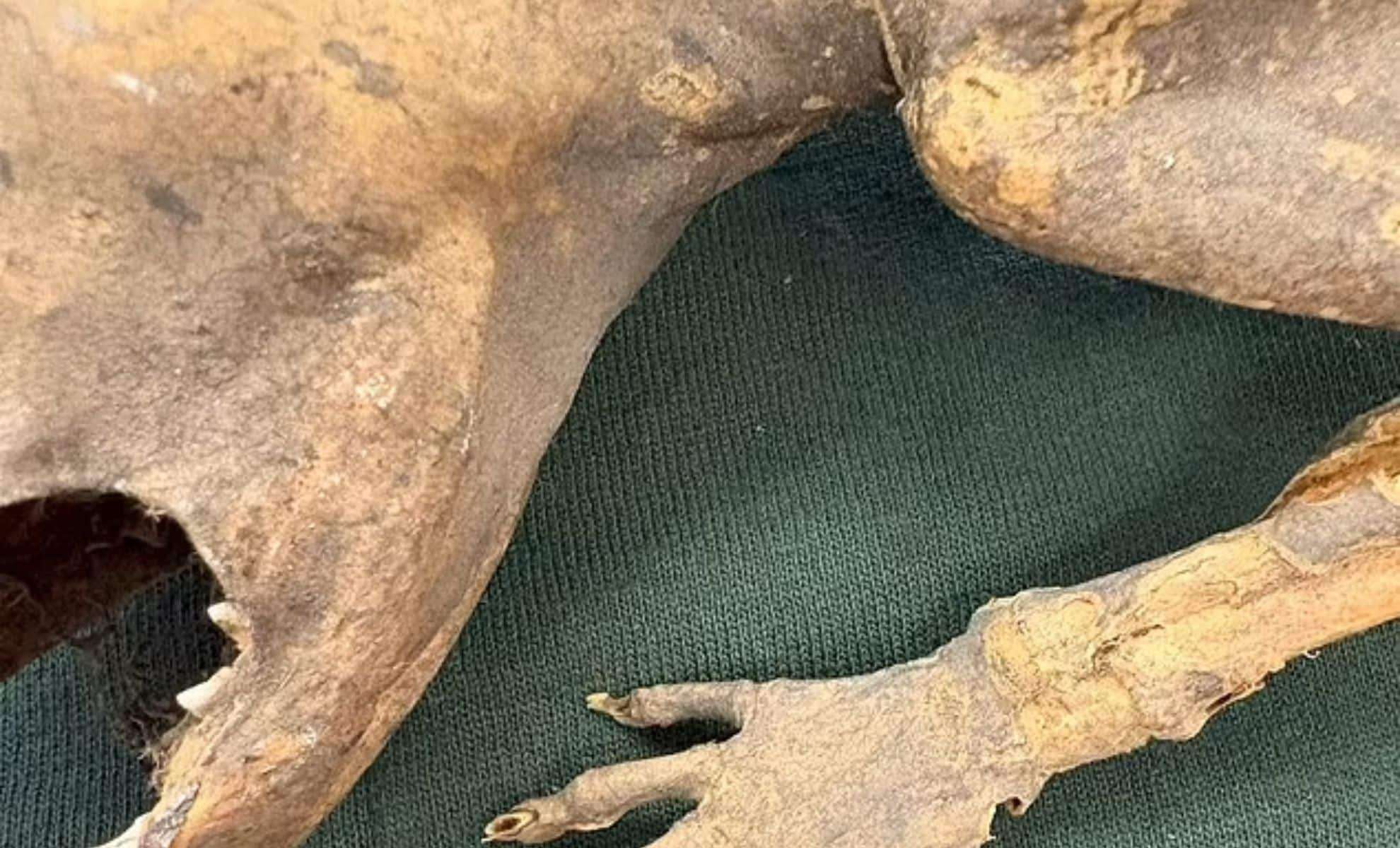
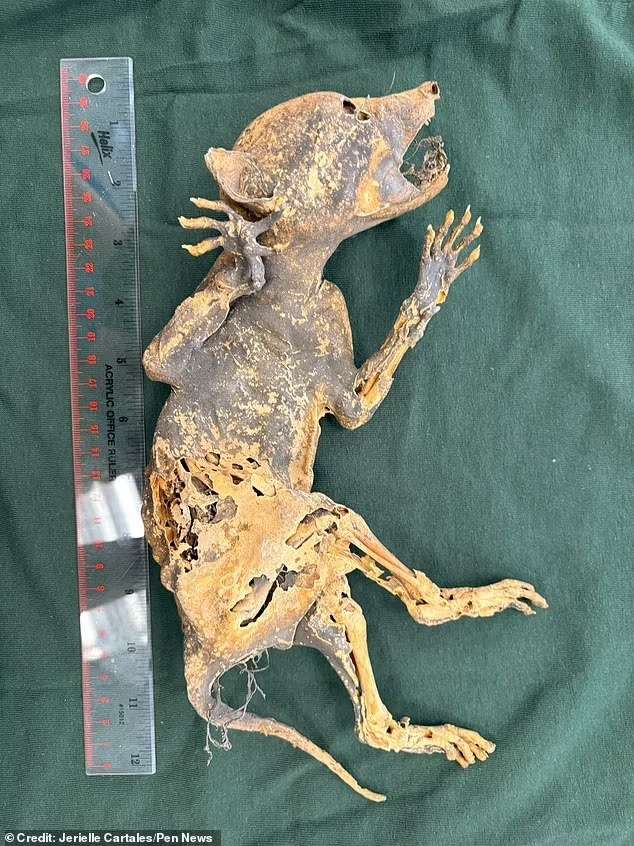
During renovation work at Michigan State University, an unusual mummified specimen captured the curiosity of researchers and folklore fans. Named the ‘Capacabra’ – borrowing from the mythical chupacabra – this peculiar creature features hands that closely resemble those of a human.
A Unique Find with Distinctly Human-like Limbs
Since its 2018 discovery, the Capacabra has fascinated experts. As explained by Jerielle Cartales, a doctoral student engaged in the study, the specimen is roughly the size of a small cat. What makes it extraordinary are its five-fingered hands, complete with nails, giving the creature an uncanny humanoid look. Its fragile skin resembles that of aged parchment paper, contributing to its eerie presence.
Though mostly dried up, the creature retains some recognizable features such as its nose and ears, albeit shrunken and desiccated. “It’s approximately cat-sized, with a notably long and slender tail, consistent with certain feline characteristics,” Cartales observed.

Parallels to the Chupacabra Legend
Reporting by Daily Mail highlights the striking resemblance between the Capacabra and the elusive chupacabra, a fabled beast known for draining livestock blood. The nickname was ingeniously created by Michigan State’s Campus Archaeology Program (CAP), sparking intriguing links between this mysterious mummy and the mythical creature.
Traditionally, the chupacabra is described as having reptilian traits with spines along its back and a reputation for attacking goats. While the Capacabra lacks some of these features, its unusual morphology has fueled widespread debate and curiosity about its origins.
The Phenomenon of Natural Mummification
The most remarkable aspect of the Capacabra is its state of natural mummification, a preservation process that happens under specific conditions such as extreme aridity and limited oxygen access, allowing a body to endure over extended periods without chemical intervention.
Cartales suggests the warm, dry environment within the building’s ventilation system likely contributed to this mummification. Given that the structure dates back to 1889, the creature must have been trapped there after that date.
The precise duration of its entrapment remains unknown. “It might have been there for just a month or possibly many decades; we simply don’t have enough data to say,” she explained.
The Leading Hypothesis: A Mummified Raccoon
Following thorough analysis, researchers lean towards the idea that the Capacabra is actually a raccoon that became trapped inside the building. Cartales points out that the skull and snout bear a resemblance to those of raccoons. Other potential animals like dogs and cats were ruled out through detailed X-rays.
Nevertheless, this conclusion isn’t ironclad. One challenge is the limited availability of dental samples for comparison. Because raccoon skeletal traits can overlap with other small mammals, Cartales plans to examine raccoon teeth to validate the hypothesis. She remains cautiously optimistic, estimating about a “75% certainty” that it is indeed a raccoon.
How the Creature May Have Become Trapped
If the Capacabra is a raccoon, scientists propose it gained access to the building’s air ducts via an entry point like a vent. Once inside, it possibly became stuck, leading to gradual drying and preservation over time.
The hot, dry airflow circulating through the ventilation likely encouraged the creature’s mummification, especially during summer months when outdoor humidity was higher. These conditions helped maintain its preserved state for several years.
Looking ahead, the research team intends to perform further examinations, including dental comparisons with raccoon specimens, which could conclusively determine whether the Capacabra is indeed a raccoon or another unexpected species.
- Categories:
- News









0 comments
Sign in to Comment