

When most people picture waterfalls, grand cascades such as Angel Falls or the mighty roar of Niagara often come to mind. These famous sites are renowned for their impressive heights and powerful torrents, captivating countless visitors annually. However, none of these terrestrial marvels compare to an immense and extraordinary force hidden beneath the ocean surface—the largest waterfall on the planet, a phenomenon no land waterfall can rival.
This underwater giant is not only remarkable for its immense scale but also for its vital influence on Earth's ecosystems. Concealed from direct sight, it quietly operates deep in one of the world’s most isolated and least-explored oceanic areas. Despite being invisible to us, its effects echo globally, playing a crucial role in Earth’s environmental equilibrium.
Exploring the Denmark Strait Cataract
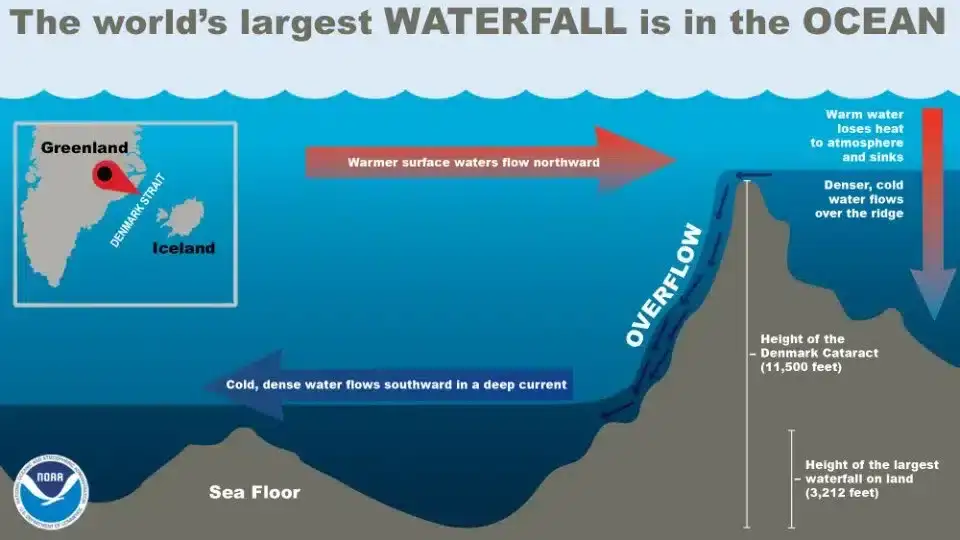
Lurking beneath the Arctic waters separating Greenland and Iceland is a spectacular underwater spectacle—the Denmark Strait cataract. This immense cascade plunges an astounding 11,500 feet, tripling the height of Angel Falls, the tallest known waterfall on land. Stretching about 300 miles (480 kilometers) wide, it's a hidden titan running beneath the waves, integral to the mechanics of global ocean circulation.

The cataract arises where the frigid, dense waters from the Nordic Seas collide with the warmer, lighter currents of the Atlantic Ocean. This stark contrast in temperature and salinity sets the stage for a massive flow of water descending along the ocean floor. Although no human eye can witness this cascade directly, it has been revealed through sophisticated marine research technologies.
Mike Clare, head of marine geosystems at the U.K.’s National Oceanography Centre, remarked, “If you were down there, you probably wouldn’t notice a whole heap going on.” Beneath the calm surface lies a critical driver of ocean currents with far-reaching effects on the global climate.
Origins: A Product of Ice Age Sculpting
The Denmark Strait cataract traces its formation back to Earth’s last ice age, spanning roughly 17,500 to 11,500 years ago. Glacial movements carved the seabed, fashioning the dramatic drop that defines this underwater waterfall. After the ice sheets receded, they left behind a natural structure unlike any other on Earth.
Unlike waterfalls found on land, this underwater marvel exists in a constantly shifting marine environment, subject to changes in currents, temperatures, and geological dynamics. These forces have preserved the cataract's form over millennia, enabling it to continue functioning as a vital component of Earth's natural systems.
The Cataract’s Influence on Global Ocean Systems
The Denmark Strait cataract’s importance extends well beyond its impressive dimensions. Its cascading water forms part of a larger mechanism that powers a global network of currents, facilitating the movement of heat, nutrients, and energy worldwide. This hidden powerhouse is essential for maintaining many of Earth’s ecosystems and shaping our climate patterns.
This underwater cascade is a crucial segment of the thermohaline circulation, often dubbed the ocean's “conveyor belt.” This global system transports water masses between the poles and equator, affecting weather, sea levels, and marine life health. The waterfall’s descent propels cold, dense water along the seafloor, energizing a series of currents linking diverse climates and ecosystems.
Marine researcher Anna Sanchez Vidal noted, “What happens here is felt everywhere. The flow creates a ripple effect that connects ecosystems and climates around the globe.”
Contrasting With Terrestrial Waterfalls
Though legendary waterfalls like Niagara Falls and Angel Falls draw crowds with their breathtaking torrents, they fall short when compared to the sheer magnitude of the Denmark Strait cataract. With a staggering 11,500-foot drop—more than three times Angel Falls’ height of 3,212 feet (979 meters)—this underwater cascade remains invisible to the naked eye, lacking the turbulent surface flows typical of land-based waterfalls and requiring scientific instruments for detection.
Hidden beneath ocean depths, the Denmark Strait cataract’s quiet yet immense movement forms a cornerstone of Earth's interconnected natural systems. Its subtle strength reveals how nature wields immense power in hidden, unexpected realms.
- Categories:
- News









0 comments
Sign in to Comment