
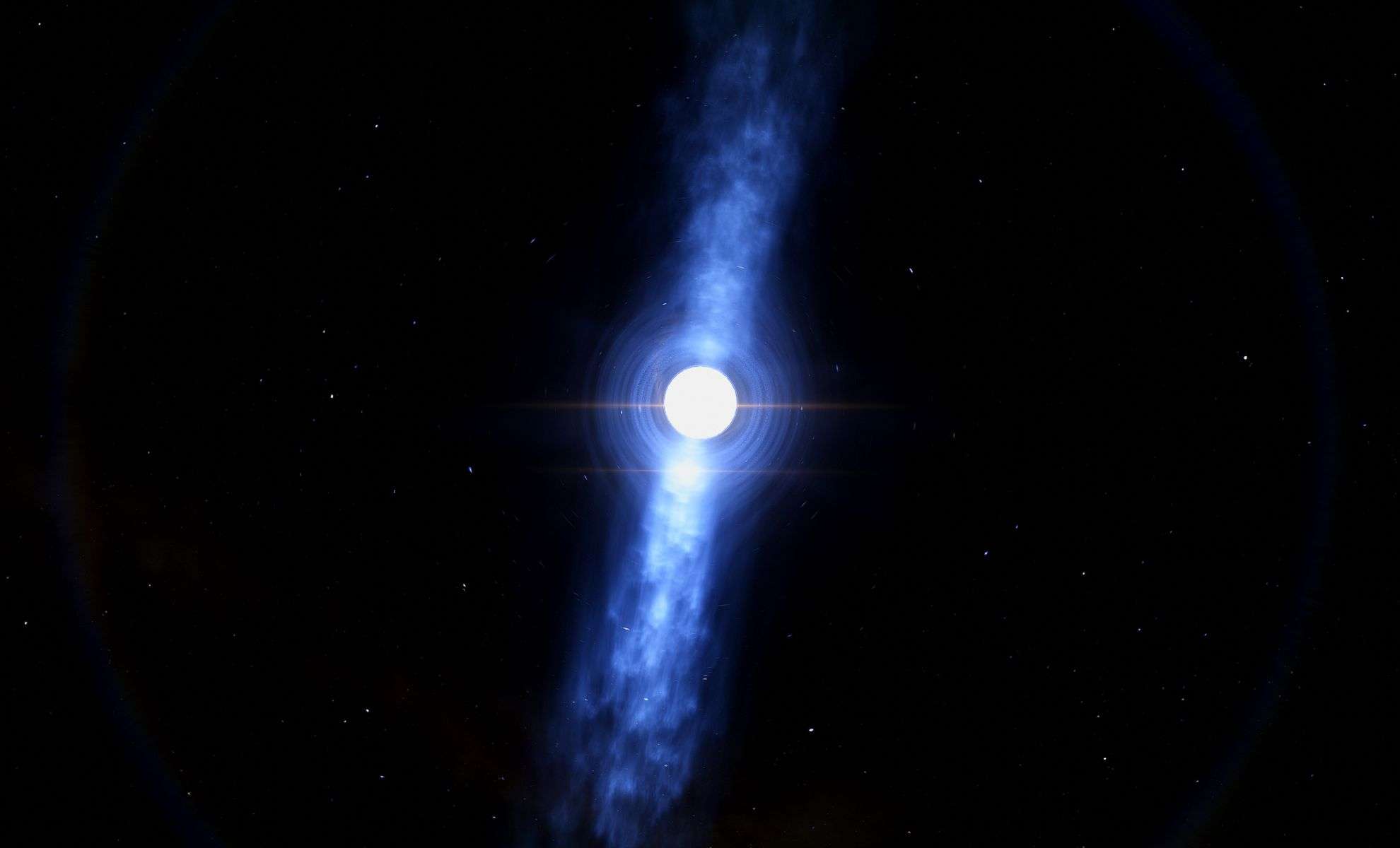
The James Webb Space Telescope (JWST) has uncovered a remarkable planet enveloped by an atmosphere predominantly composed of carbon, orbiting an exceptionally fast-spinning pulsar.
Designated PSR J2322–2650b, this planet is part of the uncommon black widow pulsar systems where the neutron star gradually strips mass from its companion. Normally, the leftover is a dense, helium-heavy core, but infrared observations from JWST revealed an atmosphere rich in unusual carbon compounds typically found in cometary or flame environments.
As reported by SciTechDaily, the chemical makeup of PSR J2322–2650b defies previous expectations. The telescope's data showed a phenomenal enrichment in carbon, with carbon-to-oxygen and carbon-to-nitrogen ratios far surpassing any known planetary atmosphere.

An Unexpected Survivor in a Harsh Stellar Environment
Belonging to the class of millisecond pulsars, PSR J2322–2650 spins at incredible speeds, hundreds of times per second. These pulsars are known to strip material from their companion stars through intensive gravitational forces and radiation. The remnants eventually form compact planetary bodies in close orbits, with PSR J2322–2650b completing a circuit every 7.8 hours, consistent with other black widow systems.
Contrary to typical expectations of helium remnants, data cited by SciTechDaily revealed a carbon-rich atmosphere. The detected carbon molecules exist in extraordinary concentrations, resembling materials found in interstellar environments or soot-laden flames rather than usual gas giant atmospheres.
Two Distinct Hemispheres On One Planet
Being tidally locked to the pulsar, PSR J2322–2650b exhibits a scorching dayside where temperatures soar beyond 2000 °C and where carbon-based molecular compounds are prominent. Conversely, the nightside displays almost negligible spectral features, likely due to a covering layer of dark substances such as soot that obscure atmospheric readings.
The planet’s chemical fingerprint is equally extraordinary, with a C/O ratio exceeding 100 and a C/N ratio soaring above 10,000, vastly different from Earth’s 0.01 and ~40, respectively. These unprecedented values place PSR J2322–2650b in a class of its own among known exoplanets.
Reevaluating Planetary Origins and Atmospheric Chemistry
While some atmospheric characteristics align with existing theories, the overwhelming carbon dominance challenges conventional explanations. Models invoking white dwarf mergers or carbon star evolution cannot fully justify the extreme carbon-to-oxygen ratios documented.
One consistent finding lies in atmospheric dynamics. For tidally locked planets with rapid rotation, significant westerly winds are predicted, and JWST’s observations confirm this pattern. SciTechDaily notes the maximum temperature zone is offset about 12 degrees west from the pulsar-facing point, a shift that matches atmospheric simulations for such planets.
Despite matching size and orbital characteristics of typical black widow system remnants, the planet’s unusual chemistry remains an enigma. Published recently on arXiv, the research invites astronomers to address the origin and persistence of these extraordinary carbon levels.
- Categories:
- Space











0 comments
Sign in to Comment