
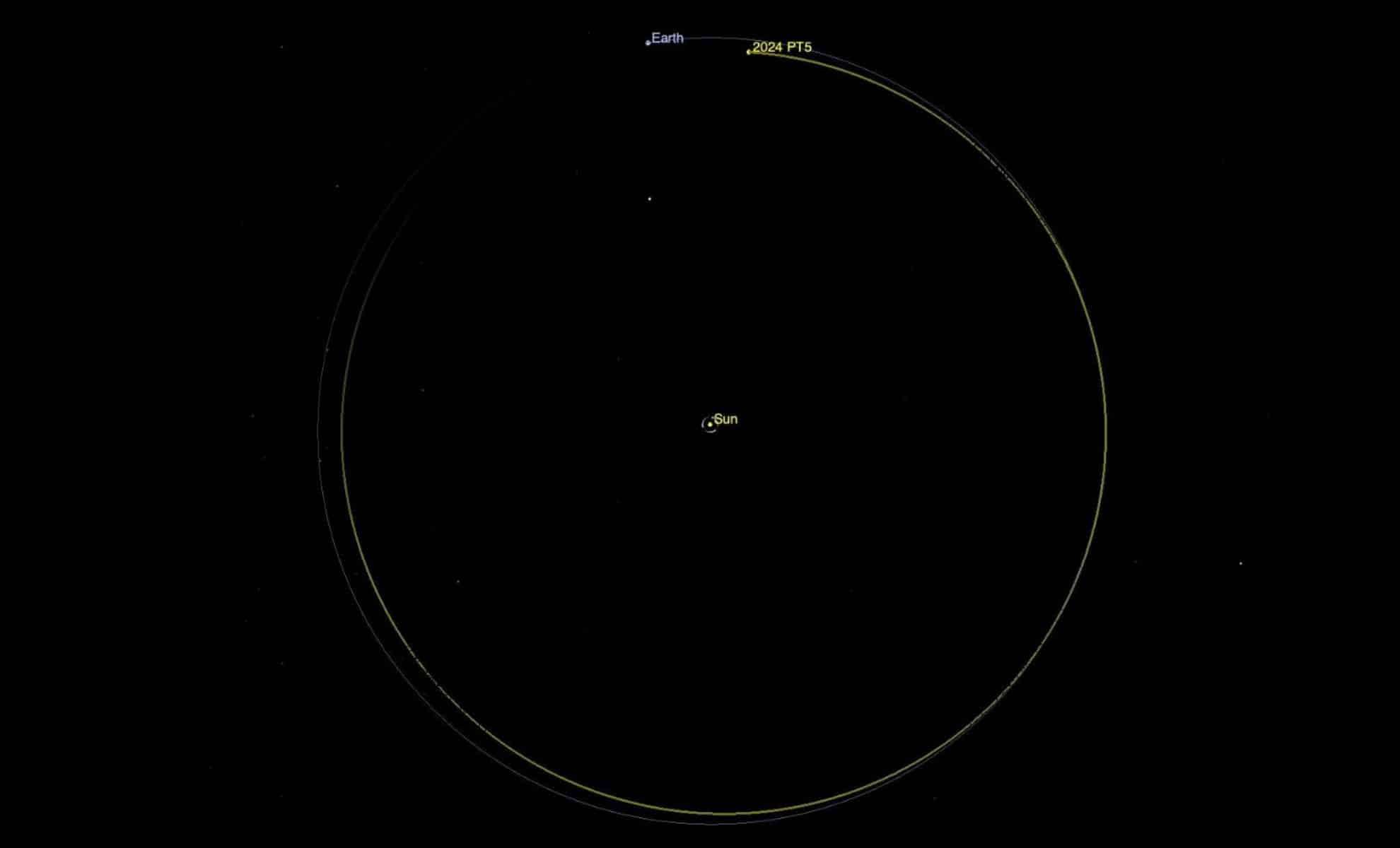
Earth has recently gained a fleeting companion, as a small asteroid named 2024 PT5 has been drawn into our planet’s gravitational field. First identified by astronomers in August 2024, this diminutive celestial object officially joined Earth’s entourage as a second moon on September 29, 2024. Though the idea of multiple moons is remarkable, temporary lunar-like companions are a known, if uncommon, occurrence.
These temporary moons, or “mini-moons,” are typically captured briefly before continuing their solar orbit. The detection of 2024 PT5 offers scientists a unique chance to observe a near-Earth object closely during its transient orbit around Earth.
Mini-Moons: Brief Guests in Earth's Orbit
Even though it may sound surprising that Earth can have more than one moon at a time, mini-moons are actually a regular part of our cosmic environment. These small asteroids usually orbit the Sun independently, but when passing near Earth, our planet’s gravity can snag them into short orbits. Richard Binzel, an astronomer affiliated with the Massachusetts Institute of Technology (MIT), explained that such captures happen with notable frequency, though their detection remains challenging. “These events occur often, but we rarely observe them because of their tiny size and faintness,” Binzel remarked.

Thanks to advances in detection technology, especially through initiatives like the Asteroid Terrestrial-Impact Last Alert System (ATLAS), astronomers have improved their ability to find these elusive objects. ATLAS played a key role in discovering 2024 PT5, allowing observation of its path and temporary capture around Earth. Though too small and faint for amateur instruments or the naked eye, 2024 PT5 provides a valuable opportunity to study the interaction of near-Earth objects with our planet’s gravity.
Exploring the Path and Features of 2024 PT5
The asteroid 2024 PT5 is classified within the Arjuna asteroid belt, a group of space rocks sharing orbital similarities with Earth. These asteroids orbit approximately 93 million miles from the Sun, mirroring Earth’s distance. Occasionally, objects like 2024 PT5 venture close enough for Earth's gravity to temporarily trap them. The brief capture, lasting only a couple of months, offers scientists an extraordinary peek into the orbital dynamics of objects near Earth.
Contrasting with Earth’s primary moon, which spans about 2,159 miles across, 2024 PT5 is minuscule—just about 37 feet in diameter, making it over 300,000 times smaller. Such a small and faint asteroid is invisible even to sophisticated amateur telescopes. As Carlos de la Fuente Marcos illustrated, “Asteroid 2024 PT5 won’t complete a full orbit; if a regular satellite is like a shopper inside a store, these objects are more akin to window shoppers.”
This mini-moon's Earth capture began on September 29, 2024 and will continue only until November 25, 2024. Throughout this interval, it won’t complete a full circuit but will instead make a brief orbital pass before escaping to resume its solar orbit.
The Scientific Value of Mini-Moons
Despite its short stay, 2024 PT5 represents a vital chance for researchers to study near-Earth objects (NEOs) and the nuances of gravitational capture. Richard Binzel highlighted these captures as “natural cosmic laboratories” enabling detailed examination of small asteroids and their gravitational interactions with Earth. “They provide insights into the small bodies approaching Earth and offer crucial information that could support future space missions,” he noted.
Investigating mini-moons like 2024 PT5 sheds light on asteroid composition, movement, and dynamics—knowledge essential for planetary defense, which aims to monitor and mitigate threats from potentially hazardous asteroids. Furthermore, studying these objects advances our preparedness for future missions that may target nearby asteroids for research or resource exploration.
Though temporary, 2024 PT5 enhances our understanding of the complex interplay between Earth and the myriad small bodies journeying through space. Mini-moons, despite their fleeting appearances and modest sizes, reveal the ever-changing character of our cosmic neighborhood.
Past Visitors: Earth’s Former Mini-Moons
2024 PT5 is part of a lineage of mini-moons Earth has hosted over recent decades, each with brief stays. One notable predecessor, asteroid 2006 RH120, was captured in 2006 and remained for nearly a year before departing in 2007. More recently, asteroid 2020 CD3 orbited Earth for several years before leaving in 2020. Such temporary moons provide astronomers with rare observational windows into near-Earth objects temporarily ensnared by Earth’s gravity.
Although the temporary capture of 2024 PT5 may seem extraordinary, Carlos de la Fuente Marcos observed that Earth experiences several such events per decade. “While having a second moon might sound unusual, these gravitational captures occur more frequently than expected,” he said, noting that many go unnoticed due to the mini-moons’ small size and faintness, which challenge detection with current telescopes.
- Categories:
- Astronomy ,
- News ,
- Science










0 comments
Sign in to Comment