
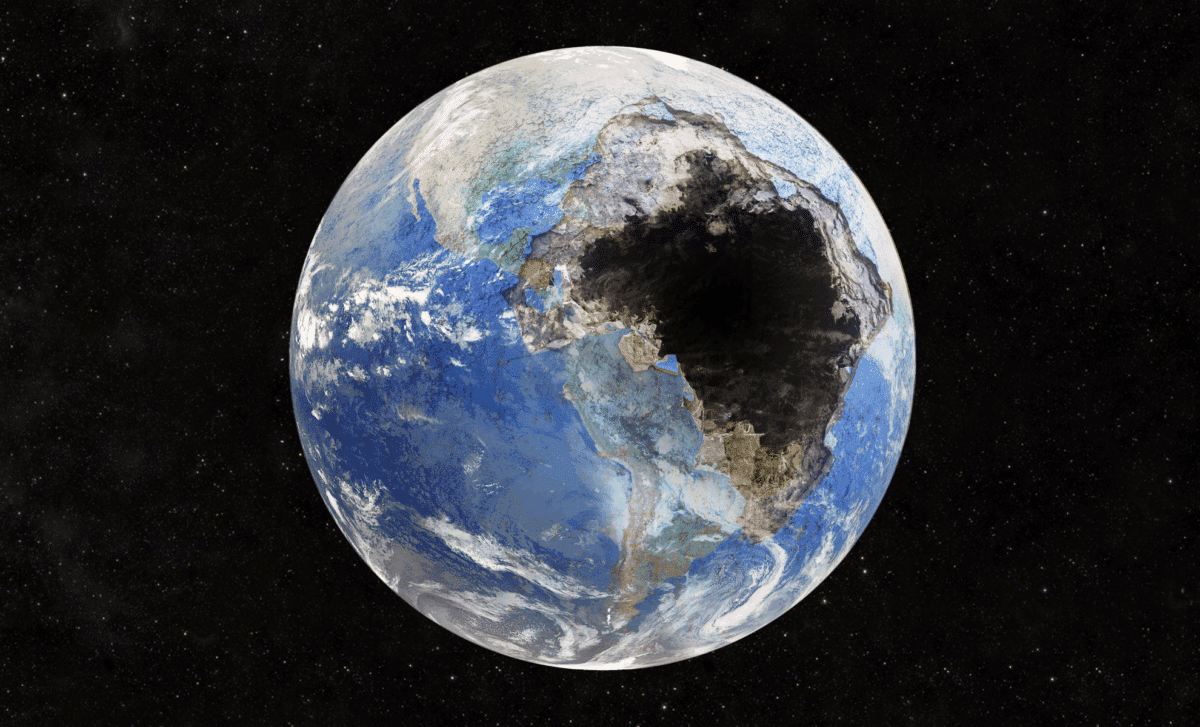
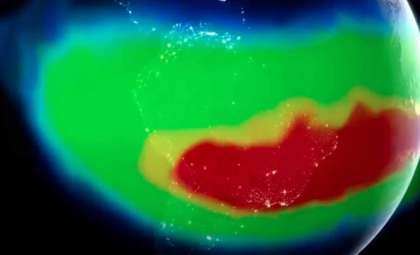
An extensive area of weakened magnetism is gradually enlarging over the South Atlantic Ocean. This region, referred to as the South Atlantic Anomaly, poses increased radiation risks for orbiting satellites and astronauts. Observations from European Space Agency missions indicate that this anomaly is growing faster than previously anticipated. The consequences extend beyond our atmosphere, impacting human activities in space.
The Expanding Magnetic Disturbance Beneath Earth’s Crust
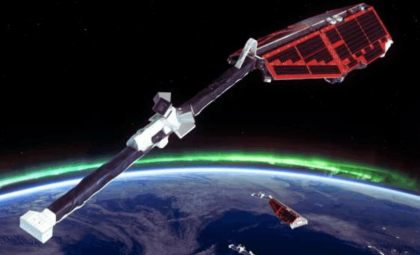
Recent research featured in the journal Physics of the Earth and Planetary Interiors demonstrates that the South Atlantic Anomaly (SAA), a notable dip in the geomagnetic field’s strength, has considerably increased in size over the last ten years. This conclusion is drawn from measurements gathered by the European Space Agency’s Swarm satellite trio, launched in 2014 to continuously observe Earth's magnetic activity.
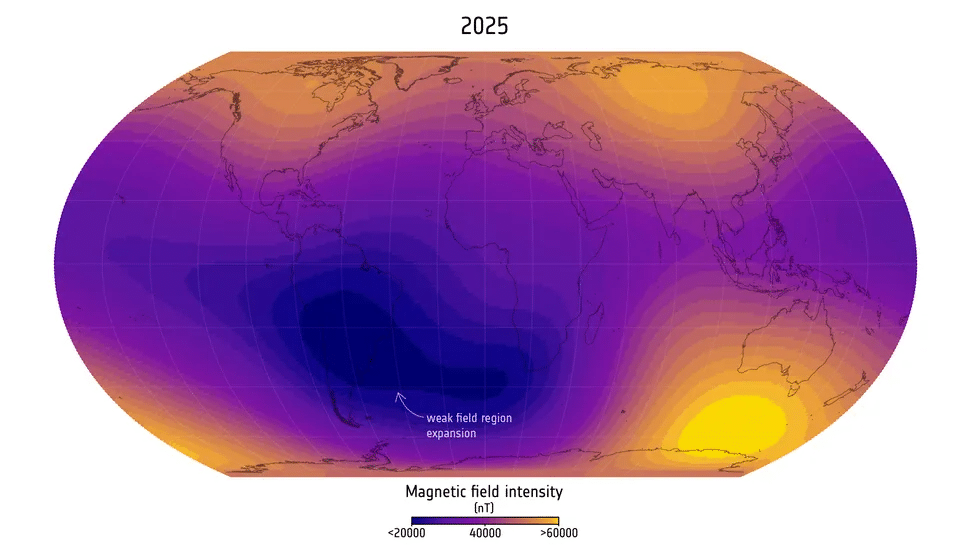
“The region of weak magnetic field in the South Atlantic has continued to increase in size over the past 11 years since the launch of the Swarm satellite constellation,” explained Chris Finlay, a geomagnetism researcher at the Danmarks Tekniske Universitet. “Although its growth was expected based on early observations, it is important to confirm this change in Earth’s magnetic field is continuing.”
Add Cosmo Herald as a Preferred Source

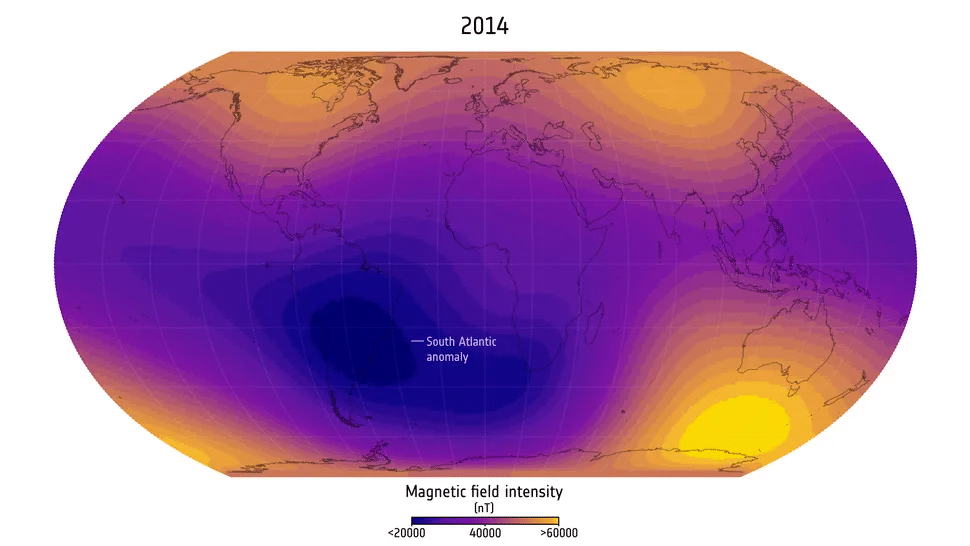
Lead author Finlay highlighted that the anomaly has now expanded to about half the size of Europe, showcasing the highly active and shifting nature of the Earth's magnetic shield.
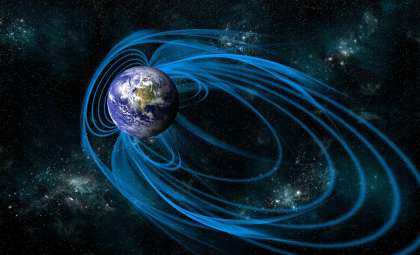
Deep below this zone, nearly 1,800 miles underground, complex currents of molten iron flow, generating Earth's magnetic protection.
“It is related to the circulation patterns of the liquid metal in the core, but we are not certain of the exact cause,” Finlay said.
The study indicates that variations in these deep flows may be responsible for the changing magnetic pattern, though the complete explanation is still unknown.
Increased Exposure for Satellites and Astronauts
This enlarging patch of weakened magnetism is becoming a practical concern for satellite operations and human spaceflight. “The primary effect concerns satellites orbiting close to Earth,” Finlay noted.
“These satellites experience higher rates of charged particles when they pass through the weak field region, which can cause problems for the electronics.”
As spacecraft enter the SAA area, they encounter energetic solar particles typically blocked by a stronger magnetic field. This interaction can lead to temporary malfunctions, corrupted data, or even complete shutdowns. For astronauts aboard the International Space Station, which occasionally traverses this region, radiation exposure poses significant health risks, including DNA damage and increased cancer likelihood.
Finlay cautions that the anomaly’s growth is accelerating:
“Since the weakness is growing, the satellites will experience such effects over a larger area, [so] this should be taken into account when designing future missions.”
To counter these hazards, spacecraft designers are being encouraged to reinforce systems against radiation in preparation for further expansion of the SAA in coming years.
Insights into Earth’s Changing Magnetic Environment
Although these developments are concerning, experts do not anticipate an imminent reversal of Earth's magnetic field, a phenomenon that has occurred repeatedly throughout geological time. Instead, the current changes represent a gradual fluctuation caused by activities within the molten iron core of the planet.
The Swarm satellites play a vital role in detecting these nuanced alterations, providing the most accurate geomagnetic data available. Their observations show that while the South Atlantic area is weakening, other regions, such as northern Canada and Siberia, experience corresponding strengthening or contraction. This highlights the ongoing dynamic balance of Earth's magnetic field.
Scientists emphasize the importance of ongoing and precise magnetic monitoring to better predict space environment hazards and improve the development of satellites and future space missions both near Earth and farther afield.
- Categories:
- News




0 comments
Sign in to Comment