
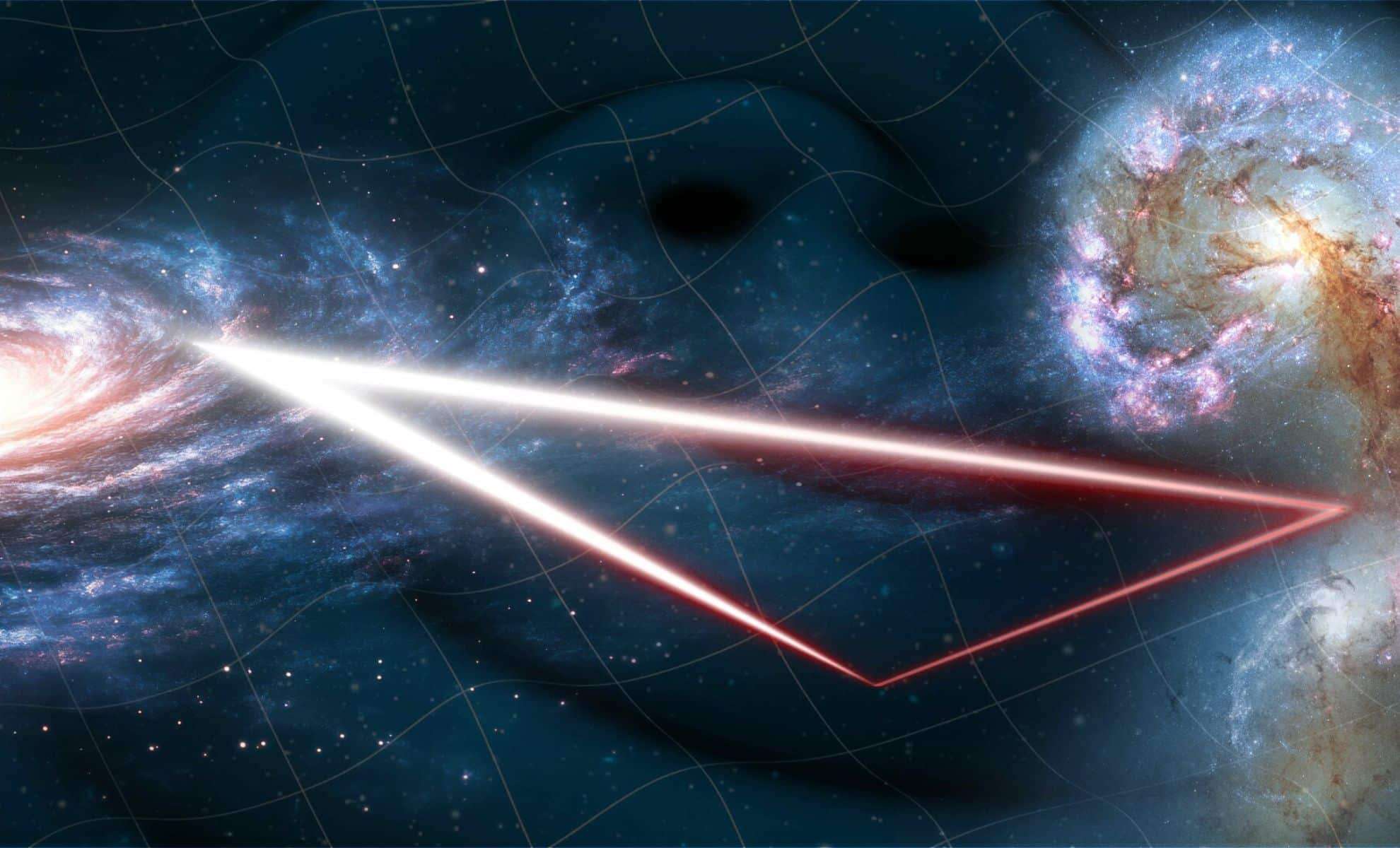
The European Space Agency (ESA) has officially embarked on assembling its ambitious Laser Interferometer Space Antenna (LISA) mission. This groundbreaking project aims to explore gravitational waves—subtle distortions in spacetime generated by some of the Universe’s most intense phenomena, including collisions of supermassive black holes. LISA will comprise three spacecraft arranged in a triangular formation, a milestone unveiled during the International Paris Air Show when ESA and OHB System AG finalized their construction agreement, signaling a significant advancement for space research.
Designed to shed new light on cosmic events shaping our Universe, LISA promises to deliver unparalleled data that could address fundamental questions about gravity, black holes, and cosmic expansion. Envisioned as a collaboration between ESA, NASA, and international partners, LISA positions Europe at the cutting edge of space innovation and cosmic science.
Understanding the LISA Mission
The LISA mission represents the first space observatory specifically geared toward detecting gravitational waves. These waves emerge from dramatic cosmic occurrences like mergers of supermassive black holes and interactions of compact massive objects that bend the fabric of spacetime. By operating at frequency bands inaccessible from Earth, LISA will identify previously undetectable gravitational phenomena.

A core aim of the mission is to investigate the development and merging processes of black holes, especially the supermassive black holes that evolve through cosmic mergers. Researchers anticipate that LISA will provide insight on black hole growth and their larger impact on the cosmos, tracing these events back to the Universe’s earliest moments.
Moreover, LISA will track tens of thousands of binary star systems within our galaxy, enhancing our understanding of their lifecycle. The mission is set to reveal aspects of the elusive "dark Universe" previously beyond our observational reach.
Overcoming Engineering Hurdles
Executing LISA poses formidable technical challenges. It will deploy three spacecraft flying in an equilateral triangle spanning 2.5 million kilometers per side—over six times the distance between Earth and the Moon. Achieving stable formation flying at such unimaginable distances demands extraordinary precision and engineering expertise.
The spacecraft will house gold-platinum test masses, roughly the size of a Rubik’s Cube, suspended in free fall. Gravitational waves will induce minute displacements in these test masses, which LISA’s laser interferometry system will measure with extreme accuracy. This system can detect changes smaller than a helium atom's diameter, a level of precision unprecedented in space-based experiments.
Chiara Pedersoli, CEO of OHB System AG, commented, “ESA and the scientific community have entrusted us with this revolutionary science mission. Together with our collaborators, we are committed to realizing LISA — advancing the capability to ‘surf gravitational waves’ and unveiling the Universe from a new perspective.” The project is set to be a remarkable achievement in space technology upon completion.
ESA’s Strategic Vision
ESA’s dedication to LISA was expressed by Prof. Carole Mundell, Director of Science at ESA, who stated, “Signing today with OHB marks a pivotal step in implementing this highly challenging project. LISA embodies long-term technological innovation, the hopes of our scientific community, and strong backing from ESA member countries.”
Beyond science, LISA is a beacon of global collaboration incorporating contributions from ESA member states, NASA, and an international network of scientists and engineers. The spacecraft construction is led by OHB System AG and Thales Alenia Space, with essential components supplied by nations such as Italy, Switzerland, Germany, the UK, France, the Netherlands, Belgium, Denmark, and the Czech Republic.
Prof. Mundell added, “Once operational, LISA will demonstrate how groundbreaking engineering combined with international collaboration can push Europe to the forefront of space technology and fundamental research.” This multinational effort epitomizes a major leap in our scientific explorations.
LISA’s Pathway to the Future
Scheduled for launch in 2035 aboard an Ariane 6 rocket, LISA reflects ESA’s long-term commitment to expanding the frontiers of space exploration and fundamental physics. Upon activation, LISA will be the first mission to observe gravitational waves from space, offering transformative insights that may reshape our cosmic understanding.
The impact of LISA extends beyond instrumentation; by detecting gravitational waves, it opens a new observational frontier, revealing phenomena inaccessible through conventional techniques. As humanity pushes scientific boundaries, LISA promises to illuminate the Universe’s hidden realms, answering some of the most profound mysteries involving space and time.
- Categories:
- News






0 comments
Sign in to Comment