
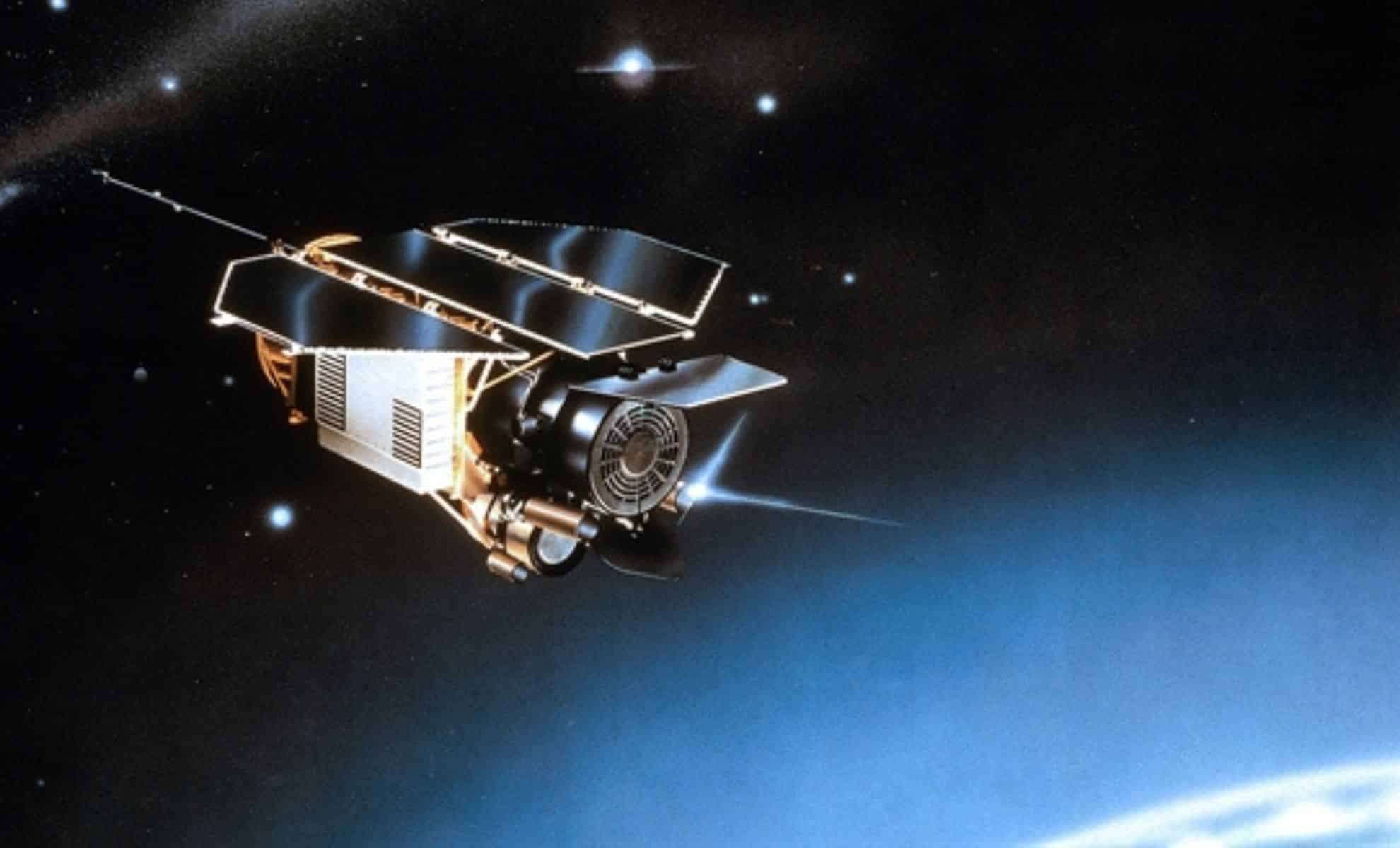
A group of researchers has uncovered an unusual polar cataclysmic variable—a distinctive binary star system where a strongly magnetized white dwarf pulls material from its companion. This system, named ZTF J0112+5827, was identified through observations from the ROentgen SATellite (ROSAT) and is notable for its brief orbital cycle of only 81 minutes.
Aside from its intense magnetic field, ZTF J0112+5827 stands out as a promising source of gravitational waves that might be detected by the Laser Interferometer Space Antenna (LISA), a space mission aiming to launch in 2035 to observe such cosmic phenomena.
Introducing a Unique Polar Cataclysmic Variable
Cataclysmic variables (CVs) are paired star systems where a white dwarf—the ultra-dense core left after a star exhausts its fuel—accretes matter from a nearby companion. These systems often display sudden brightening events when material rapidly accumulates and ignites on the white dwarf’s surface.

ZTF J0112+5827 is classified as a polar, a subtype of CVs distinguished by the absence of a conventional accretion disk. Instead, the white dwarf’s powerful magnetic field channels infalling gas directly along magnetic lines, producing vivid cyclotron radiation signatures.
An Intensely Magnetic System with a Rapid Orbit
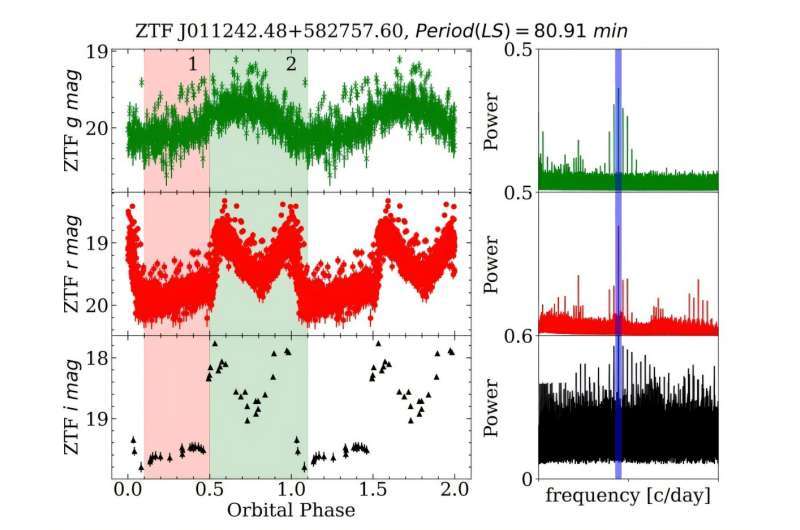
Examination of ZTF J0112+5827’s light patterns and emissions revealed its white dwarf possesses a magnetic field strength near 38.7 megagauss (MG), ranking among the most magnetic polars documented. With an orbital span of just about 80.9 minutes, the two stars orbit each other extraordinarily quickly compared to other cataclysmic variables.
The team’s research, shared on arXiv, estimates the mass of the white dwarf to be around 0.8 times that of the Sun, while the companion star weighs in at roughly 0.07 solar masses.
Potential Gravitational Wave Emitter
One of the most compelling findings is that ZTF J0112+5827 could serve as a future gravitational wave source. As its double stars whirl around each other at rapid speeds, they are expected to generate spacetime ripples. These waves fall below the detection range of present Earth-based observatories like LIGO and Virgo.
The forthcoming LISA mission, targeting launch in 2035, is designed to detect such low-frequency waves emitted by compact binaries. Ongoing studies of ZTF J0112+5827’s mass and orbital behavior may clarify its detectability by LISA.
Implications for Stellar and Gravitational Wave Research
The identification of ZTF J0112+5827 enriches the catalog of known polar cataclysmic variables, offering astronomers valuable data to better understand binary star lifecycle, magnetic field effects, and sources of gravitational waves.
As the hunt for similar systems continues, ZTF J0112+5827 emerges as a critical subject for observation, potentially unlocking deeper knowledge about highly magnetized white dwarfs and gravitational wave signals across the universe.
- Categories:
- News








0 comments
Sign in to Comment