

The most extensive family lineage ever recorded traces back to the Chinese philosopher Confucius, whose descendants span over 80 generations, covering nearly three millennia from the 8th century B.C. to today. While impressive, this record represents just a minuscule portion of human history. The species Homo sapiens has existed for about 300,000 years as indicated by the oldest fossils, prompting a larger inquiry: how many generations preceded the ones we know by name?
According to Matthew Hahn, a population geneticist at Indiana University Bloomington, determining this involves two key factors. First is the total time Homo sapiens has existed. Second is the generation interval, which is the typical timespan between a parent’s birth and that of their offspring. By dividing the species’ age by this interval, scientists can estimate the number of generations, though the precise figure depends on the generation length applied.
Defining the Length of a Human Generation
The generation interval isn’t a fixed unit like a year; rather, it reflects the average age when people have children, which varies by geography, culture, and era. Since men generally become fathers later than women become mothers, including both sexes usually increases the average interval.

Genealogy research provides some of the best figures. For example, a 2003 investigation into Icelandic genealogies by deCODE Genetics found that the biological generation time in Iceland over the last 300 years averaged 30.3 years.
Similarly, a 2005 study analyzing European women born between 1960 and 2000 reported a slightly shorter average generation interval of 29.1 years. While these recent values are reliable for recent centuries, they cannot be extended far back into prehistoric times due to the absence of written genealogical records.
Tracing Generations Over 250,000 Years Using Genetic Mutations
To reach deeper into the past, researchers examined human DNA itself, which retains records spanning hundreds of thousands of years. A 2023 study in Science Advances, headed by Hahn, mapped generation intervals over 250,000 years by analyzing how genetic mutation patterns passed from parents to offspring differ with parental age. Older parents tend to transmit distinct mutation types compared to younger parents, allowing scientists to infer parental ages at conception from the genetic data.
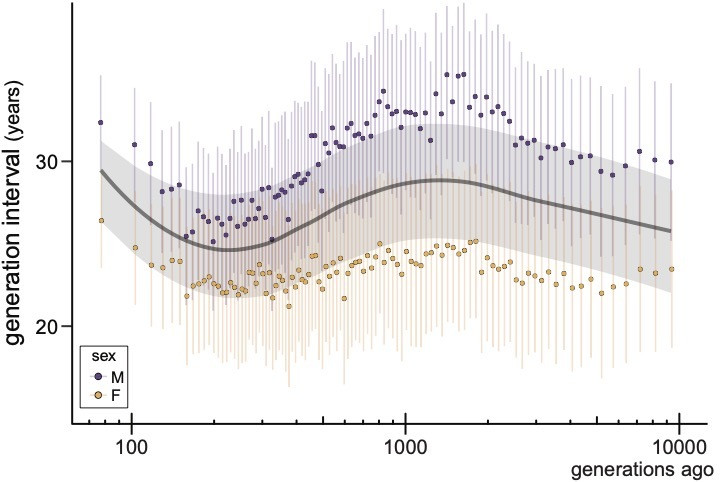
“If you know the mutation types typically passed to children based on parental age, and you have a dataset of mutations, you can estimate the average age of the parents,” Hahn explained. His team integrated data from a 2017 Icelandic parental study and a 2020 research that dated millions of mutations in current humans, organizing these mutations by age to deduce generation intervals across time periods.
The findings indicate an average generation length of 26.9 years throughout the 250,000-year timeframe, with fathers averaging 30.7 years and mothers 23.2 years. This interval fluctuated over time, but when applied to the ~300,000-year history of Homo sapiens, it suggests there have been about 11,152 human generations progressively since our species emerged.
Understanding the Range, Not Just a Single Figure
Not all experts agree on one definitive value. Moisès Coll Macià, an evolutionary biologist and geneticist at the Institute of Evolutionary Biology in Barcelona, told Live Science that the 26.9-year average is plausible, but he prefers a range rather than one fixed number.
To establish a minimum, Coll Macià refers to chimpanzees, our close relatives, whose generation interval is estimated at about 24.6 years based on a 2012 PNAS study. Since humans and chimps share a common ancestor from the Miocene epoch between 5 and 23 million years ago, earlier human generation lengths likely fell between chimpanzee and modern human averages.
On the higher end, he points to a 2016 PNAS paper that used Neanderthal DNA from ancient and present-day human genomes to estimate generation times over the past 45,000 years, suggesting an average between 26 and 30 years.
Calculating across this wider interval only moderately affects the total generation count. The upper limit of roughly 30 years yields a minimum of 10,000 generations, while the lower end of 24.6 years suggests as many as 12,195 generations.
- Categories:
- Science












0 comments
Sign in to Comment