
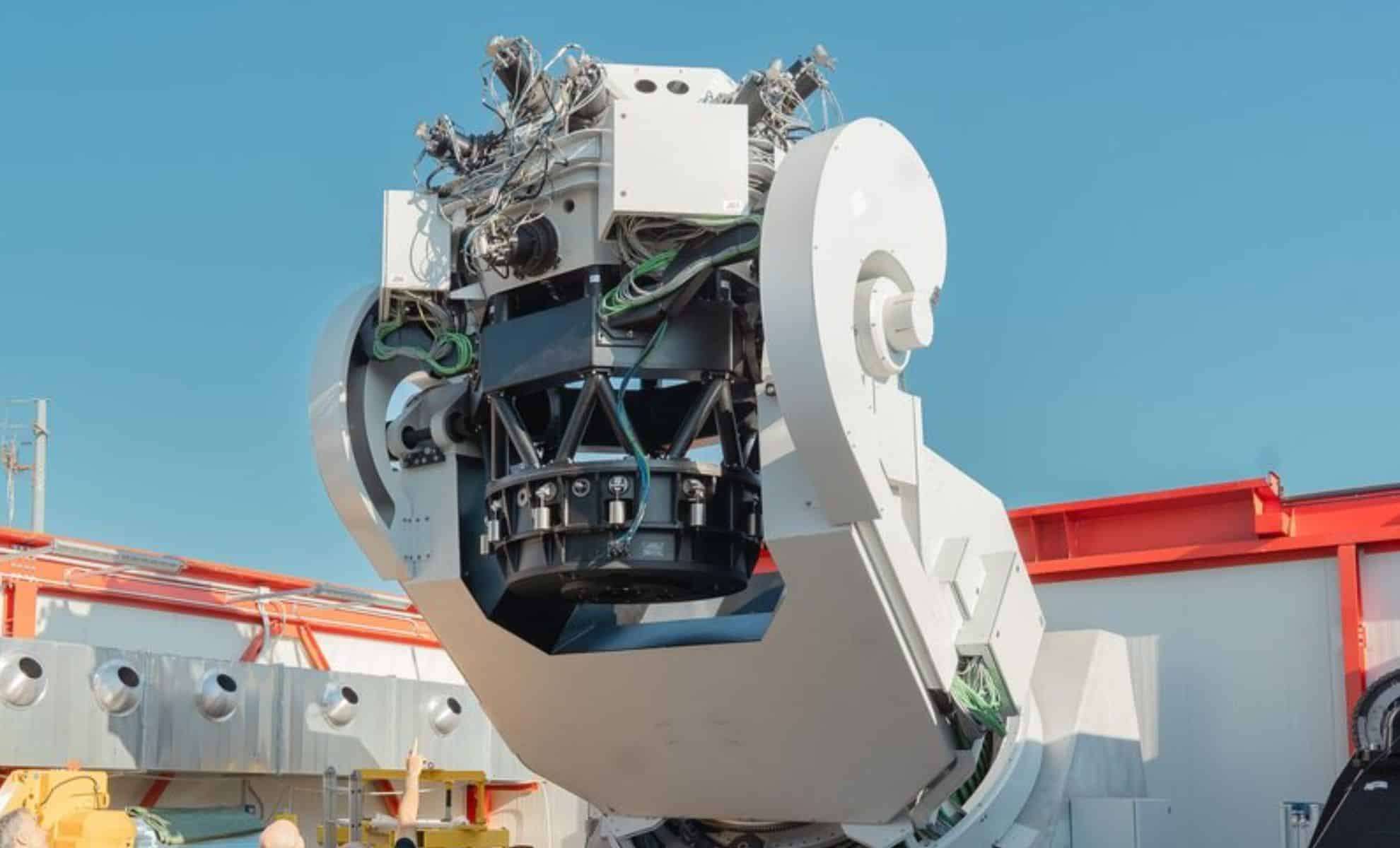
The European Space Agency (ESA) has taken a significant step forward in protecting Earth with the activation of its innovative Flyeye telescope. As detailed in ESA’s official update in 2025, this cutting-edge robotic observatory has captured its first celestial images—the milestone known as “first light”—from its station in Italy. This marks the commencement of its mission to detect potentially hazardous near-Earth asteroids and comets. Created in partnership with OHB Italia, Flyeye introduces a pioneering technique for spotting space objects thanks to its extensive sky coverage and autonomous systems.
Planetary Defense Meets Insect-Inspired Engineering
Unlike conventional telescopes, the Flyeye instrument is modeled after an insect’s compound eye, granting it an expansive surveying capability. It can capture a sky region exceeding 200 times the full Moon's apparent size in a single shot. The telescope features a one-meter diameter primary mirror that collects light, which is then separated into 16 distinct optical channels. Each channel is outfitted with its own camera tuned to detect faint and distant astronomical objects.
Roberto Aceti, Managing Director at OHB Italia, comments:
“The Flyeye’s novel optical layout is tailored to conduct comprehensive sky scans without compromising image sharpness across its broad field of view.” He continues, “Its one-meter primary mirror efficiently gathers incoming photons, which are subsequently split into 16 camera-equipped channels, enabling the detection of extremely subtle celestial signals.” This arrangement empowers Flyeye to conduct highly sensitive, large-scale observations, crucial for early identification of space threats.

Validating Capabilities with First Observations
In May 2025 testing sessions, Flyeye successfully tracked several known space objects, including asteroid (139289) 2001 KR1, asteroid 2025 KQ, and comet C/2023 A3 (Tsuchinshan–ATLAS). These initial detections highlight its proficiency not only in discovering new objects but also in rapidly performing follow-up imaging. Notably, the telescope captured images of asteroid 2025 KQ a mere two days after its discovery, a critical capacity for determining trajectories and threat levels.
The first light trials were conducted at the Space Geodesy Centre in Matera, Italy, managed by the Italian Space Agency (ASI). Following successful tests, Flyeye is preparing for relocation to its permanent observatory atop Monte Mufara in Sicily, where it will become an integral member of an international network monitoring Earth’s cosmic environment.
Expanding a Global Array for Asteroid Surveillance
ESA envisions enhancing sky monitoring with a constellation of Flyeye telescopes positioned at key sites across both hemispheres. Up to four such units will provide overlapping sky coverage, mitigating data loss due to adverse weather at any one location.
Ernesto Doelling, ESA’s Flyeye Project Manager, shares:
“In the future, a network of up to four Flyeye telescopes spread across the northern and southern hemispheres will work together to further improve the speed and completeness these automatic sky surveys and to reduce the dependence on good weather at any individual site.”
This distributed approach aims to strengthen detection rates and reliability, supporting worldwide efforts to identify and track hazardous celestial bodies.
Automated Monitoring and Rapid Global Notification
Operating autonomously, Flyeye conducts nightly scans without human oversight. When the system identifies a potential near-Earth object, data is sent to ESA’s Near-Earth Object Coordination Centre (NEOCC). After confirmation, discoveries are forwarded to the Minor Planet Center which manages global asteroid tracking records.
Richard Moissl, Head of ESA’s Planetary Defence Office, remarks:
“The earlier we spot potentially hazardous asteroids, the more time we have to assess them and, if necessary, prepare a response. ESA’s Flyeye telescopes will be an early-warning system, and their discoveries will be shared with the global planetary defence community.”
This streamlined, real-time sharing system is vital for issuing prompt alerts and enabling informed planetary defense decisions worldwide.
- Categories:
- News









0 comments
Sign in to Comment