
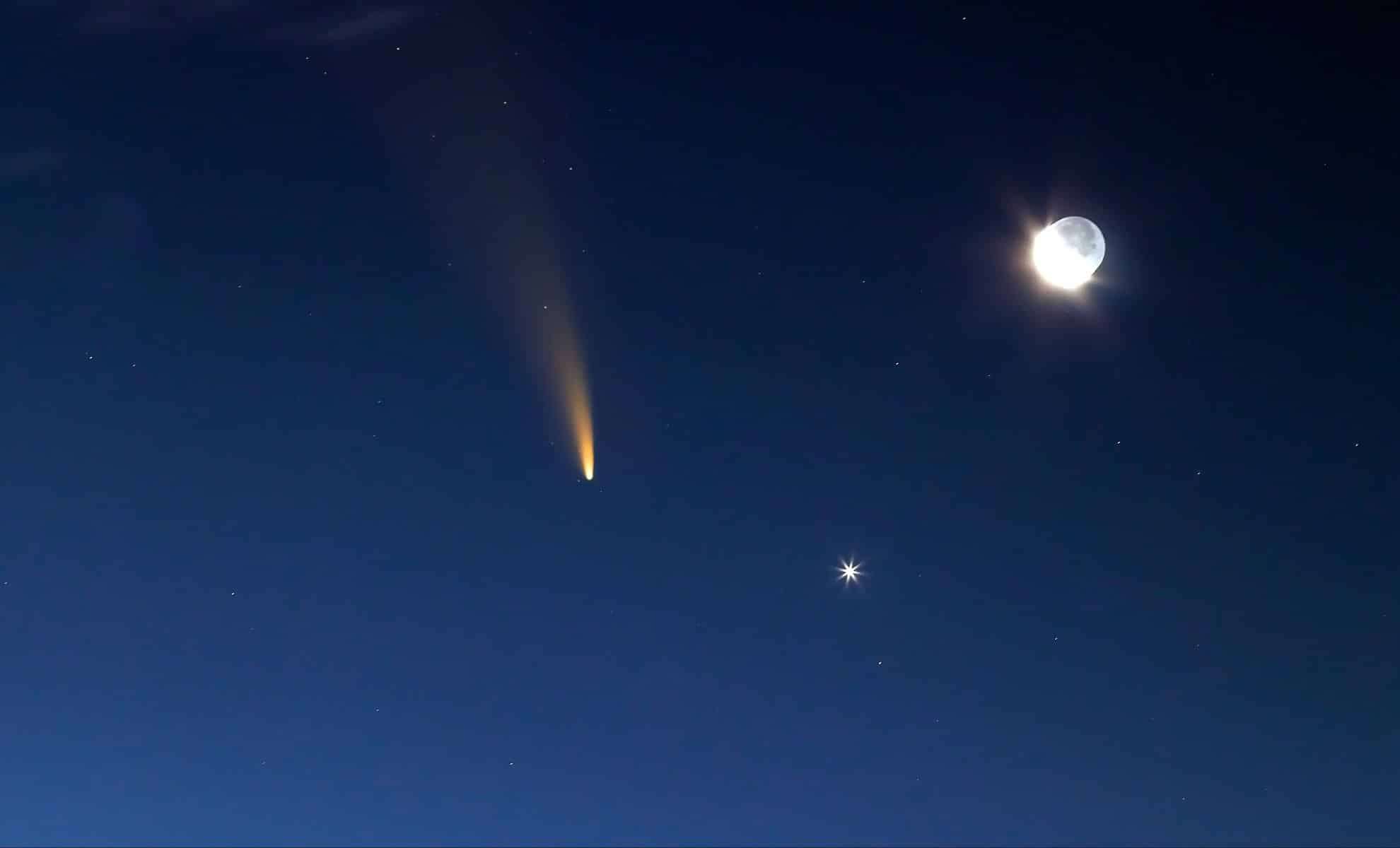
May’s evening skies present an exciting lineup of celestial phenomena, featuring the waxing Moon alongside some of the season’s most luminous stars. As Sky & Telescope highlights, this timeframe is rich with opportunities to spot planets, stars, and other cosmic marvels. The Moon will play a prominent role, moving close to brilliant stars, while various planets provide excellent chances for observation—perfect for both telescope users and casual sky watchers.
Tracking the Moon’s Journey
Beginning on May 9, the Moon advances toward fullness, interacting with several bright stars along the way. On this night, the stars Arcturus, Vega, and Capella shine prominently, their brightness enhanced by their proximity and intrinsic luminosity. As it continues its orbit, the Moon will approach Spica in Virgo—a star that's less bright than Arcturus and may appear subdued due to the Moon’s glow. The full Moon occurs on May 12, accompanied by Antares in Scorpius just to its lower left, creating excellent conditions for observing stars and planets alike.
Following this, on May 13, the Moon rises close to Antares, forming a striking pairing across the night sky. The Moon’s brightness can overshadow surrounding stars, but using simple techniques like covering the Moon with a finger can reveal the fainter members of the Scorpius constellation, enhancing the viewing experience.

Witnessing Some of the Universe’s Oldest Stars
During this period, stargazers have a unique chance to observe some of the ancient stars visible to the naked eye. On May 11, look toward the constellations Boötes and Libra to find stars estimated to be around 12.7 to 13 billion years old—remnants from near the dawn of the universe, only a short time after the Big Bang 13.8 billion years ago.
These venerable stars contrast with the relatively young objects within our solar system, including Earth. Their faintness, due to distance and a scarcity of heavy elements, poses a challenge for observation. Scientists determine their ages through spectroscopic analysis, revealing their low metallicity, which points to their early origin.
Planets on Display: Jupiter and More
This week’s planetary lineup offers some distinct viewing opportunities. Jupiter, the largest planet in our solar system, is visible in the western sky around dusk. On May 15, it aligns between the horns of Taurus, near Beta Tauri and Zeta Tauri, forming a nearly straight line. Although bright, Jupiter will appear smallest this year at 33 arcseconds wide and low on the horizon, causing some image blurring that obscures finer details like its cloud bands and moons.
In the early morning hours, the pair of Venus and Saturn can be seen rising well before sunrise. Venus glows brilliantly at magnitude -4.7, far outshining Saturn, which has a magnitude of +1.2. On May 10, these two planets will be close, with Saturn positioned roughly 8° to Venus’s upper right. Through telescopes, Venus will reveal a thick crescent phase, while Saturn will appear as a small orb with faint ring details visible under steady skies.
The Great Diamond Shapes the Spring Sky
May 14 brings the visibility of the expansive Great Diamond asterism in the southeastern sky. Spanning five constellations and towering 50° high, this arrangement features some of the night’s brightest stars. Start at Spica in Virgo, forming the base of the diamond. Moving upward, Arcturus in Bootes anchors the upper left corner, while Cor Caroli and Denebola mark the upper right and lower right points, respectively. The three brightest stars compose an equilateral triangle known as the Spring Triangle, which becomes visible shortly after sunset, providing a helpful guide for stargazers mapping the constellations.
The Great Diamond not only highlights some of the brightest stars but also serves as an accessible introduction to navigating the spring night sky, ideal for novices eager to familiarize themselves with stellar patterns.
Spotting Venus, Mars, and Other Planets
This week features a mix of planetary targets both in the morning and evening hours. Venus and Saturn stand out at dawn for their proximity despite differing brightness levels. As Venus rises first, its striking brilliance contrasts with the dimmer but still visible Saturn. Their relative positions shift throughout the week, offering interesting contrasts by May 17.
Evening viewers can spot Mars in the southwestern sky, glowing a subtle orange near the twin stars Pollux and Castor in Gemini. This is an excellent chance to compare Mars’s reddish hue to Pollux’s yellow-orange tone. Although Jupiter appears as a bright point in the twilight, it’s not ideally positioned for detailed observations this week and is better suited for binocular viewing.
- Categories:
- News






0 comments
Sign in to Comment