
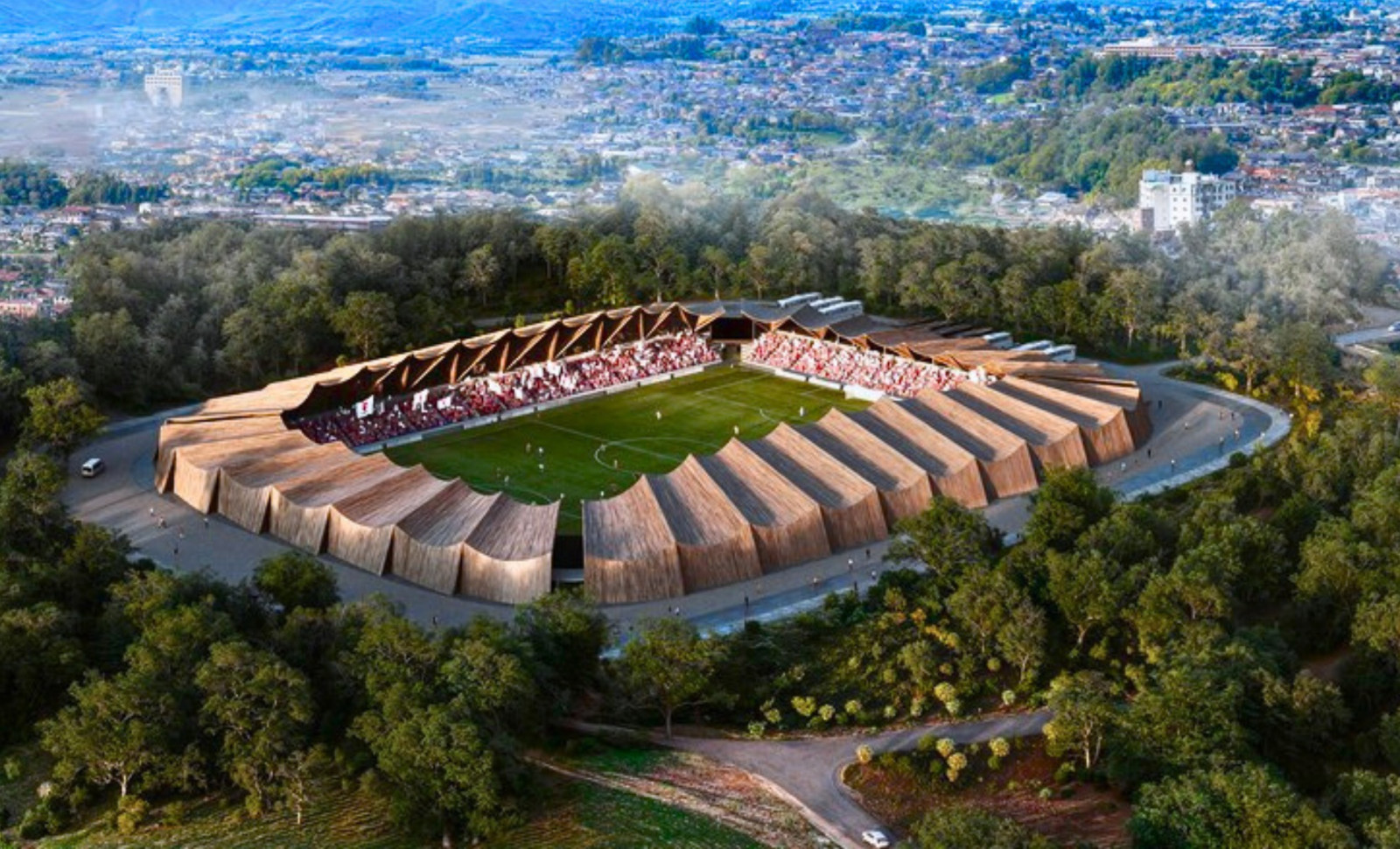
In Fukushima, Japan, a groundbreaking football stadium is set to challenge the traditional norms of sports infrastructure. Eschewing carbon-heavy concrete and large-scale contractors, this innovative project emphasizes local wood, natural energy systems, and active community participation in its construction. Designed by the architectural team at VUILD, the stadium concept debuted at the Venice Architecture Biennale and exemplifies regenerative design principles in a region still healing from the 2011 triple disaster: earthquake, tsunami, and nuclear crisis.
Serving as the home venue for Fukushima United FC, a club emblematic of the area's resilience, the stadium represents more than just a sports ground. Inspired by the phoenix featured on the team's logo, it stands as a tangible symbol of rebirth. By sourcing materials and engaging labor from the local environment and community, the design aims to craft a “human-scale stadium” organically connected to Fukushima’s culture and natural resources.
Locally Sourced Timber Forms a Circular, Community-Built Arena
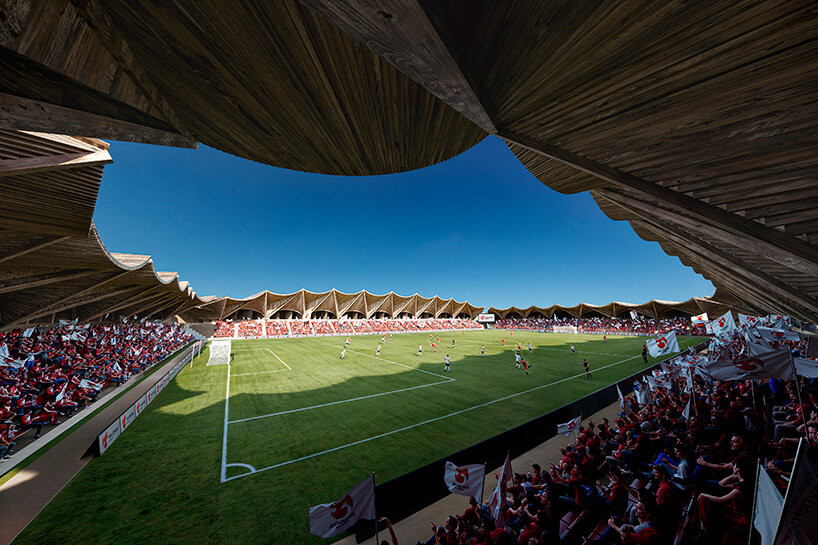
Nearly the entire stadium will be constructed from wood, integrating timber harvested in Fukushima and repurposed wood. Rejecting the notion of colossal single-stand structures common in contemporary stadiums, VUILD modeled the design on a compact two-story building module, repetitively arranged in an enclosed ring around the playing field, as explained in their official announcement. This strategy limits the building height to under 16 meters and subdivides the complex into sections smaller than 3,000 square meters to meet fire safety rules while preserving a cozy atmosphere.

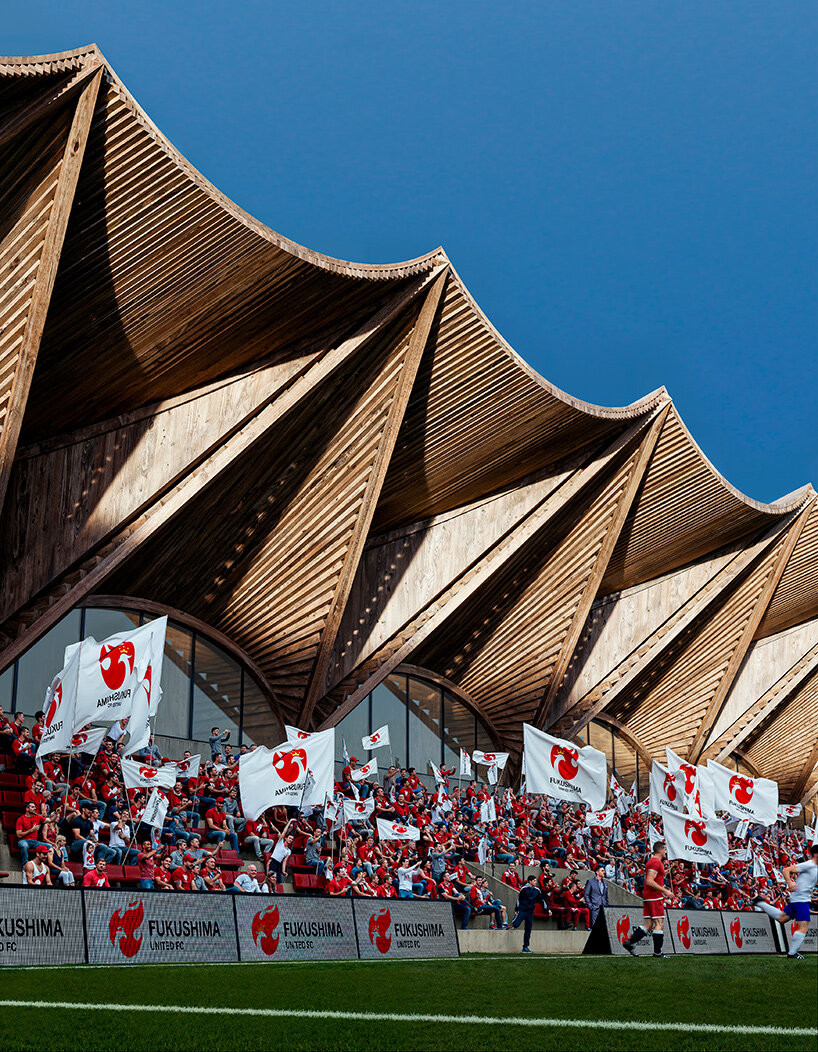
With seating capped at 5,000 spectators, the stadium intentionally integrates into its natural surroundings rather than overwhelming them. Its circular layout draws inspiration from the historic tulou communal dwellings of Fujian in China, dating back to the 12th century. The roof shape also pays homage to the triangular thatched roofs of Fukushima’s Ouchi-juku, a village famed for its Edo-era preservation.
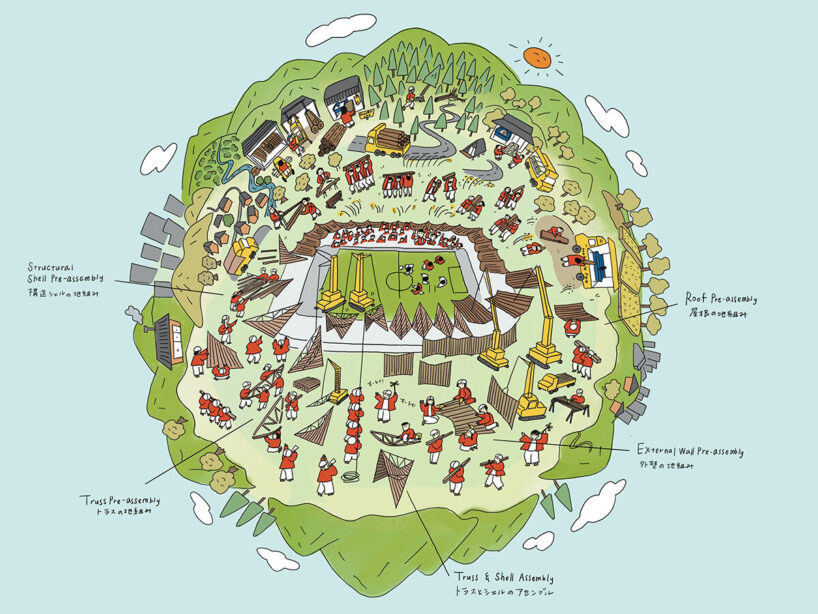
Perhaps most notable is the stadium’s construction process. Wooden elements will be prefabricated offsite before being assembled with the active involvement of fans, local inhabitants, and community organizations. VUILD compares this communal building effort to traditional Japanese collective rituals seen in shrine or festival architecture, where locals unite to raise heavy timber frames. The stadium, therefore, becomes a collaborative symbol built through community spirit.
Efficient Climate Adaptation Using Roof Design, Walls, and Ice Storage
Passive environmental strategies tailored to Fukushima’s specific basin climatic conditions underpin the stadium’s design. VUILD’s engineers optimized the roof and wall structures to exploit sunlight and prevailing winds without relying on conventional mechanical cooling or heating, as noted by designboom.
The roof on the south side is intentionally shortened to permit sunlight to nourish the playing field, ensuring turf vitality. Conversely, the northern roof extends to shield spectators from intense summer sunlight, minimizing heat accumulation. The stadium’s exterior walls serve as wind channels, directing summer northwest breezes into seating areas for natural cooling while deflecting cold winter winds. Ventilation gaps beneath the stands enable airflow circulation around the pitch and spectator zones year-round.
The cooling concept extends further with an innovative ice storage system positioned beneath the stands. Winter’s cold air is harnessed to create ice reserves, which then provide chilled air to fans during summer months, significantly reducing reliance on traditional air conditioning. This design cleverly transforms cold winters from a challenge into an energy resource.
Rainwater Harvesting and Living Building Challenge Goals
Designed for sustainability, the stadium captures and purifies rainwater from its roof, storing it in tanks under the seating area. This harvested water is reused for irrigation of the pitch and restroom facilities, lowering dependence on municipal supplies and cutting operational environmental impacts.
These innovations contribute toward fulfilling the Living Building Challenge certification, which mandates net-positive water and energy use, non-toxic building materials, and a harmonious relationship with local ecosystems and community. VUILD also plans to incorporate on-site renewable energy systems and storage capabilities, aiming for energy autonomy, although detailed energy specifications remain undisclosed.
Optimization of the stadium’s form was achieved through collaboration with engineering specialists at Arup. They employed a multi-parameter approach evaluating factors such as spectator thermal comfort—measured by SET* (Standard Effective Temperature)—structural volume and carbon impact, wind flow over the pitch, and grass growth conditions. This rigorous process ensured the final shape balances environmental performance with structural efficiency.
Innovative Hybrid Roof Design for Column-Free Spanning
The roofing system features a dual structural approach to span 12 meters without support columns. Its primary framework consists of HP shell surfaces (hyperbolic paraboloid shells), prized for their inherent stiffness. These shells are crafted from straight timber planks manipulated into curved forms and fastened with structural screws, a method akin to Nail-Laminated Timber. The shell edges tilt to create arch-like supports that simultaneously brace the structure and act as roof columns.
Above this shell layer, a secondary framework of straight wooden members is suspended in a catenary curve, forming a light hanging roof membrane. Tension is applied during assembly to solidify the shape and enhance strength. The entire construct is divided into prefabricated units that can be transported and assembled by community members.
According to VUILD, combining digital fabrication, off-site manufacturing, and collaborative local construction enables use of smaller-scale regional timber, eliminating the need for large, old-growth logs. By engineering composite wood shells, the design meets structural demands with environmentally responsible materials.
- Categories:
- News





0 comments
Sign in to Comment