
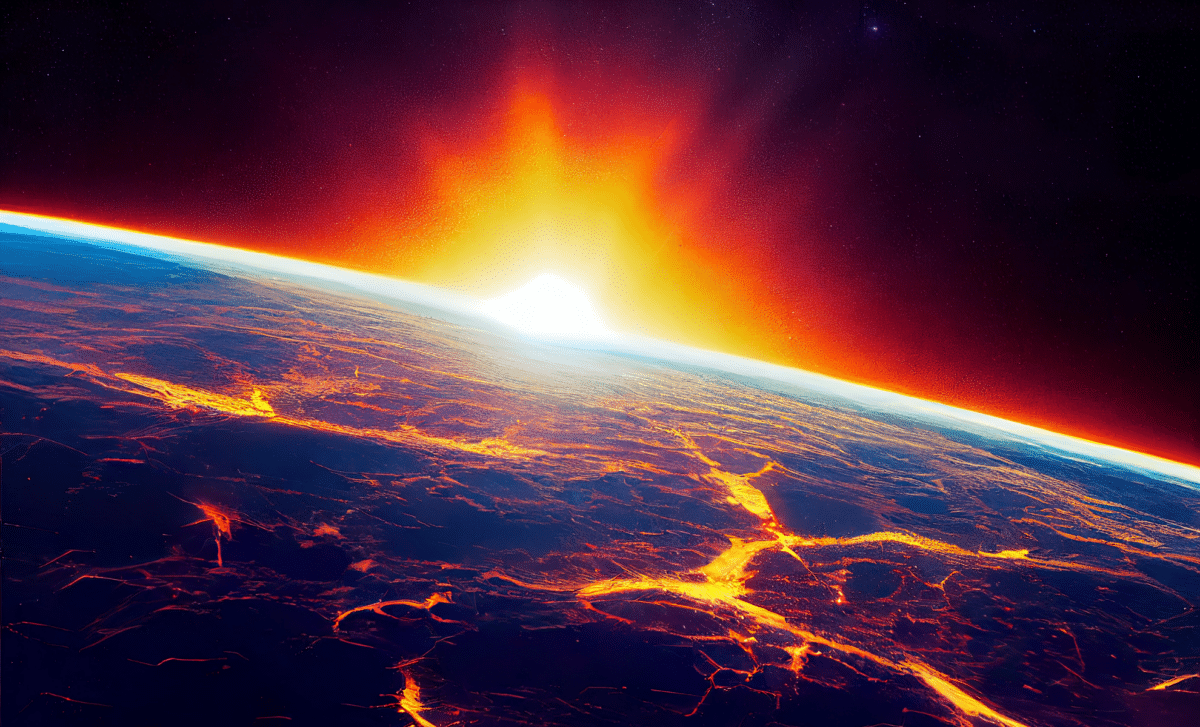
Our sun currently sits near the midpoint of its lifecycle, but what awaits once it starts to perish? A new investigation featured in Eos sheds light on this far-off scenario by exploring how mature stars engulf their innermost planets. Leveraging data from NASA’s Transiting Exoplanet Survey Satellite (TESS), researchers have begun to piece together how these stellar “consumptions” occur—and the implications they carry for Earth’s ultimate destiny.
The Fate of Planets Around Aging Stars
Stars undergo profound changes as they age. When their hydrogen fuel is exhausted, they inflate into massive red giants, sometimes growing over a hundred times larger than their original size. For planets in close orbits, this spells inevitable doom.
Scientists Edward Bryant from the University of Warwick and Vincent Van Eylen of University College London utilized TESS data to scrutinize hundreds of thousands of such evolved stars. Their research uncovers a revealing trend.

“We saw that these planets are getting rarer [as stars age],” Bryant said. “In other words, planets are disappearing as their host stars grow old.” The comparison between young and old stellar systems shows that this phenomenon isn’t due to differences in formation. “We’re fairly confident that it’s not due to a formation effect,” Bryant explained, “because we don’t see large differences in the mass and [chemical composition] of these stars versus the main sequence star populations.”
As highlighted by Space.com, the evidence points to stars engulfing or obliterating their closest planets as they evolve, a fate that ultimately awaits Mercury, Venus, and quite possibly Earth.
Insights from the Observational Data
Analyzing 456,941 post–main-sequence stars detected by TESS, Bryant and Van Eylen identified 130 planets and potential candidates extremely close to their aging hosts.
“We’re looking at how common planets are around different types of stars, with number of planets per star,” Bryant said. The results were striking:
“The fraction [of stars with planets] gets significantly lower for all stars and shorter-period planets, which is very much in line with the predictions from the theory that tidal decay becomes very strong as these stars evolved.”
This inward spiraling known as tidal decay, driven by the gravity of swelling stars, appears to be the primary driver of planetary loss. Even without total engulfment, these gravitational forces can strip away atmospheres or break planets apart. Detecting these systems remains a challenge, however.
“If you have the same size planet but a larger star, you have a smaller transit,” Bryant said. “That makes it harder to find these systems because the signals are much shallower.”
Nevertheless, this innovative approach provides astronomers with an unprecedented window into a long-theorized but seldom observed cosmic process.
A Transformative Phase for Exoplanet Exploration
This research expands on three decades of exoplanet discoveries, which have confirmed over 6,000 planets beyond the solar system. Detecting planets orbiting older stars has historically been difficult, but missions like TESS and the upcoming European Space Agency’s Plato Mission, set for launch in December 2026, are rapidly changing the landscape.
Sabine Reffert, an astronomer from Universität Heidelberg who was not involved in this study, highlighted the importance of this methodology.
“The processes that take place once the star evolves [past main sequence] can tell us about the interaction between planets and host star,” she said. “We had never seen this kind of difference in planet occurrence rates between [main sequence] and giants before because we did not have enough planets to statistically see this difference before. It’s a very promising approach.”
By integrating data from multiple space observatories, researchers are starting to measure not only the frequency of planet destruction but also the pace at which these events unfold. As discussed in Eos, this field marks a key advancement in understanding the complex relationship of stellar-planetary coevolution—the intricate interplay between dying stars and the planets they once nurtured.
- Categories:
- Astronomy



0 comments
Sign in to Comment