
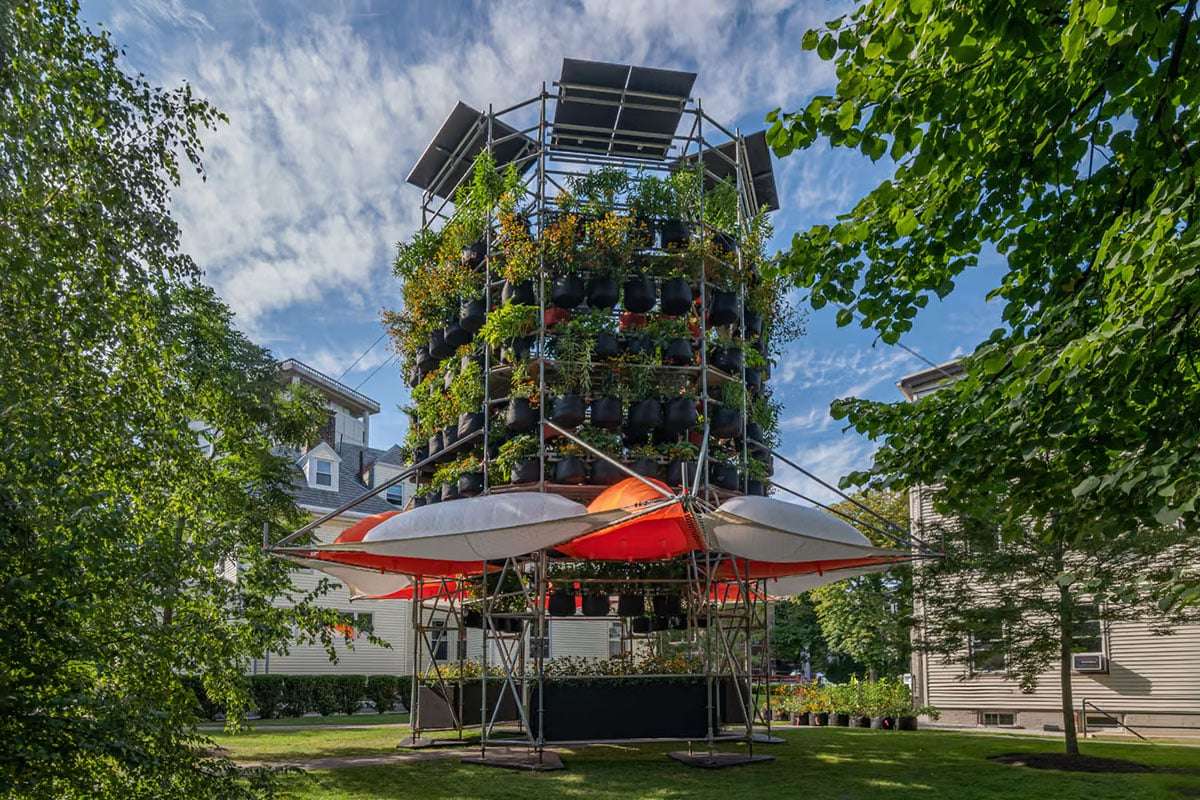
The Polinature tower showcases innovative modular design that allows for swift assembly and disassembly. Its steel framework supports a rich variety of native plants alongside distinct “climate bubbles.” These spherical elements, positioned just above ground level, come in two types:
- White bubbles that maintain a steady inflation
- Orange bubbles that adapt to changing environmental factors
The responsive orange bubbles are especially noteworthy, as they expand only when specific discomforts like high humidity or excessive heat arise. Featuring specialized air outlets, they produce a cooling airflow that refreshes the area beneath and elevates warm air upwards, naturally cooling the surrounding environment.
At the tower’s summit, solar panels capture sunlight and store energy in an onboard battery. This system enables the Polinature tower to operate independently, highlighting the promise of self-reliant green infrastructure within urban centers.

Encouraging Urban Biodiversity
A standout feature of the Polinature tower is its function as a vertical ecosystem, hosting 1,400 plant species native to Massachusetts. These thoughtfully chosen plants provide a range of ecological benefits:
Benefit Description Climate resilience Plants flourish under local weather conditions Low upkeep Uses an efficient drip irrigation system Temperature control Helps cool the nearby environment Attracts pollinators Draws bees, monarch butterflies, and hummingbirds
The vegetation is cultivated in suspended grow bags, creating a vibrant, vertical garden that revitalizes urban spaces. This green refuge not only beautifies the area but also plays an essential role in reducing urban heat and fostering local wildlife.
Serving as a sanctuary for pollinators, the tower supports various species critical to maintaining balanced urban ecosystems, enhancing the ecological well-being of its surroundings.
Advanced Environmental Sensing
More than a structure, the Polinature tower is embedded with high-tech sensors that track and assess its influence on the local climate. These monitoring tools provide real-time data on atmospheric conditions around the tower.
Collected information serves several purposes:
- Evaluates the tower’s effectiveness in altering microclimates
- Offers valuable research and learning opportunities for Harvard’s academic community
- Allows visitors to engage with and understand the tower’s environmental impact via interactive displays
- Supports wider urban planning and ecological research efforts
Functioning as both a research instrument and an educational platform, the Polinature tower exemplifies how sustainable technology combined with data analytics can drive smart urban development.
Envisioning the Cities of Tomorrow
More than just a novel architectural work, Harvard’s Polinature tower represents a pioneering vision for future cities. Addressing major challenges like urban heat, biodiversity decline, and sustainability, it offers a transformative model for urban spaces.
As global cities face increasing climate pressures and population demands, initiatives like the Polinature tower provide a hopeful blueprint for greener, more sustainable urban living. Its modular and self-sufficient design highlights how eco-friendly innovations can be harmonized with existing cityscapes, delivering immediate environmental benefits alongside long-term improvements.
Although currently a temporary installation at Harvard, the Polinature concept holds vast potential to reshape urban environments worldwide. By redefining city spaces as zones for ecological restoration and climate action, it charts a path toward resilient, nature-integrated urban futures.
- Categories:
- Tech













0 comments
Sign in to Comment