
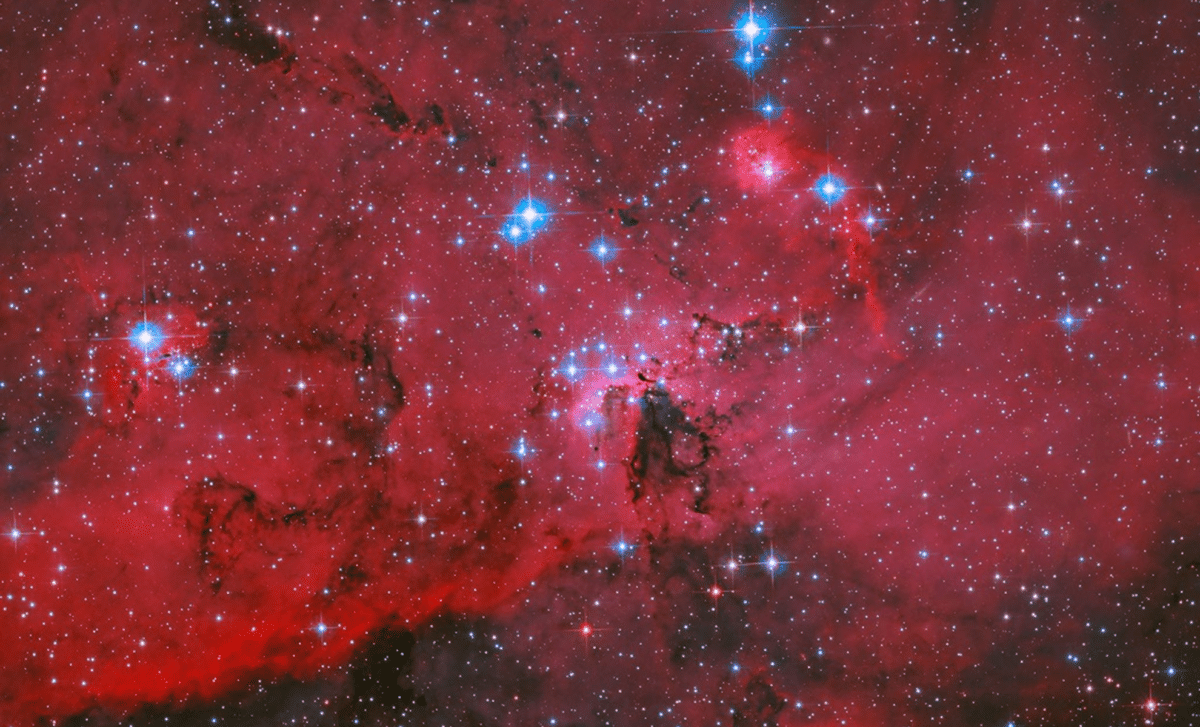
The Hubble Space Telescope has delivered a breathtaking image revealing one of the most dynamic star-forming regions ever witnessed. The captivating snapshot of LH 95, nestled within the Large Magellanic Cloud, highlights dazzling blue stars piercing through vivid red hydrogen clouds and exposes thousands of nascent stars still developing before igniting nuclear fusion.
A Vivid Nebula Rich with Young Stars and Radiant Hydrogen
Situated in the Large Magellanic Cloud, a satellite galaxy orbiting the Milky Way, LH 95 is a colossal stellar cluster hosting stars of various masses. The striking image contrasts brilliant blue and white stars against sweeping clouds colored by glowing hydrogen gas. Towering blue giant stars dominate the scene, while numerous smaller stars populate the surrounding nebula. The dominant red hues arise from hydrogen-alpha emissions, a crucial marker revealing active star creation.
Intertwined dark dust lanes thread through the region, resisting the strong ultraviolet rays and fierce stellar winds from the largest stars. These forces continuously reshape the nebula, creating a dynamic setting where fresh stars keep forming. This combination of beauty and scientific significance provides an intricate glimpse into a multi-scale stellar nursery bustling with activity.

Thousands of Stars Grow Before Igniting Core Fusion, NASA Reports
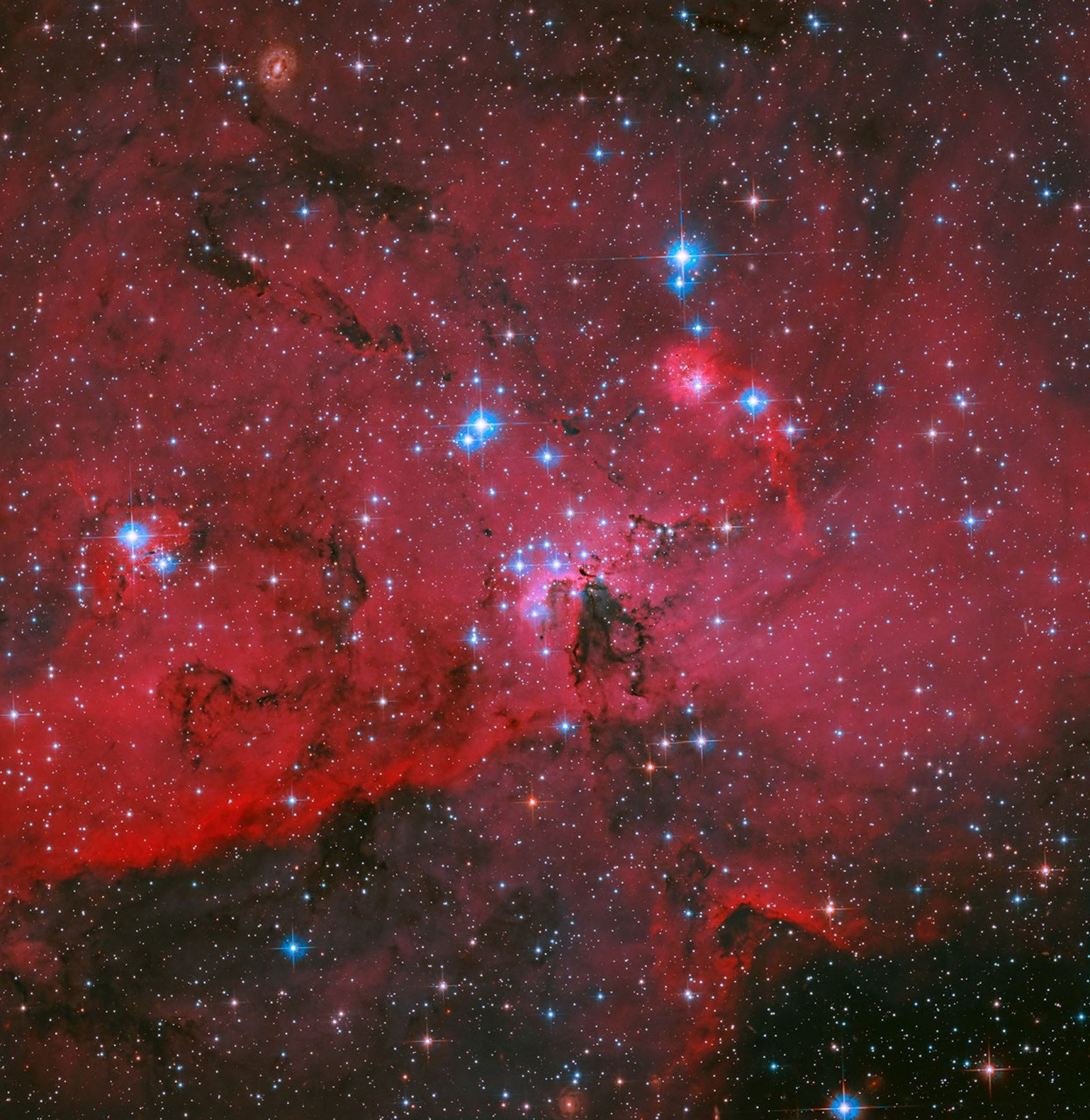
NASA reveals that LH 95 harbors roughly 2,500 pre-main-sequence stars. These celestial objects have nearly acquired their full mass but are yet to initiate the hydrogen fusion processes characteristic of true stars. As material continues to accrete from surrounding gas and dust disks, their mass slowly increases until their cores reach temperatures sufficient for fusion. Detailed study shows accretion rates naturally decline as stars mature.
These findings also extended the timeline for accretion to several million years, far longer than earlier estimates. This improved understanding sheds light on planetary system development since the same circumstellar disks feeding stars are often sites where planets form. Each fresh observation from Hubble refines the cosmic story of how planetary systems, including ours, come into being.
Multiple Star Generations Coexist Within This Stellar Cradle
A striking revelation in LH 95 is its continuous star formation history rather than a single event. Scientists identified several star populations occupying the same space. Many stars are approximately four million years old, while the region’s most massive star, estimated at between 60 and 70 solar masses, is about a million years junior to its neighbors.
This staggered formation timeline implies a prolonged starbirth process instead of an instantaneous burst. Understanding this sequential birth offers insight into how intense radiation, stellar winds, and eventual supernova explosions from massive stars can trigger subsequent star formation. Studying these overlapping generations allows astronomers to reconstruct the complex evolutionary narrative within this stellar nursery.
Why LH 95 Is a Premier Cosmic Laboratory
LH 95 is prized for combining a vast population of youthful stars with relatively low dust obscuration compared with similar star-forming regions in the Milky Way. This clarity gives scientists an unparalleled view into unfolding stellar development stages while tracking mass accretion and interactions with the environment.
The recent revelations reinforce the enduring legacy of the Hubble Space Telescope, which, more than thirty years post-launch, continues to unveil transformative discoveries. Alongside observatories like the James Webb Space Telescope and soon the Nancy Grace Roman Space Telescope, Hubble remains integral to unraveling the mysteries of galactic star formation across cosmic history, ultimately advancing our grasp of the origins of our own stellar neighborhood.
- Categories:
- News


0 comments
Sign in to Comment