
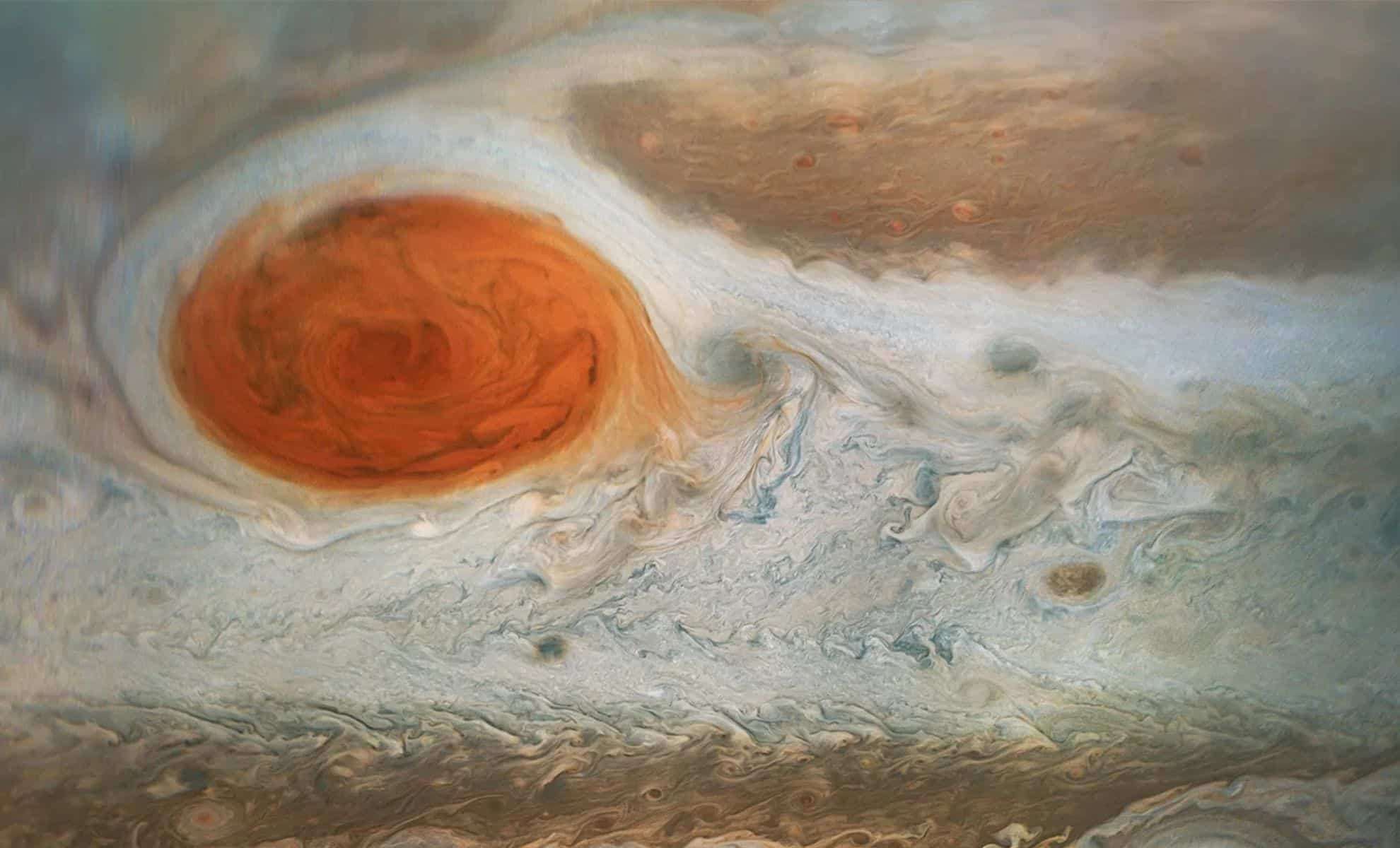
Jupiter’s iconic Great Red Spot (GRS), a gigantic storm system visible for over a century and a half, continues to intrigue scientists with its dynamic nature. Large enough to envelop Earth, this immense anticyclonic vortex has recently been observed exhibiting unexpected variations by NASA’s Hubble Space Telescope. Data gathered between December 2023 and March 2024 reveals that the GRS fluctuates in both dimension and form, providing fresh perspectives on the behavior of this planetary tempest.
Scientists Detect Unexpected Variations in GRS Dimensions
Traditionally viewed as a stable, oval-shaped feature gradually diminishing over time, the Great Red Spot now shows signs of rhythmic changes in size and outline. Amy Simon, principal investigator at NASA’s Goddard Space Flight Center, explained the surprise: “The size oscillations caught us off guard; nothing like this has been confirmed before.” This breakthrough was achievable thanks to Hubble’s continuous monitoring, which allows for detailed observation of subtle fluctuations over extended periods.
The storm exhibits a wobbling effect, likened to a gelatin dessert jiggling, as it cycles through phases of elongation and contraction while altering its speed. This elliptical morphing occurring alongside velocity shifts challenges previous concepts of the GRS as a steady storm. Simon emphasized, “Hubble’s clarity has unveiled simultaneous squeezing and speed variation in the GRS, an unexpected phenomenon lacking current hydrodynamic explanations.”


The Role of Surrounding Jet Streams in GRS Fluctuations
The interaction between the Great Red Spot and adjacent powerful jet streams is believed to influence its oscillatory behavior. Jupiter’s atmosphere features numerous swift jet streams flanking the storm, located between two ambient wind currents parallel to the planet’s equator. Mike Wong, a researcher at the University of California at Berkeley, compared the arrangement to a sandwich whose contents push outward on the bread slices when overfilled.
This dynamic between the GRS and its jet stream boundaries likely contributes to the storm’s changing size and shape. Variations in the storm’s velocity cause it to expand or compress as it presses against the northern and southern jet streams, creating the observed wobble. These interactions add complexity to the GRS’s structure and motion, yielding new insights into Jupiter’s atmospheric behavior.
Unraveling the Causes Behind the GRS’s Changing Form
Despite long-term examination, the mechanisms driving the Great Red Spot’s rhythmic size oscillations remain unclear. Jupiter’s tumultuous gaseous environment and the GRS’s immense scale challenge existing hydrodynamic models to fully explain the storm’s actions. Amy Simon noted the ongoing mystery: “Currently, we lack adequate hydrodynamic theories for these behaviors.”
One theory connects these fluctuations to the ongoing shrinkage of the GRS observed over recent decades. Since the start of the Outer Planet Atmospheres Legacy (OPAL) program ten years ago, the GRS has steadily diminished in scale. It's possible that as the storm contracts, it becomes increasingly impacted by the jet streams pressing on its boundaries, resulting in the observed oscillations.
Looking Ahead: The Future of Jupiter’s Great Red Spot
For more than a century, the Great Red Spot’s gradual reduction has been documented, with projections indicating this trend will persist until the storm stabilizes at a smaller, more rounded dimension. Amy Simon observed that the GRS currently exceeds the latitude range supported by surrounding winds, implying that as the storm contracts, these winds will take on greater control of its form and movement. Once the storm fits neatly within its atmospheric band, oscillations may diminish, leading to a steadier shape.
The newly uncovered oscillations add complexity to the GRS’s evolution, but more research is needed to determine if these shifts represent a repeating pattern or a temporary anomaly. Future Hubble campaigns aim to gather additional data on Jupiter’s atmospheric conditions to clarify the causes behind these changes.
Implications for Understanding Giant Planet Weather Systems
Insights gained from studying Jupiter’s Great Red Spot extend beyond our solar system, contributing valuable knowledge to the field of planetary meteorology. Examining the dynamics of massive storms on gas giants helps refine models applicable to weather phenomena on both solar and extrasolar planets. Mike Wong highlighted this broader relevance: “Deciphering the workings of the solar system’s largest storms broadens the context for Earth hurricane theories and may enhance understanding of climate systems on planets orbiting other stars.”
These discoveries underscore the importance of high-resolution imaging technologies like Hubble, which enable precise tracking of changes in size, shape, and color of features like the GRS. Continued observations will deepen comprehension of the physical forces at play in Jupiter’s atmosphere and contribute to a wider grasp of meteorological processes on gas giants.
- Categories:
- Astronomy ,
- News ,
- Nasa





0 comments
Sign in to Comment