
Was there light in the universe’s infancy, or was it concealed from sight? While the notion appears straightforward, a Live Science article uncovers a much more complex story. Photons—the fundamental particles of light—were present immediately following the Big Bang, yet initially, they remained trapped within an intense, dense surroundings. It took hundreds of thousands of years before these photons managed to escape, marking a critical phase in cosmic evolution. The tale of light’s passage through the universe’s earliest epochs highlights rapid expansion, cooling processes, and the formation of the cosmos we observe today.
The Universe’s Fiery Beginnings
In the aftermath of the Big Bang, space underwent swift expansion, spreading matter and energy throughout the cosmos. Andrew Layden, physics and astronomy chair at Bowling Green State University, describes this monumental event: “The Big Bang initiated space itself, alongside all components of the universe.” During this turbulent period, the environment was extremely hot, energized with particles moving at tremendous velocities. Photons did exist then but could not move freely because the universe’s density resembled a thick fog, with electrons scattering light and preventing its travel.
Layden offers an analogy: “Consider fog and dew. High-energy particles are like water vapor in fog, and as energy decreases, they condense much like dew droplets.” This comparison illustrates how electrons and protons transitioned from a high-energy state, gradually allowing photons to pass unimpeded as cooling took place. The early cosmos was a “dense soup” where constant photon-electron collisions restricted light’s movement.

Recombination: When Light Broke Free
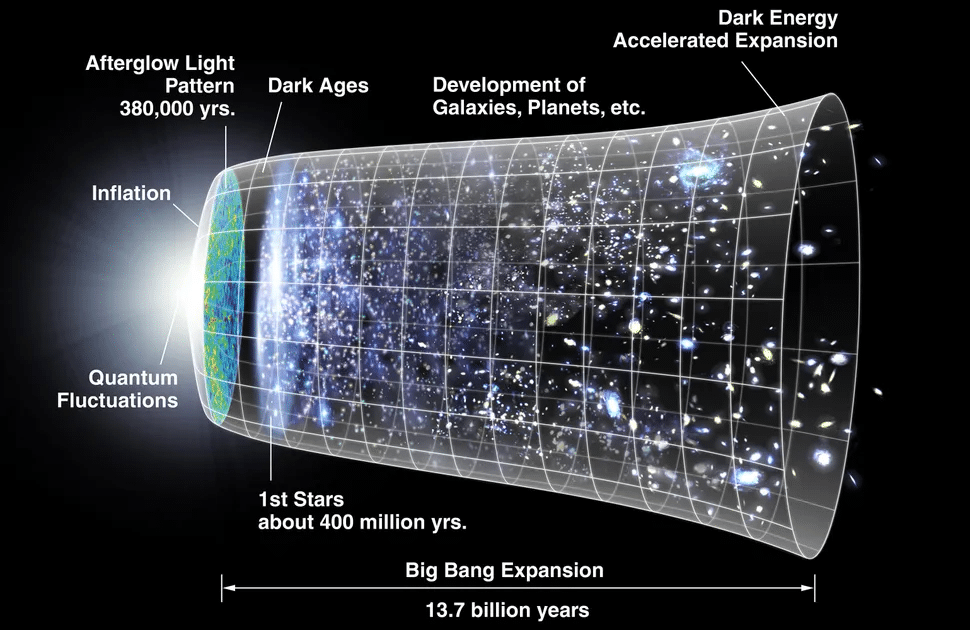
Approximately 380,000 years post-Big Bang, the universe cooled enough to allow electrons to combine with atomic nuclei, a process termed “recombination.” This temperature drop enabled electrons to settle into stable atomic orbits, causing the dispersal of free electrons scattered throughout space.
Layden clarifies, “At higher temperatures, electrons moved too swiftly to stay bound to nuclei.” Once cooled, electrons ceased scattering photons, letting light escape for the first time and transitioning the universe from opaque to transparent.
The Cosmic Microwave Background: Relic Radiation
These released photons form what we now observe as the cosmic microwave background (CMB) radiation, a residual glow from the Big Bang era. Initially emitted within infrared to visible wavelengths during recombination, this radiation expanded and stretched across billions of years, shifting into the microwave spectrum we detect today.
The CMB is pivotal in cosmology, providing concrete backing for the Big Bang model. Through its study, researchers glean insights into the universe’s primordial structure, expansion velocity, and matter distribution. Essentially, the CMB offers a glimpse into the cosmos as it was a mere few hundred thousand years old, illuminating the origins and early transformations of the universe.
The Cosmic Dark Ages and Star Formation
Following the release of escaping light, the cosmos entered the cosmic dark ages, a prolonged phase lasting millions of years, characterized by gas filling space but lacking stars and galaxies. Over time, gravity induced the collapse of gas clouds, triggering the birth of the first stars. Around one billion years after the Big Bang, these stars congregated into galaxies, heralding the start of the “cosmic dawn.”
Star formation signified a critical juncture, serving as the foundation for galaxies and more intricate cosmic architecture. Early stars illuminated the universe and synthesized heavier elements, paving the way for the development of planets, moons, and ultimately, life.
Learning From Our Sun and the Early Cosmos
To grasp the restrictions on light’s movement in the primordial universe, we can draw parallels with the Sun’s internal processes. According to Srinivasan Raghunathan, a cosmologist at the University of Illinois, Urbana-Champaign, photons generated by nuclear fusion at the Sun’s core take an arduous path outward. “A photon originating in the Sun’s center encounters countless collisions with free electrons, making its journey to the surface incredibly prolonged,” he explains.
This solar scenario mirrors early cosmology, where light remained confined amidst hot, dense matter. Only when temperatures dropped and stable atoms formed could photons finally travel freely through space, ending the cosmic opacity that prevailed since the universe’s inception.
- Categories:
- News






0 comments
Sign in to Comment