
Metal detector enthusiasts exploring the Baltic Sea coastline in Poland have uncovered a remarkable artifact: a polished metal dagger estimated to be around 2,500 years old. This rare find has captured the attention of both historians and archaeologists.
Unearthing History Along the Pomeranian Shore
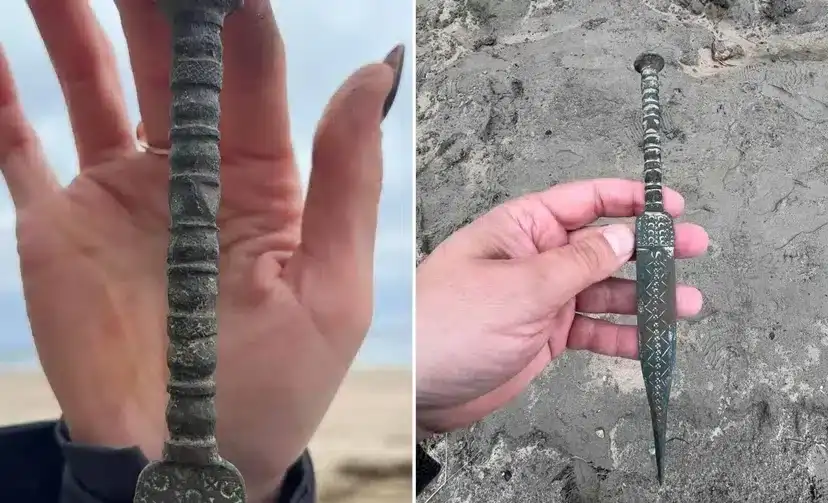
The unusual dagger was discovered on a rugged beach by the Baltic Sea, where a fragment of clay dislodged from an eroding cliff to reveal the artifact embedded within. According to Earth.com, a portion of the object was still visible inside the clay.
“The clay fragment broke away from a crumbling cliff and fell onto the sand, perfectly concealing the newly exposed artifact.”
Linking the Dagger to the Hallstatt Civilization
Specialists suspect the dagger is connected to the Hallstatt culture, which thrived across parts of Europe between the 8th and 5th centuries BCE.
Known for advanced metalworking and societal structure, the Hallstatt culture left behind artifacts rich in symbolism.
The dagger’s detailed ornamentation, showcasing delicate crescent and star patterns, hints at its possible ceremonial or spiritual importance.

Mr. Grzegorz Kurka from the Kamien Region Historical Museum remarked, “I have never encountered such a dagger in my experience with Polish archaeological finds.”
Examining the Craftsmanship of the Ancient Blade
Measuring approximately 24 centimeters in length, the dagger exhibits masterful workmanship. Its handle narrows seamlessly into a sharp blade adorned with motifs thought to symbolize early celestial or solar iconography.
Initial metallurgical studies suggest a carefully crafted alloy of copper and tin.
Scientists are preparing for a detailed metallurgical examination to better understand the dagger’s material composition and provenance. Jacek Ukowski, one of the finders, described the dagger as “my most treasured discovery.”
Weapon or Status Emblem?
The precise role of the dagger continues to be debated. Some experts view it as a functional weapon used by warriors, while others propose it served as a ceremonial item or a symbol of elite status during ancient gatherings.
Its intricate crescents and star decorations may point toward its use as a prestige object or religious emblem.
“Theories vary between seeing it as a combat tool and viewing it as a status symbol presented during rituals,” the article explained.
Natural Forces Uncovering Hidden Artifacts
Pomerania’s coastal region has long yielded archaeological treasures.
Shifting sands and powerful storms regularly expose a variety of historic relics, from ancient currency to ship remains.
Researchers highlight how natural disruptions have inadvertently opened new avenues for archaeological investigation.
Erosion caused by wind and water gradually reveals items buried for centuries, bringing them to light just before they risk damage or loss.
This phenomenon, sometimes called an “unintended excavation,” presents rare chances to recover and study artifacts that history had concealed.
- Categories:
- News











0 comments
Sign in to Comment