
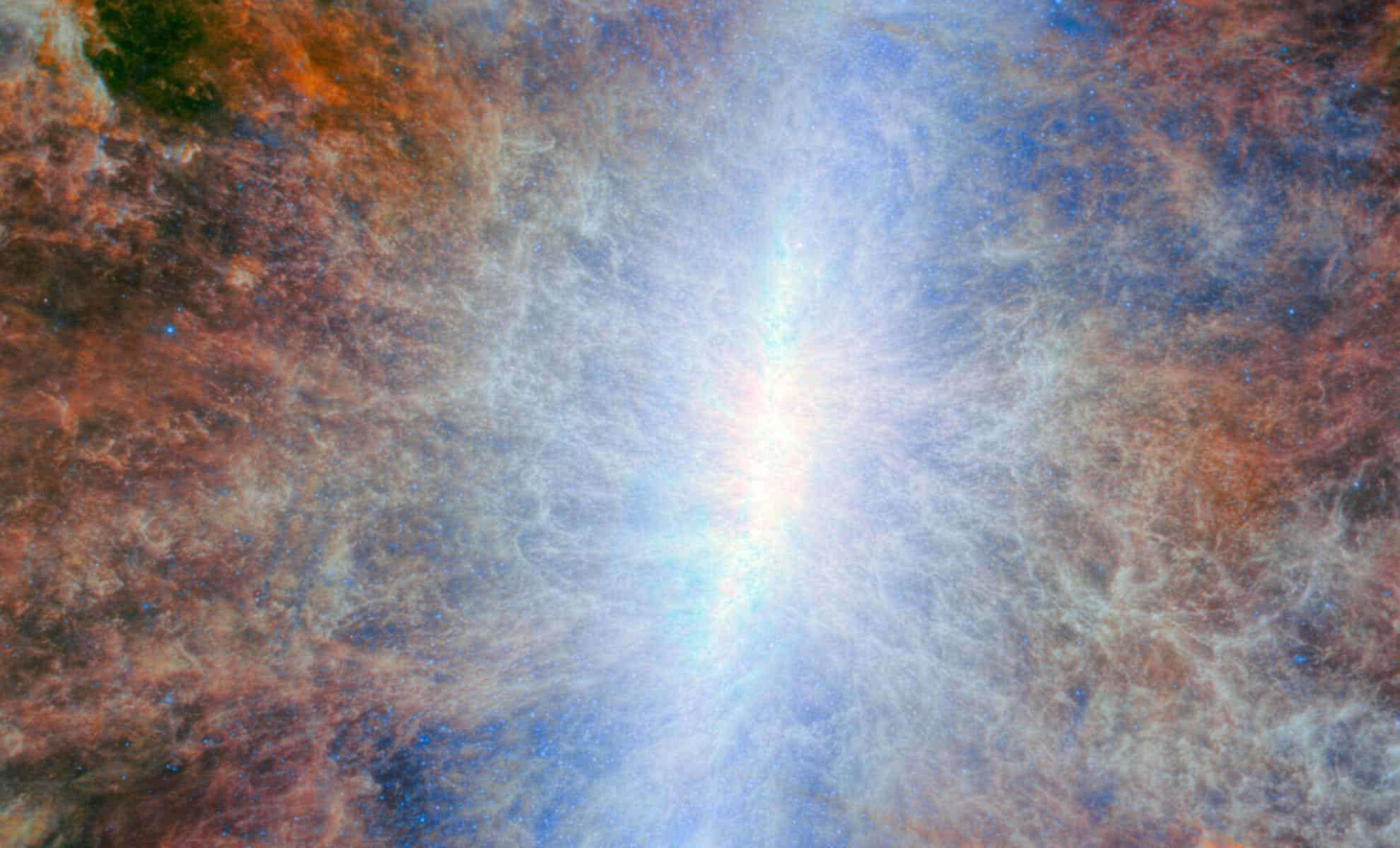
The James Webb Space Telescope (JWST) has once again provided remarkable insights into the cosmos by spotlighting the remarkable starburst activity within Messier 82 (M82), commonly called the Cigar Galaxy. Positioned approximately 12 million light-years away in the Ursa Major constellation, this galaxy showcases an intense star-forming environment. Utilizing Webb’s advanced infrared capabilities, astronomers have gained an unprecedented view of M82’s intricate star formation processes and how the galaxy is evolving. The observations, released by the European Space Agency (ESA), reveal the previously obscured core of the galaxy, hidden behind dense clouds of dust and gas for decades.
M82: A Starburst Galaxy Surpassing All Expectations
Messier 82 is smaller than our own Milky Way but stands out as a luminous star-producing powerhouse. It shines with about five times the brightness of the Milky Way and forms new stars at an astounding rate roughly ten times greater. This intense activity classifies M82 as a classic “starburst galaxy,” distinguished by its exceptional star formation speed compared to typical galaxies.
M82’s unique environment is further shaped by its gravitational relationship with the neighboring large spiral galaxy, Messier 81 (M81). The gravitational pull from M81 likely channeled substantial gas towards M82’s center millions of years ago, fueling the galaxy’s rapid star creation. Today, M82’s core continues to produce stars at an energetic pace, but the consequences of this frenzy could eventually alter its development.

Infrared Observations Peel Back Layers of Dust
Previous visual light observations of M82 revealed dense gas and dust veiling the central region of active star formation, but Webb’s Mid-InfraRed Instrument (MIRI) cuts through this cosmic fog. MIRI’s infrared eyes expose a star-scarce yet complex scene dominated by thermal emissions from warm dust and polycyclic aromatic hydrocarbons (PAHs). These molecules, abundant in star-forming clouds, trace outflowing gas being pushed by the powerful winds from young, hot stars.
The emissions from PAH molecules offer key insights into the energetic processes driving M82’s evolution. The outflows, energized by the intense radiation and stellar winds from super star clusters at M82’s core, significantly influence the star formation cycle. Yet these stellar gusts might also bring about the eventual cease of the starburst phase by expelling the cool gas necessary for future star birth.
Impact of Super Star Clusters on M82’s Starburst Life
Central to M82’s vigorous star formation are the super star clusters—dense and massive groupings containing roughly 100,000 stars each. These extraordinary clusters outshine typical star clusters and are fundamental drivers of new star creation in the galaxy. M82 hosts over 100 such clusters, several of which are still emerging.
Nevertheless, the strong galactic winds generated by these super star clusters are actively removing star-forming gas from the central region. This depletion of cool material could signal a reduction in M82’s starburst intensity, potentially marking the onset of a slowdown in its star-forming vigor. While star formation will continue, the prolific pace that characterizes M82 today is likely to diminish, shifting the galaxy’s overall evolutionary path.
- Categories:
- News




0 comments
Sign in to Comment