
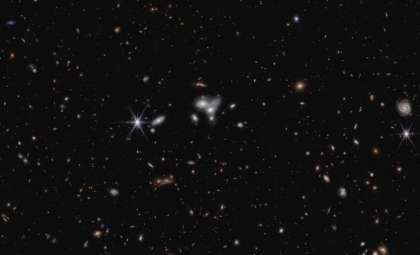
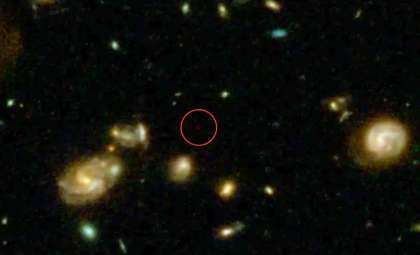
Scientists have identified one of the oldest and most intricate galaxy collisions ever recorded—a group of at least five physically connected galaxies seen just 800 million years after the Big Bang. This finding, derived from combined data gathered by the James Webb Space Telescope (JWST) and the Hubble Space Telescope, was published in Nature Astronomy.
An Unprecedented Galactic Encounter
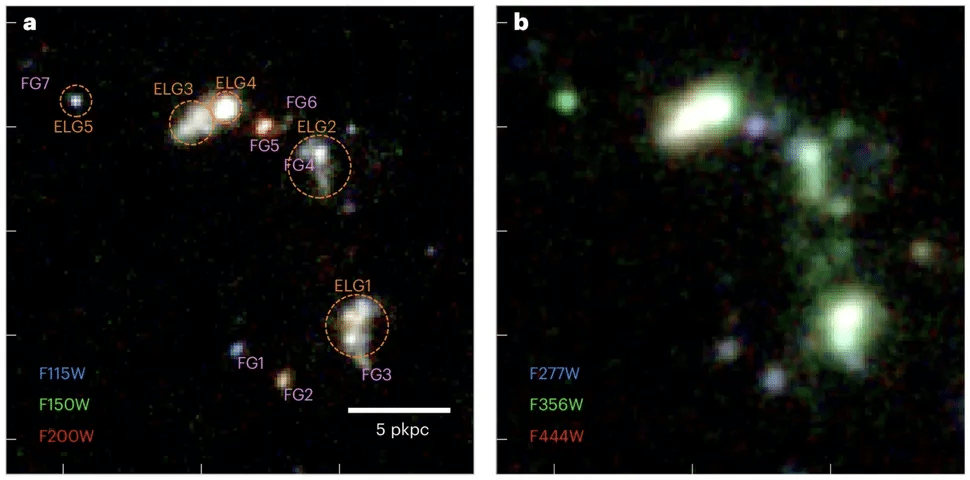
Galaxy mergers are fairly common in the early universe, but they nearly always involve only two galaxies. JWST’s newly identified system, however, defies that norm. It features five separate galaxies alongside 17 individual galaxy clumps, reflecting a tumultuous and active interaction within the cluster. Utilizing JWST’s Near-Infrared Camera (NIRCam), researchers detected a shared gas halo that envelops all five galaxies, signaling that they are bound together by gravity rather than being a coincidental alignment.
“Finding such a system with five physically linked galaxies is exceptionally rare, both in current simulations and in observations,” said study lead author Weida Hu, a postdoctoral researcher at Texas A&M University. “The probability of detecting even one [multiple-galaxy merger] is quite low, which raises the possibility that we may have been ‘lucky’ in identifying this system so early,” Hu told Live Science in an email.
Add Cosmo Herald as a Preferred Source

Located during a period when the cosmos was just starting to take shape, the galaxies’ close arrangement strongly implies they are in the process of merging, potentially forming one of the earliest large galactic structures.
Placing the Collision in the Cosmic Timeline
At merely 800 million years after the Big Bang, the universe was in a formative phase, making the discovery of such a substantial galaxy merger extraordinary. Current models rarely show multi-galaxy mergers at this nascent stage. JWST’s superior sensitivity and imaging capabilities surpassed those of the earlier Hubble Space Telescope, allowing this breakthrough.
While some of these galaxies were previously detected by Hubble, it was JWST’s redshift analysis that confirmed their physical association. Their matching redshifts verify they reside at the same distance, ruling out chance alignment.
“If you look at all galaxies, then 20-30% of them will be in a merger. This will be just two galaxies. The fraction of these multiple merger systems will be much, much lower, and we don’t have stats on it quite yet, but certainly lower than 1%,” said Christopher Conselice, professor of extragalactic astronomy at the University of Manchester.
Measurements indicate the two central galaxies are separated by roughly 43,300 light-years, and the most distant pair lies about 60,700 light-years apart—distances small enough to suggest they will coalesce. To put this in perspective, the Milky Way has a diameter of just under 100,000 light-years.
“The fact that the galaxies are spatially close together is the indication that they probably will merge,” Conselice added. “There is some room for interpretation regarding whether some objects might be parts of the same galaxy.”
Connecting Gas Filaments and Intense Starburst Activity
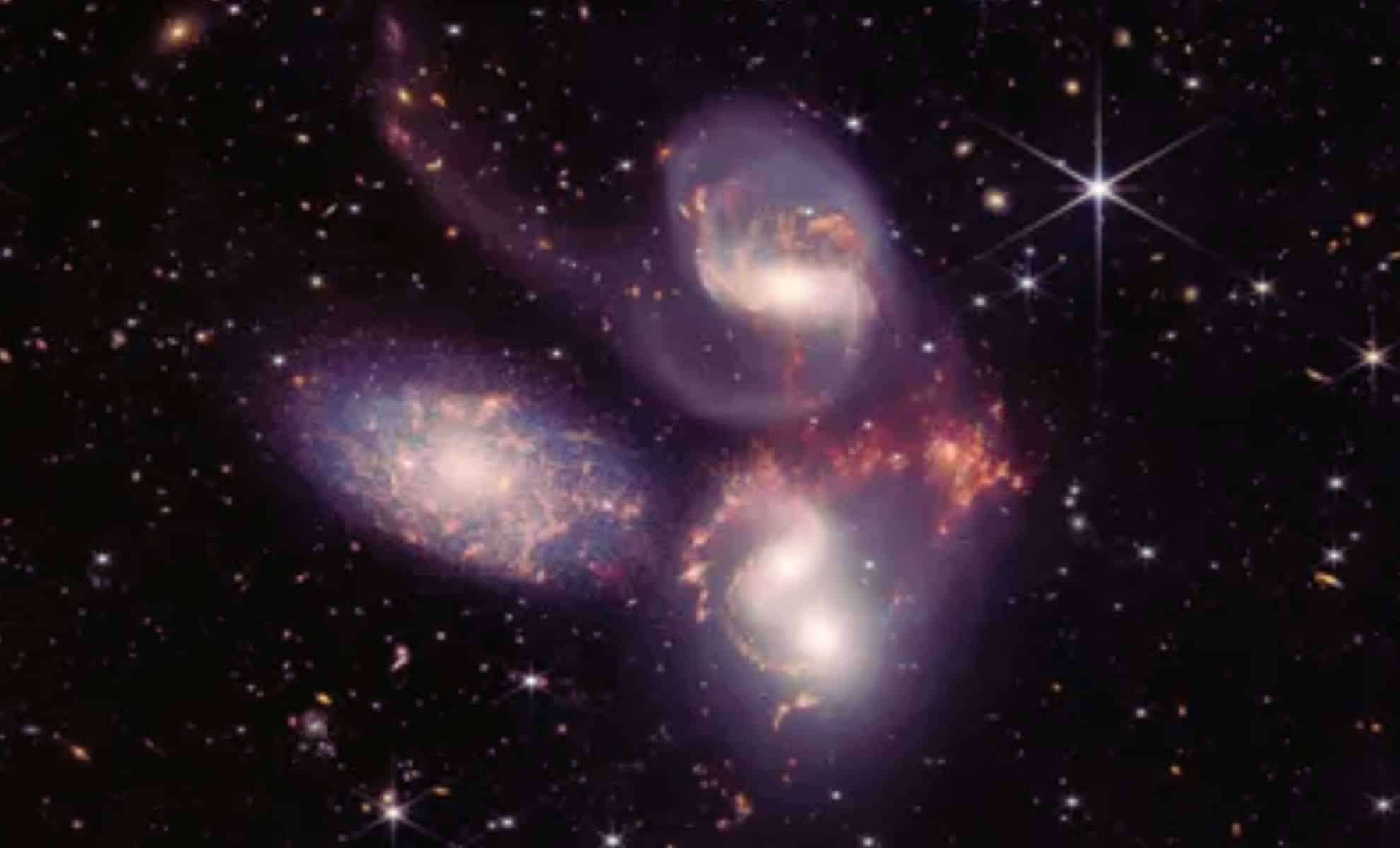
The arrangement of JWST’s Quintet resembles that of a more nearby group known as Stephan’s Quintet. Both show material bridges linking the galaxies—features identified as tidal tails shaped by gravitational forces during galactic interactions. Such structures are rarely observed with this level of clarity in distant, early-universe clusters.
“A striking similarity is the presence of a bridge of material connecting two galaxies in JWST’s Quintet — a feature also seen in Stephan’s Quintet, indicative of tidal tails produced by the galaxy interaction,” Hu said. “However, the star formation rate of JWST’s Quintet is much higher.”
The heightened rate of star formation is probably fueled by the plentiful flow of cold gas inside these youthful galaxies. As the group merges, gas is compressed, sparking intense starbursts. The study suggests JWST’s Quintet may eventually evolve into a quiescent galaxy, ceasing star formation within the next 1 to 1.5 billion years. Its combined stellar mass is already near 10 billion solar masses, hinting it could mature into a significant early-universe elliptical galaxy.
Insights Into Early Galaxy Evolution and Star Formation Shutoff
This remarkable find sheds light on the origins of quiescent galaxies—massive galaxies that ended star formation surprisingly early in cosmic history. JWST has previously detected such inactive galaxies, posing questions about mechanisms responsible for this premature star formation shutdown.
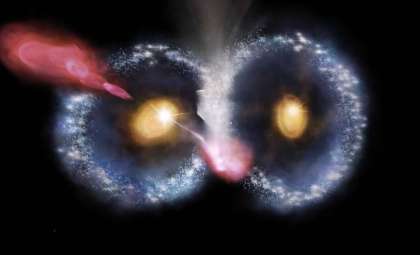
One hypothesis proposes that these dramatic early mergers might activate active galactic nuclei (AGN)—supermassive black holes at galaxy centers that release energy powerful enough to disrupt the gas supply and halt further star formation. Although this study has yet to confirm AGN presence in JWST’s Quintet, upcoming multi-wavelength observations will seek to explore this possibility.
The researchers emphasize that spectroscopic observations, beyond imaging alone, will be essential to precisely measure the metal content, gas dynamics, and overall characteristics of this intricate merger. These details will determine if JWST’s Quintet is an outlier or part of a wider population missed until now.
- Categories:
- News

0 comments
Sign in to Comment