

The James Webb Space Telescope has provided a remarkable view of atmospheric phenomena occurring on a rogue planet located 20 light-years away from Earth. Known as SIMP 0136, this enigmatic brown dwarf showcases swirling storms and molten iron clouds that surpass the intensity of even Jupiter’s wildest weather.
Researchers have gained an unprecedented window into the meteorological dynamics of SIMP 0136, an object straddling the line between planet and star with a mass approximately 13 times that of Jupiter. This discovery sheds light on atmospheric processes in celestial bodies that defy traditional categorization. The findings, published in The Astrophysical Journal, highlight the power of JWST to probe the weather of starless, planet-like bodies.
What Makes SIMP 0136 Unique?
Described by Roman Akhmetshyn, an astronomer at McGill University, SIMP 0136 is classified as a brown dwarf. It has too little mass to generate sustained nuclear fusion like a star but is far heftier than a typical planet. Free-floating in space without orbiting a star, SIMP 0136 has a faint intrinsic glow that allows scientists to study its atmospheric characteristics without stellar interference.

Because brown dwarfs such as SIMP 0136 roam independently of stars, they offer a rare chance to examine atmospheric behavior in isolation. Equipped with the James Webb Space Telescope, researchers have obtained direct observations of its climate that are unimpeded by the light of a nearby sun.
Decoding SIMP 0136’s Stormy Skies
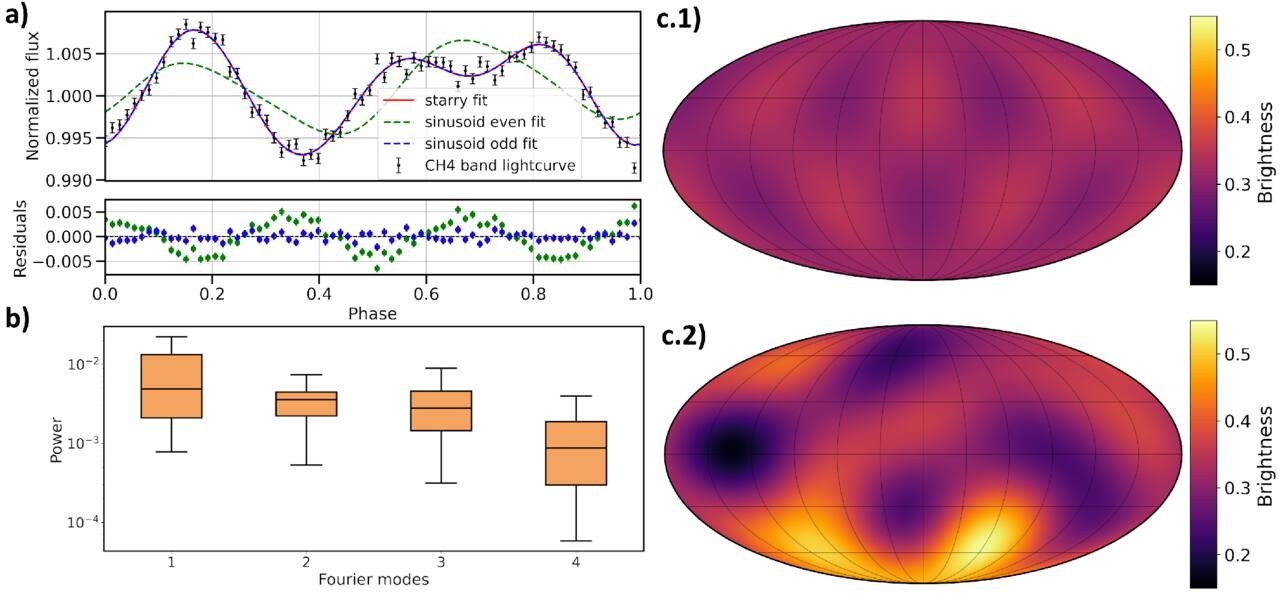
Employing the Near-Infrared Imager and Slitless Spectrograph (NIRISS), scientists monitored SIMP 0136 as it completed its rapid rotation—only 2.4 hours per spin. This revealed a remarkably dynamic atmosphere structured in at least three distinct layers. Deep within, molten iron clouds form, while the upper reaches feature grains of forsterite, a mineral that is also a component of Earth’s mantle.
As Akhmetshyn explains, SIMP 0136’s atmosphere is far from static. The cloud formations shift continuously, accompanied by pronounced temperature shifts and chemical diversity.
“We suspect numerous small-scale patchy clouds of different temperatures and chemistry, scattered across the globe.”
The upper atmospheric layers contain carbon monoxide and water vapor, while the deeper layers reach searing temperatures between 1,000 and 1,300 Kelvin, indicating an ever-changing meteorological state.
Irregular Weather Beyond Familiar Patterns
Contrasting with the symmetrical meteorology found on Earth or Jupiter, SIMP 0136’s northern and southern hemispheres display major disparities in cloud and chemical layouts. This asymmetry hints at the presence of jet streams, cyclonic vortices, or potentially banded atmospheric systems similar to those on Jupiter but operating on a far more turbulent scale.
Advanced analytical methods, including principal component analysis, revealed that no single model can fully capture the weather patterns on SIMP 0136. Instead, diverse models are required, pointing to an extraordinary level of atmospheric complexity and chaos.
- Categories:
- Space





0 comments
Sign in to Comment