
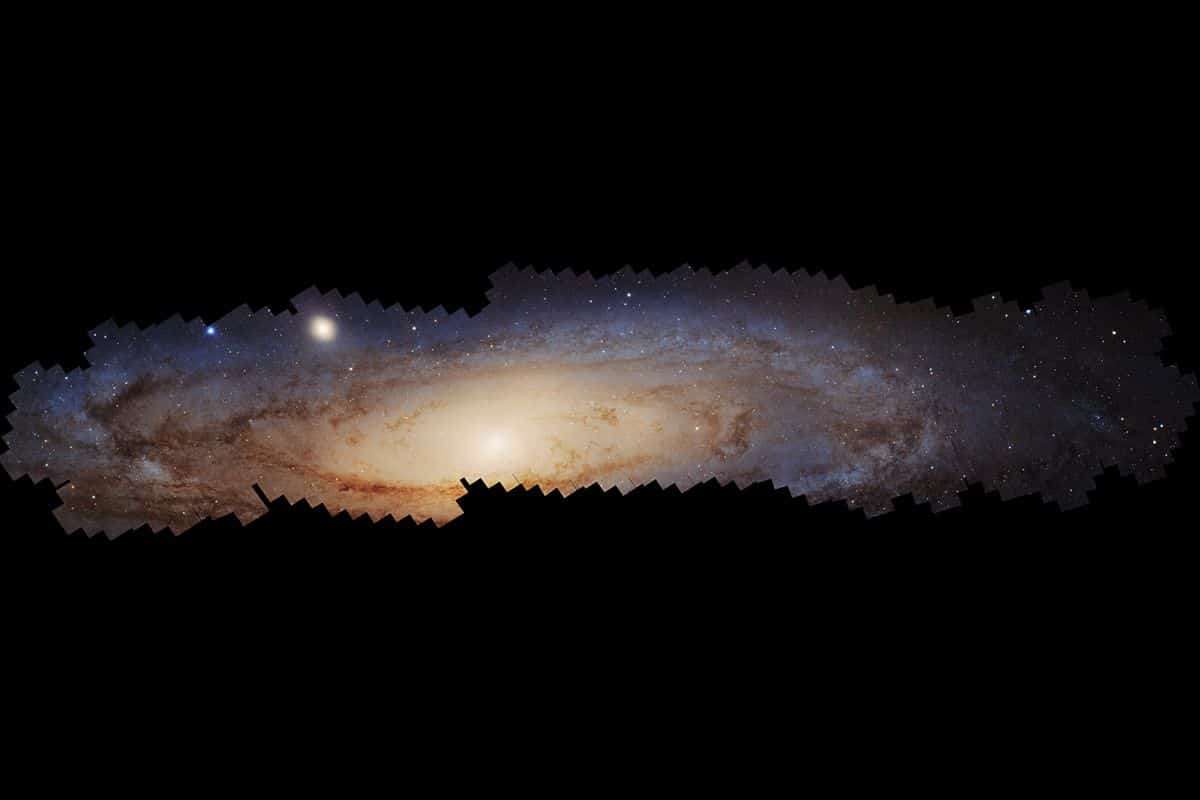
The Andromeda galaxy, our nearest major galactic neighbor, exhibits far more dynamic and disorderly behavior than scientists had anticipated. Utilizing fresh observations from the Hubble Space Telescope, astronomers have charted the tumultuous evolution of Andromeda’s surrounding dwarf galaxies, uncovering unexpected motion patterns and puzzling stellar phenomena.
Galactic Evolution Marked by Turbulence
Traditionally, astronomers have leaned on the Milky Way as a model for understanding how galaxies evolve. However, new Hubble observations reveal that Andromeda’s satellites display a far more complex and chaotic lineage, suggesting each galactic system evolves under distinct conditions.
In contrast to the more orderly Milky Way satellite groupings, Andromeda’s smaller companions appear to have experienced violent encounters throughout their histories, resembling a long-lasting cosmic collision course.

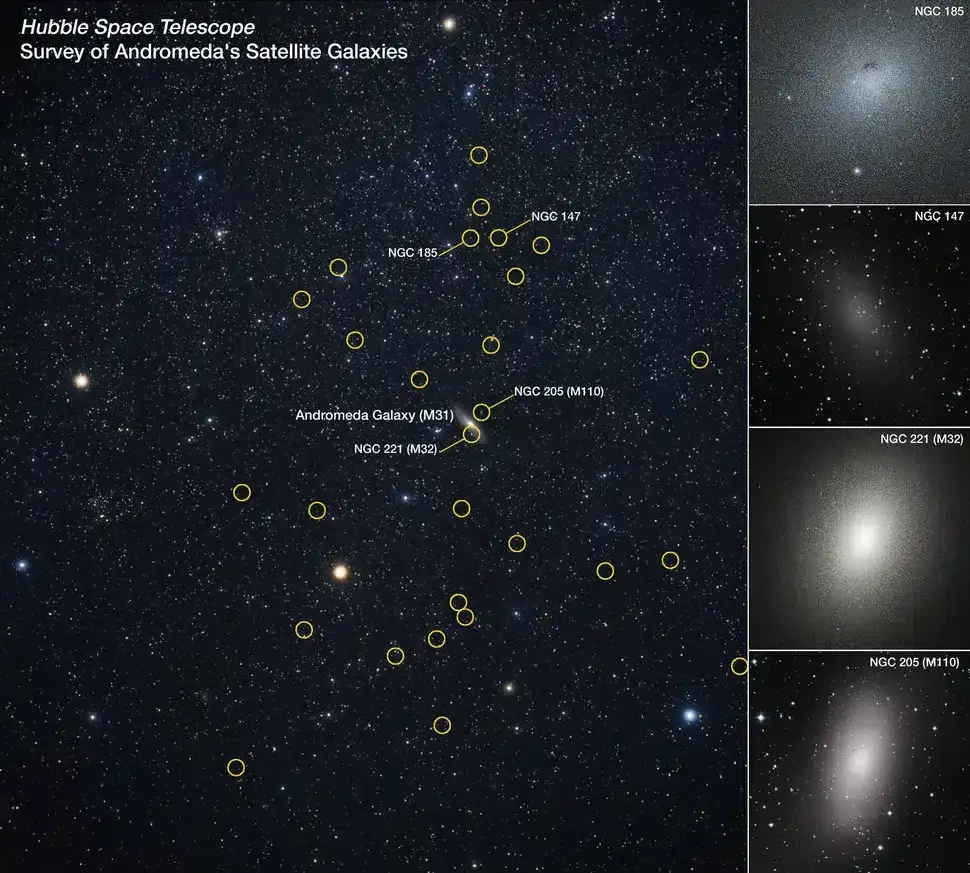
Published in The Astrophysical Journal, the study examined 36 dwarf galaxies orbiting Andromeda, constructing the first-ever three-dimensional map of this galactic environment. Findings hint at a massive merger event in Andromeda’s past, possibly involving a now-absorbed galaxy occurring several billion years ago.
This merger could explain the irregular movements seen in its satellite galaxies—an arrangement unlike anything in the Milky Way’s orbiting companions.
Unveiling Andromeda’s Hidden Past
Located roughly 2.5 million light-years away, Andromeda is the closest major galaxy neighbor to us. While it appears as a faint, elongated glow to the unaided eye, this visual doesn’t capture the multitude of dwarf galaxies orbiting it—akin to miniature moons circling a planet.
Beginning in 2019, the Hubble mission began mapping 36 Andromeda dwarf galaxies, documenting their positions, trajectories, and internal features. The resulting 3D mapping offers unprecedented insight into galactic motion spanning the past 14 billion years.
The analysis revealed stark contrasts to the Milky Way’s satellites. Andromeda’s surrounding dwarf galaxies are arranged haphazardly and asymmetrically, clear indicators of a dramatic and chaotic history.
Evidence of a Significant Galactic Clash
The research team proposes that Andromeda experienced a colossal galactic merger a few billion years in the past. A probable remnant of this collision is Messier 32 (M32), a prominent satellite of Andromeda.
Such an intense encounter would have significantly disturbed the orbits of the galaxy’s smaller companions, accounting for their irregular trajectories. This highlights how Andromeda’s evolutionary path contrasts strongly with the Milky Way’s comparatively stable development.
Daniel Weisz, co-author and University of California researcher, emphasized that these observations disrupt long-held assumptions that the Milky Way’s characteristics apply broadly across other galaxies.
“Our work has shown that low-mass galaxies in other ecosystems have followed different evolutionary paths than what we know from the Milky Way satellite galaxies,” he said.
The Enigma of Andromeda’s Galactic Plane
A particularly striking finding is that nearly half of Andromeda’s dwarf galaxies align in a thin, disk-like plane, all moving synchronously. This arrangement, termed the Great Plane of Andromeda, has no counterpart among the Milky Way’s satellites.
As lead researcher Alessandro Savino remarked, this alignment “doesn’t appear in computer simulations.” Despite extensive theoretical efforts, astronomers are still stumped about what mechanism organized these galaxies in such an unusual configuration.
Adding to the mystery, several of Andromeda’s dwarf galaxies continue forming stars billions of years longer than expected. Given Andromeda’s strong gravitational forces, these small galaxies should have lost their star-forming gas long ago, yet they show ongoing stellar birth.
Looking Ahead to the Milky Way-Andromeda Merger
Our own Milky Way is destined to collide and merge with Andromeda in roughly 5 billion years. The turbulent conditions unveiled in Andromeda today could foreshadow the future upheaval awaiting our galaxy. The chaos in Andromeda’s past provides a preview of how dramatically the Milky Way might be transformed by this impending cosmic encounter.
- Categories:
- Space




0 comments
Sign in to Comment