

The James Webb Space Telescope has uncovered a puzzling infrared absorption feature observed on both Pluto and Saturn’s moon Titan, hinting at the existence of a previously undetected molecule in our solar system, according to a recent study shared on arXiv.
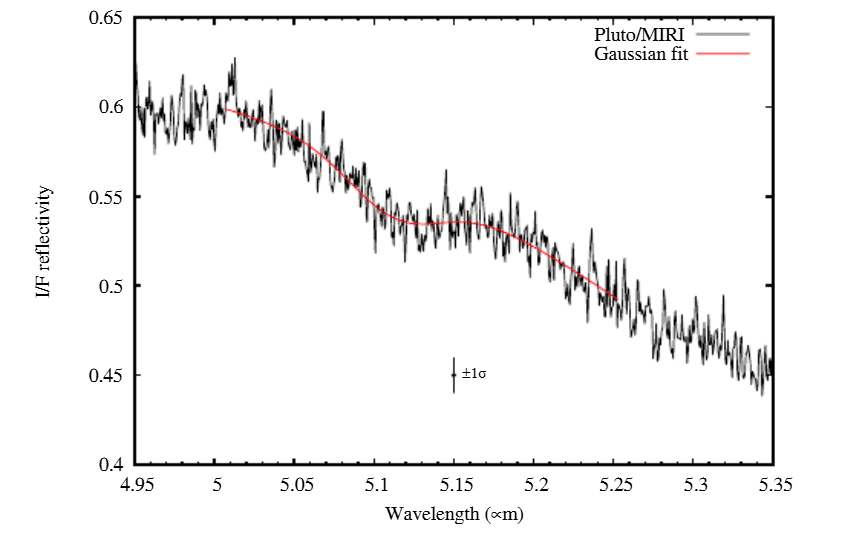
This discovery arose from examining rarely studied infrared wavelengths. By comparing the spectral data from Pluto and Titan, scientists noticed a unique absorption at about 5.11 micrometers, an elusive signature not matching any documented molecular fingerprints in current planetary spectra.
What makes this finding especially intriguing is that despite Pluto and Titan’s stark differences, both possess atmospheres dominated by methane and nitrogen. Researchers suggest that the mysterious absorption likely originates from surface materials, rather than their atmospheric gases, adding complexity to the enigma.

Distinctive Spectral Feature Unmatched by Existing Records
Astronomers decode the chemical makeup of celestial bodies through the absorption of electromagnetic radiation. Various atoms and molecules absorb light at specific wavelengths, creating unique absorption patterns that act as chemical identifiers.
In the paper posted on arXiv on June 11, the team analyzed James Webb’s infrared observations of Pluto and Titan. They detected a clearly defined absorption line around 5.11 micrometers in data from both bodies.
The scientists then cross-referenced this feature with known planetary spectral databases. The paper says:
they “did not find any band referenced in these publications that corresponds to the location of the observed absorption in Titan and Pluto.”
This means the detected spectral signature doesn’t align with any known compounds identified in our solar system or observed exoplanets. Previously, Webb has successfully determined chemical compositions of exoplanet atmospheres and distant galaxies by analyzing light spectra. Now, it has revealed an unexpected molecular mystery much closer to home.
Unexpected Shared Trait Between Pluto and Titan
The find is surprising given the significant differences between Pluto and Titan. Titan, Saturn’s largest satellite, is bigger than Mercury and uniquely hosts liquid bodies on its surface similar to Earth. Pluto, in contrast, is a small icy dwarf planet orbiting much farther from the Sun—roughly four times the distance of Titan.
Despite these differences, both have atmospheres rich in methane and nitrogen. The researchers report that the new infrared feature seems to come from their surfaces, not the atmosphere.
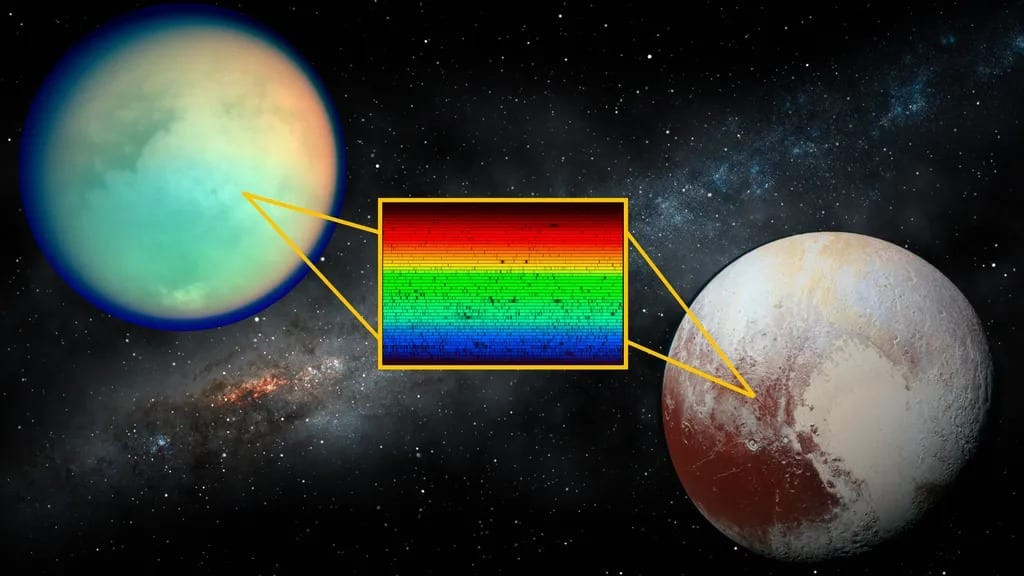
The absorption signature is roughly thrice as strong on Pluto compared to Titan, implying the unknown substance is abundant there. On Titan, this feature shows uneven distribution, being more pronounced on its trailing hemisphere as it orbits Saturn, rather than evenly spread.
Researchers Explore Multiple Hypotheses
The exact molecule behind this absorption remains a puzzle. Scientists have proposed candidates including benzene mixed with another unidentified molecule, acetylene ice, or ketene ice, but none have been definitively confirmed. Further study is essential to verify these ideas.
The study also points to a future chance to investigate the mystery more closely. NASA’s Dragonfly mission, planned for launch no earlier than 2028 with Titan atmospheric explorations scheduled for 2034, will carry instruments able to analyze surface compositions in detail.
Data returned by Dragonfly may unlock the identity of this unknown molecule on Titan and clarify whether Pluto hosts the same compound. However, the 5.11-micrometer infrared feature remains unexplained, as no known substance has been linked to it yet.
- Categories:
- Science












0 comments
Sign in to Comment