

Researchers employing the James Webb Space Telescope (JWST) have reported two remarkable discoveries: compelling signs pointing to a potential Saturn-sized exoplanet in orbit around Alpha Centauri A, our nearest sun-like star, alongside the identification of an unprecedented climate mechanism on Pluto. The Alpha Centauri observations are documented in two articles published in The Astrophysical Journal Letters, whereas the findings regarding Pluto appear in Nature Astronomy.
A Massive Planet Candidate Near Alpha Centauri
NASA explains that Alpha Centauri, a system only 4 light-years from Earth and composed of two sunlike stars — Alpha Centauri A and Alpha Centauri B — plus the red dwarf Proxima Centauri known to host planets, has long been a prime subject for exoplanet hunting.
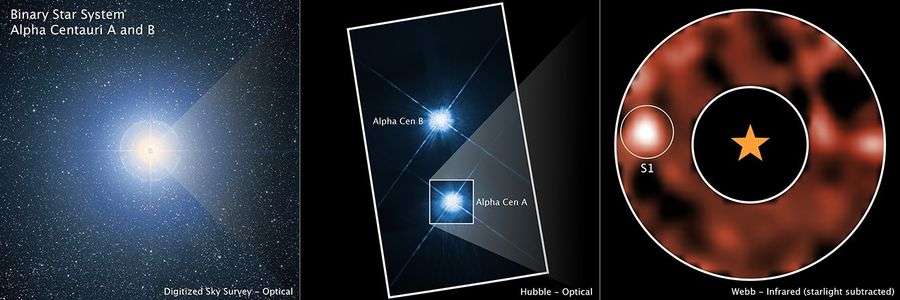
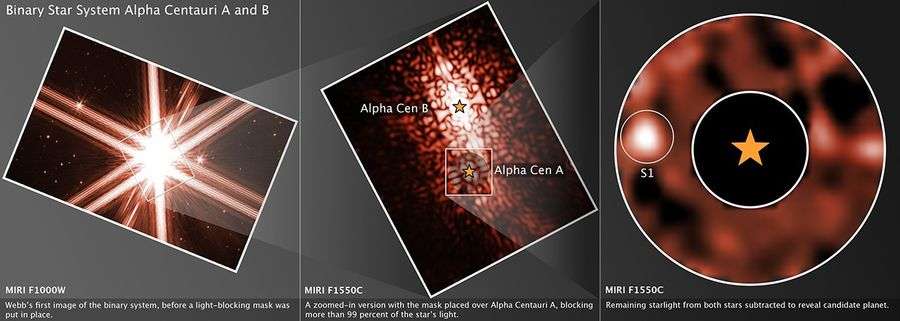
In August 2024, JWST’s Mid-Infrared Instrument (MIRI) identified a faint source located roughly two astronomical units from Alpha Centauri A, about twice the distance between Earth and the Sun. This object’s brightness is over 10,000 times dimmer than the star it circles and suggests the presence of a gas giant with a mass comparable to Saturn, traveling on an elliptical orbit.

Overcoming Obstacles in Alpha Centauri Observation
Studying Alpha Centauri poses challenges because of its closely spaced, bright stars that rapidly change position. To isolate the faint planet, the JWST team developed a special coronagraphic technique to block stellar glare. However, follow-up imaging in early 2025 did not detect the object again, leading scientists to simulate millions of possible orbital paths.
The analysis suggests that in about half of these scenarios, the planet would have been too close to the star during subsequent observations to be visible to JWST. If verified, this discovery would represent the nearest exoplanet directly observed orbiting a star and the closest identified planet lying within a sun-like star’s habitable zone. Although, as a gas giant, it would be unlikely to support life.
Pluto’s Climate Driven by Upper-Atmosphere Haze
In a separate revelation, the JWST team uncovered that Pluto’s atmospheric conditions are dominated not by its thin nitrogen-methane atmosphere, but by a high-altitude haze layer that acts like a planetary thermostat. This haze extends up to 200 kilometers (125 miles) above Pluto’s surface and contains organic particles similar to those found on Titan, coated in thin layers of hydrocarbon and nitrile ices.
The haze absorbs solar radiation by day and releases infrared energy at night, which cools the atmosphere more efficiently than gaseous components alone. This creates a stable but ultra-chilly upper atmosphere, maintaining temperatures near -202°C (-333°F), about 30 degrees colder than previous models predicted when only atmospheric gases were considered.
During 2022, JWST’s MIRI instrument was able to distinctly pick out the faint thermal emission from Pluto separately from its moon Charon, confirming the haze is responsible for the additional infrared radiation.
Broader Consequences for Planetary Science
Similar haze-related climate effects could be present on bodies like Triton and Titan, and these findings may refine our understanding of hazy exoplanet atmospheres. Moreover, such haze layers might have played a role in Earth's primordial climate by moderating temperatures and shielding early life forms from harmful ultraviolet radiation.
These dual discoveries showcase JWST’s remarkable ability to capture both a distant, faint planetary candidate within our stellar neighborhood and delicate thermal characteristics of a chilly dwarf planet’s atmosphere.
Should the Alpha Centauri planet’s existence be confirmed, it will pave the way for future investigations, including by the forthcoming Nancy Grace Roman Space Telescope. Meanwhile, understanding Pluto’s haze mechanism could fundamentally alter atmospheric models and inform assessments of habitabilities on worlds near and far.
- Categories:
- News













0 comments
Sign in to Comment