
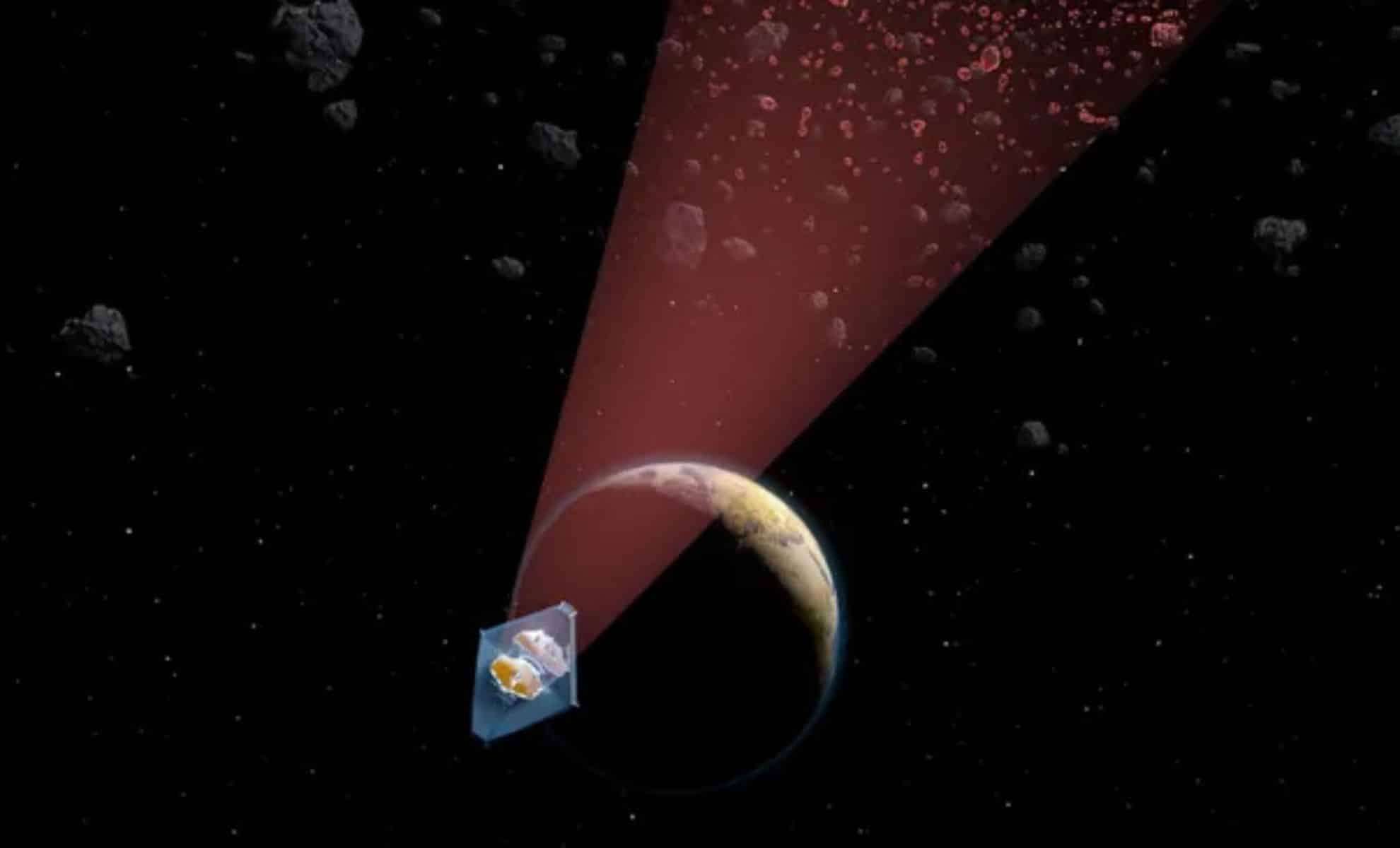
The James Webb Space Telescope (JWST) has detected a previously unknown group of more than 100 asteroids in the main asteroid belt, the region between Mars and Jupiter. Notably, several of these asteroids follow paths that bring them perilously close to Earth, highlighting the importance of enhanced asteroid monitoring for planetary protection. This significant finding showcases how novel analysis techniques of JWST’s data are revolutionizing our view of the solar system.
Smallest Asteroids Identified to Date
The newly spotted asteroids range from the size of a bus to that of large stadiums. These decameter-scale bodies rank among the tiniest ever found within the main asteroid belt. By utilizing its high-sensitivity infrared instruments, the JWST detected these objects by capturing their heat signatures, which are often more detectable than their dim reflected sunlight that traditional telescopes rely upon.
Main Points of the Discovery:
- Size Range: Between 10 and several hundred meters.
- Location: Situated in the main asteroid belt between Mars and Jupiter.
- Detection Technique: Identification through thermal infrared emissions analyzed with sophisticated computational tools.
- Earth Threat: Six asteroids influenced by gravitational forces are on orbits approaching Earth’s vicinity.
“Thanks to advanced technologies, we have entered an entirely new observational frontier,” stated Artem Burdanov, a principal investigator at MIT. “Reimagining how we analyze data can yield remarkable discoveries, and this is a perfect example of that.”

Assessing the Risks Posed by Asteroids
Though these recently discovered asteroids are much smaller than the 10-kilometer object linked to the dinosaurs’ extinction event, they still pose considerable risks. Even smaller asteroids can deliver powerful impacts. In 2013, a 20-meter asteroid detonated over Chelyabinsk, Russia, releasing energy comparable to 30 atomic bombs and injuring more than 1,000 people.
Smaller asteroids occur far more frequently. They strike Earth thousands of times more often than their larger counterparts, yet their diminutive size and faint appearance make them extremely challenging to monitor.
“We now can detect these smaller bodies from much farther away, allowing for more accurate orbit tracking, which is vital for Earth’s defense,” Burdanov added.
Why It Matters for Earth’s Safety:
Cutting-Edge Techniques Propel the Find
The team employed a computationally intensive analysis, combining and stacking JWST’s archival images to enhance faint signals from fast-moving small objects. Applying this approach to data from the TRAPPIST-1 star system, located 40 light-years from Earth, allowed them to uncover 138 decameter-scale asteroids, including eight that were already known.
This method overcomes the shortcomings of conventional asteroid detection. By harnessing powerful graphics processing units (GPUs) alongside novel algorithms, researchers made possible the spotting of faint asteroids with previously unknown orbits.
“We expected just a few new discoveries, but found many more — especially small ones,” said Julien de Wit, MIT planetary science associate professor. “This indicates we are exploring an unseen population of asteroids.”
What Lies Ahead for Asteroid Monitoring
This discovery marks only the start. JWST’s pioneering observations pave the way for deeper exploration of the solar system’s small, hidden bodies. Planned JWST missions aim to dedicate 500 hours to identifying similar asteroids, potentially revealing thousands of additional objects. Moreover, the future Vera C. Rubin Observatory in Chile will significantly boost asteroid cataloging, employing the world’s largest digital camera.
The Rubin Observatory’s regular surveys of the southern sky are expected to discover up to 2.4 million asteroids in just half a year—nearly doubling the known asteroid population. Together, these endeavors will enhance our grasp of Earth’s cosmic environment.
Enhancing Earth's Planetary Defense
Detecting smaller asteroids well ahead of their Earth encounters revolutionizes planetary defense efforts. Early tracking makes it easier for scientists to accurately project asteroid paths and prepare potential countermeasures.
“This breakthrough highlights how cutting-edge technology combined with creative analysis can revolutionize our approach,” said Burdanov. “We’re finally closing the gap on tracking dangerous small space objects.”
Steps Toward Stronger Planetary Protection:
- Early Identification: Spotting small asteroids before they near Earth.
- Better Orbit Prediction: Mapping precise trajectories to evaluate threats.
- Mitigation Plans: Developing strategies for deflection or evacuation.
Towards a Safer Cosmic Neighborhood
Discovering this hidden asteroid population via the JWST highlights how modern astronomy tools are rewriting our comprehension of the solar system while directly aiding planetary protection. By revealing elusive space rocks, researchers not only solve scientific mysteries but also enhance Earth’s safety.
With JWST’s leadership and the Rubin Observatory’s upcoming contributions, humanity is entering a new era of asteroid detection and defense.
- Categories:
- News








0 comments
Sign in to Comment