
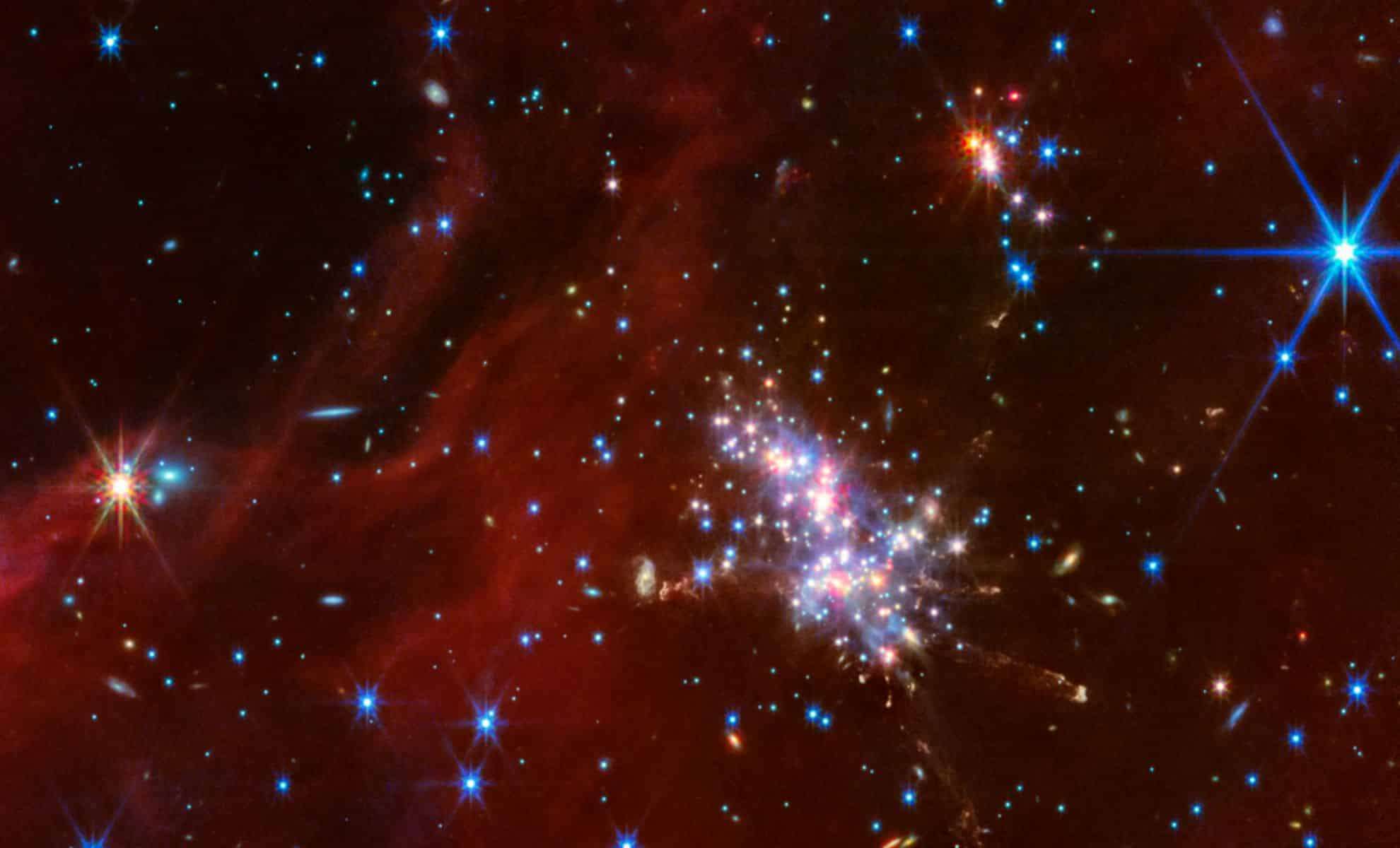
The James Webb Space Telescope has delivered groundbreaking views of star formation within the distant outskirts of our galaxy, known as the Extreme Outer Galaxy.
Situated over 58,000 light-years from the center of the Milky Way, this remote area provides a unique window into conditions resembling those of the galaxy’s earliest evolutionary stages.
Investigating the Digel Molecular Clouds
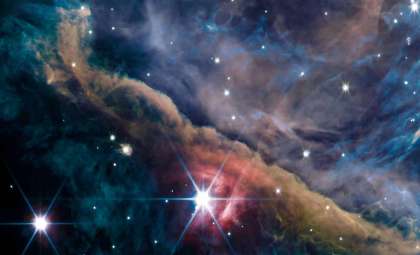
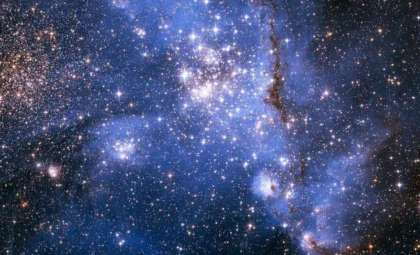
Recent Webb observations targeted two colossal molecular clouds, Digel Clouds 1 and 2, which harbor clusters of stars actively undergoing formation. These clouds feature low levels of elements beyond hydrogen and helium, bearing chemical similarities to dwarf galaxies and the ancient Milky Way. Utilizing the Near-Infrared Camera (NIRCam) and the Mid-Infrared Instrument (MIRI), astronomers were able to penetrate these dense regions, uncovering star clusters in stunning detail.

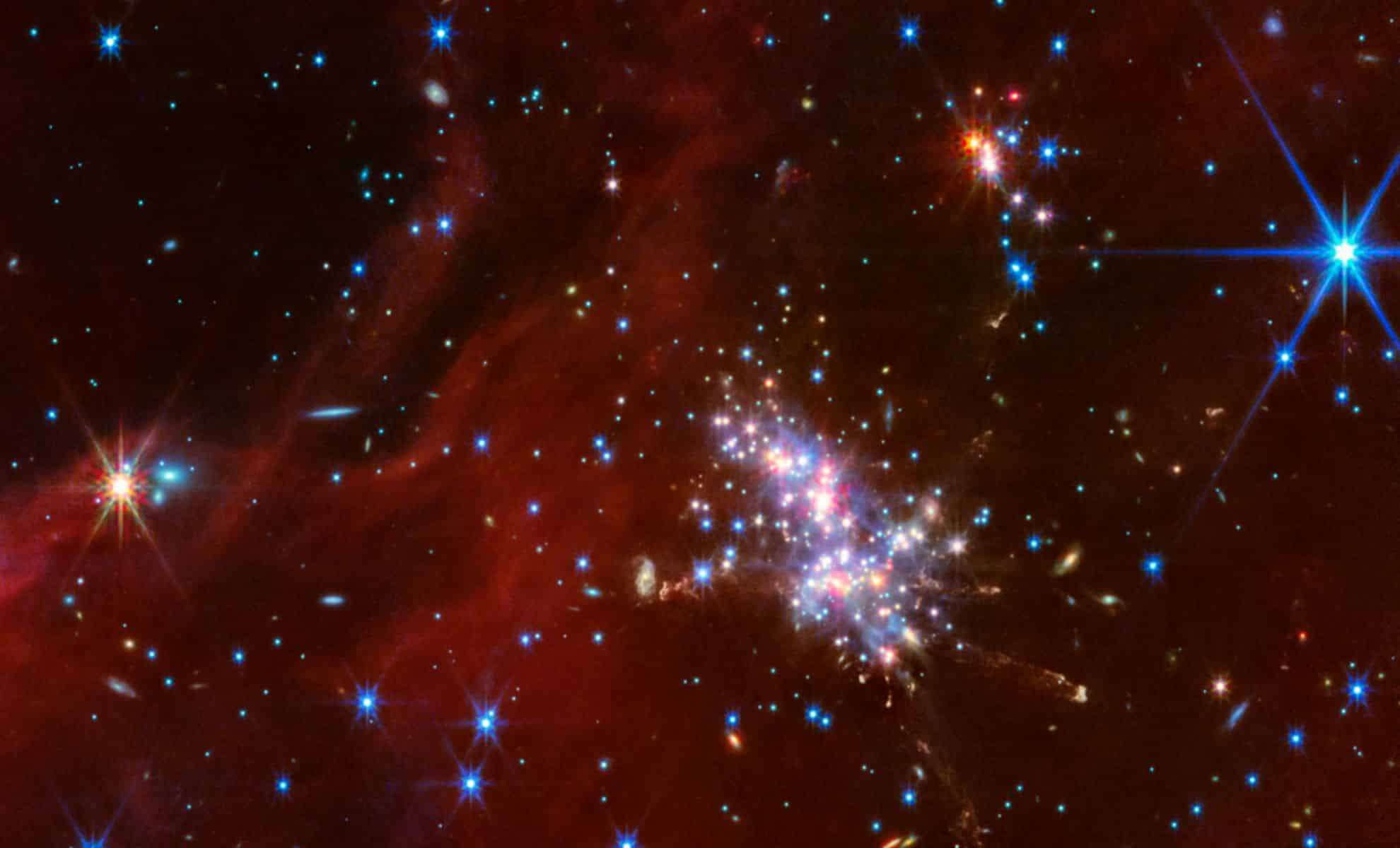
Among the clusters observed, Digel Cloud 2S revealed a particularly dense grouping of newborn stars ejecting jets of matter along their axes. This jetting process, a signature of early stellar formation, was captured with unparalleled clarity. “What was fascinating and astounding to me from the Webb data is that there are multiple jets shooting out in all different directions from this cluster of stars,” said Mike Ressler, the lead scientist overseeing the observations. “It’s a little bit like a firecracker, where you see things shooting this way and that.”
Advancing Our Knowledge of Stellar Origins
The James Webb Space Telescope has dramatically enhanced our understanding of how stars form, particularly in the scarcely studied Extreme Outer Galaxy. This region’s remoteness and low metallicity have historically complicated detailed study. Webb’s ability to capture images across near- and mid-infrared bands grants astronomers unprecedented insights into these elusive star-forming locales.
“Previously, these areas were known but poorly characterized,” stated Natsuko Izumi of the National Astronomical Observatory of Japan, lead author of the research. The new Webb data enriches decades of earlier findings, yielding fresh perspectives. “Regarding Digel Cloud 2, the level of active star formation and spectacular jet structures exceeded my expectations,” Izumi noted.
Prospects for Upcoming Studies
These initial discoveries mark only the start of Webb’s deep dive into the Extreme Outer Galaxy. Future investigations will examine the distribution of stellar masses within these star clusters, potentially revealing how their local environment affects star creation. Researchers also aim to understand the surprisingly brief lifespans of circumstellar disks in this region, which appear shorter than those near Earth.
“The reason behind these shortened disk lifetimes remains a mystery,” Izumi said, pointing to a compelling question that Webb observations may soon clarify. Additionally, the team intends to analyze the dynamics of jets in Cloud 2S to better comprehend the mechanisms driving these powerful ejections.
Expanding the Horizon of Astronomy
Continuing its mission to extend human knowledge, the James Webb Space Telescope pushes the boundaries of observation with extraordinary imaging capabilities. By unveiling star formation in the most distant parts of our galaxy, Webb is enriching our comprehension of how stars and galaxies originate and transform across cosmic time.
These findings from the Digel Clouds arise from an ongoing observation campaign published in the Astronomical Journal. The project benefits from the Guaranteed Time Observation allocation, with additional surveys planned to probe the secrets of the Milky Way’s farthest reaches.
- Categories:
- Astronomy ,
- Space ,
- Nasa







0 comments
Sign in to Comment