
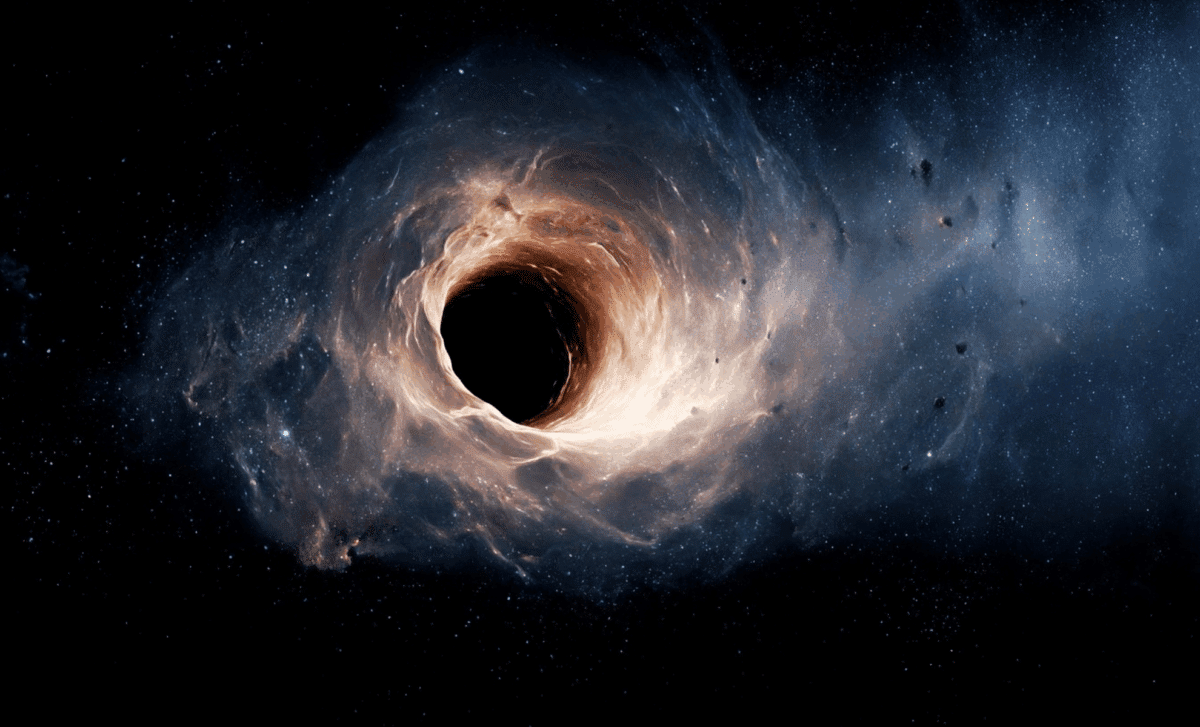
The James Webb Space Telescope (JWST) has revealed new insights into the early Universe with the detection of a colossal black hole residing in a galaxy formed just 570 million years after the Big Bang. This finding offers fresh perspectives on the rapid accumulation of mass by supermassive black holes during cosmic infancy, challenging established growth theories. The European Space Agency (ESA) has published these groundbreaking results that shed light on the early stages of cosmic evolution.
Unexpected Speed of Supermassive Black Hole Development
A recent investigation led astronomers to identify an extraordinarily large and fast-growing supermassive black hole within a galaxy dating back merely 570 million years post-Big Bang. Captured by the advanced instruments aboard the JWST, this discovery upends traditional assumptions about simultaneous black hole and galaxy formation. The astonishing growth rate of this black hole, occurring in such a nascent galaxy, defies previous predictions. Roberta Tripodi, principal investigator, comments:
“This discovery is truly remarkable. We’ve observed a galaxy from less than 600 million years after the Big Bang, and not only is it hosting a supermassive black hole, but the black hole is growing rapidly—far faster than we would expect in such a galaxy at this early time.”
Add Cosmo Herald as a Preferred Source

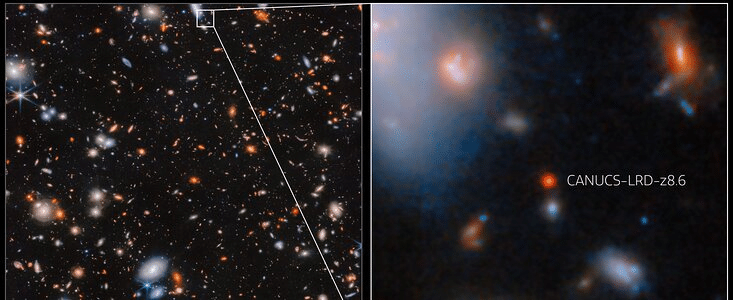
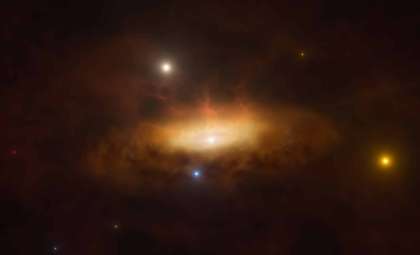
The galaxy, designated CANUCS-LRD-z8.6, belongs to a group of distant, compact galaxies often referred to as “Little Red Dots,” a name highlighting their dim and faint nature that historically made them challenging to examine. Thanks to the JWST’s exceptional sensitivity, researchers detected distinctive spectral signatures indicative of a black hole actively accreting material at the galaxy’s core. This unexpected combination of size and activity prompts a reevaluation of how black holes formed so swiftly in the young Universe.
Spectral Evidence Highlights the Feeding Black Hole
The JWST’s precise spectral analysis was instrumental in characterizing this early cosmic giant. By studying the galaxy’s faint emissions, scientists identified highly ionized gas near the black hole, a clear indicator of intense material consumption.
“The data we received from Webb was absolutely crucial,” said Dr. Nicholas Martis, University of Ljubljana collaborator. “The spectral features revealed by Webb provided clear signs of an accreting black hole at the center of the galaxy, something that could not have been observed with previous technology.”
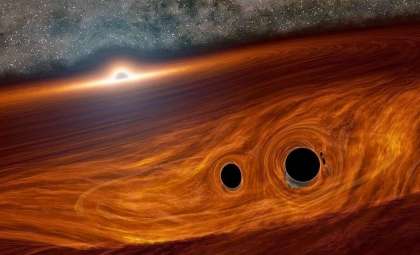
This pivotal observation enabled measurement of the black hole’s mass, which far exceeds expectations for a galaxy of its modest size and age. CANUCS-LRD-z8.6 remains compact and largely lacks heavy elements, consistent with early galaxy stages. Yet its central black hole’s exceptional mass implies black holes may have grown more rapidly than their host galaxies during the Universe’s infancy.
Challenging Conventional Wisdom on Black Hole and Galaxy Growth
The relationship between galaxy size and its central black hole’s mass has long followed a proportional pattern: larger galaxies tend to harbor heavier black holes. Intriguingly, the galaxy in question is substantially smaller than those typically associated with such massive black holes.
“What makes this even more compelling is that the galaxy’s black hole is overmassive compared to its stellar mass,” Dr. Martis pointed out.
This mismatch suggests black holes in the early Universe may have grown independently and at a much faster rate than their galaxies, contrasting with longstanding models of intertwined cosmic growth.
These findings prompt fresh inquiries into the mechanisms that enabled such rapid black hole formation and expansion. The evidence disputes the notion that galaxies and their central black holes grow in lockstep, proposing instead that black holes might have harnessed intense accretion during early galaxy assembly. This could reshape our understanding of black hole genesis and their role in shaping cosmic history.
Hunting for More Relic Galaxies Like CANUCS-LRD-z8.6
The accelerated growth of CANUCS-LRD-z8.6’s black hole has galvanized astronomers to search for similar objects in the cosmos.
“This discovery is an exciting step in understanding the formation of the first supermassive black holes in the Universe,” said Prof. Maruša Bradač, University of Ljubljana team leader. “The unexpected rapid growth of the black hole in this galaxy raises questions about the processes that allowed such massive objects to emerge so early.”
Researchers aim to identify additional galaxies exhibiting early black hole growth to deepen insights into galaxy-black hole formation dynamics.
Continued analysis of JWST data alongside other observatories will refine theoretical models of early Universe development. Discovering further rapidly growing black holes will enhance comprehension of the conditions enabling their formation. This evolving research promises to unlock secrets about supermassive black holes’ origins and the galaxies that nurture them, offering a richer narrative of cosmic evolution.
Exploring the Dawn of the Cosmos
The James Webb Space Telescope persists in revolutionizing our grasp of the Universe, persistently revealing phenomena that challenge traditional astrophysics. Each new observation enriches our understanding of cosmic birth and progression. As astronomers probe deeper into the distant Universe, more astonishing revelations about early cosmic structures are anticipated. The findings related to CANUCS-LRD-z8.6 mark the start of an exciting new chapter in exploring the Universe’s formative epochs. According to ESA reports, upcoming investigations will elucidate the intricate connections between black holes and their host galaxies, continuously rewriting the cosmic storyline.
- Categories:
- Astronomy



0 comments
Sign in to Comment