
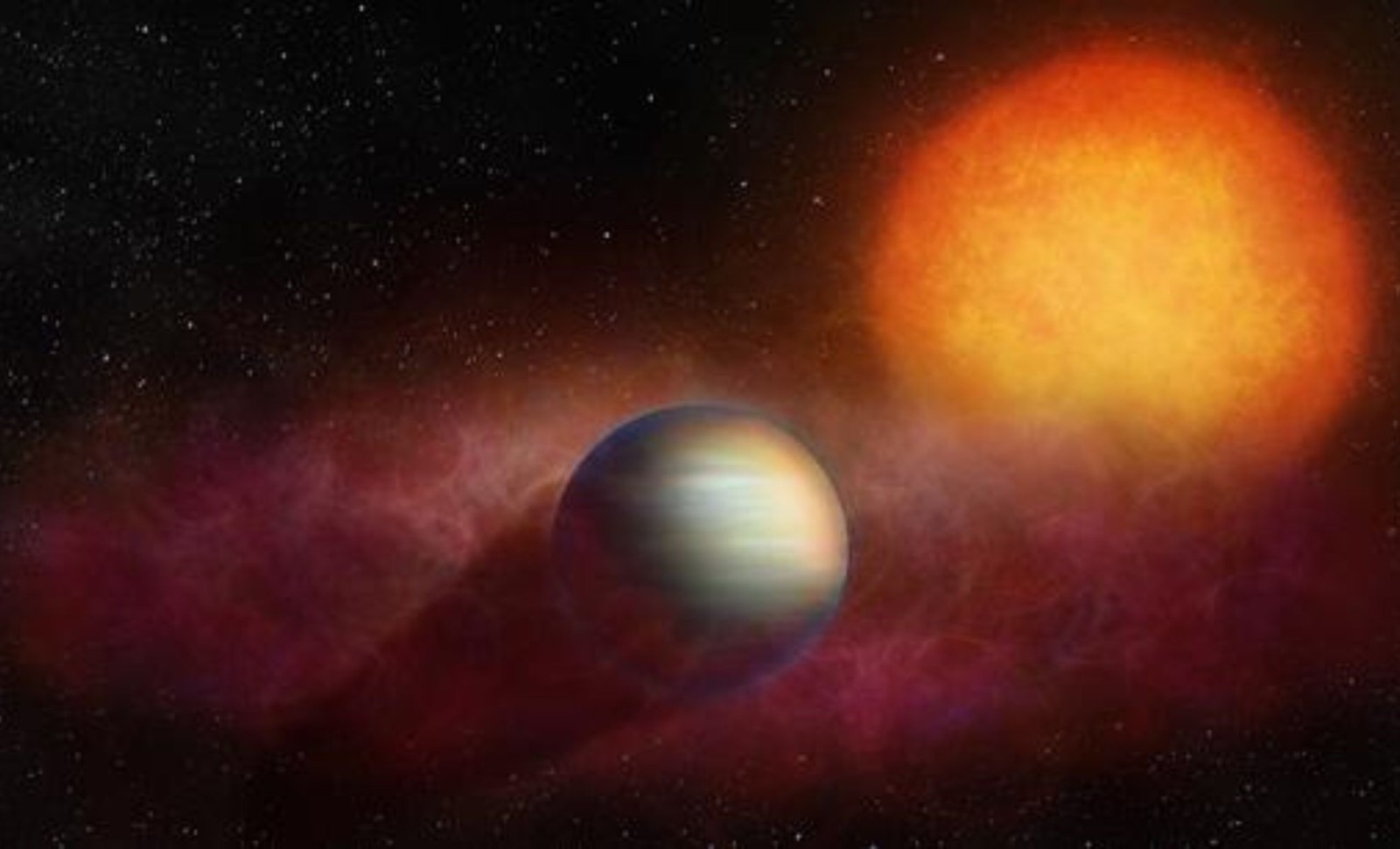
The James Webb Space Telescope (JWST) has delivered an extraordinary find by observing an exoplanet actively losing its atmosphere. The exoplanet, WASP-107b, is surrounded by a vast helium cloud that extends significantly into space, leading its orbit as it circles its star. This observation marks an unprecedented glimpse into atmospheric loss outside our solar system.
WASP-107b distinguishes itself with a radius close to that of Jupiter, yet it possesses only a small portion of Jupiter’s mass. This unusually low density makes the planet exceptionally lightweight and susceptible to atmospheric erosion. Orbiting very near its star—only about seven times the Earth-Sun distance from Mercury—the intense stellar heat steadily strips away its gaseous envelope, making it an intriguing subject for researchers.
The Enigma of Super-Puff Worlds
WASP-107b falls into the category of “super-puff” exoplanets, a term describing worlds that are extraordinarily large yet have remarkably low densities. Despite their giant size, these planets are remarkably light, which heightens their vulnerability to atmospheric escape, especially given their close proximity to their parent stars. A report from EurekAlert! highlights that the high radiation levels near WASP-107b drive gradual evaporation of its atmosphere.

The helium envelope detected by JWST stretches roughly ten times the planet's radius, forming a cloud that astonishingly leads the planet along its orbital path. This helium veil dims the stellar light slightly before the planet itself transits the star.
Advancing Astronomy With JWST
The ability of the James Webb Space Telescope to capture this phenomenon is a major leap forward. Utilizing its Near Infrared Imager and Slitless Spectrograph (NIRISS), JWST measured the subtle infrared signals emitted by the helium escaping from the planet. The findings, documented in a study published by Nature Astronomy, represent the first real-time visualization of atmosphere escape on an exoplanet.
“The amount of oxygen in the atmosphere of WASP-107b is larger than what we would expect if it formed on its current close-in orbit,” says Caroline Piaulet-Ghorayeb, co-author of the study.
By observing the escaping helium before the planet’s transit, JWST effectively recorded a “mini-transit” caused by the atmospheric tail, creating a brief dimming of the star’s light. This achievement showcases JWST’s unparalleled sensitivity and its critical role in exploring distant planetary systems.
Insights Into Planetary Evolution and Atmosphere Composition
Besides helium, the JWST detected traces of water vapor high up in WASP-107b’s atmosphere, though it found no methane. This absence implies active atmospheric mixing, possibly driven by the intense heat that pushes methane-deficient gases upwards.
The chemical characteristics of WASP-107b’s atmosphere hint at a formation history far from its star, followed by inward migration that exposed the planet to strong stellar radiation, stripping away its outer layers.
Supporting this scenario, the presence of another planet in the system, WASP-107c, which orbits much farther out, suggests that gravitational interactions may have nudged WASP-107b closer to its star. This offers a crucial piece of the puzzle regarding the dynamic evolution of exoplanets under extreme stellar influence.
- Categories:
- Space










0 comments
Sign in to Comment