
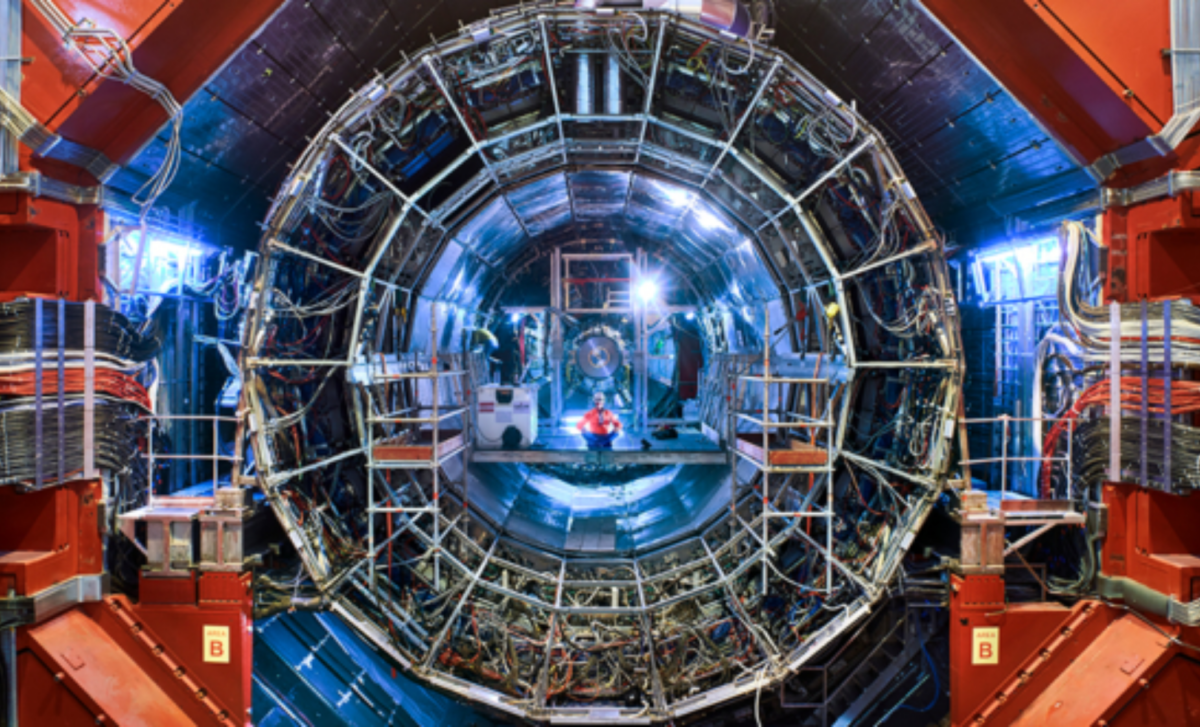
Researchers using the Large Hadron Collider (LHC) have made significant strides in exploring the universe’s earliest conditions right after the Big Bang. Led by the ALICE (A Large Ion Collider Experiment) collaboration, the team successfully generated and analyzed quark-gluon plasma, a primordial state of matter that permeated the cosmos at its inception. This advancement promises to deepen our grasp of how matter began to form and evolve in the newborn universe.
ALICE Experiment’s Pivotal Role in Unlocking Early Universe Secrets
The ALICE experiment stands as a globally renowned scientific project designed to simulate and examine conditions resembling those just after the Big Bang. It focuses on producing quark-gluon plasma, an ephemeral and fundamental state of matter present only momentarily in the universe’s infancy, essential for understanding cosmic evolution.
Traditionally, ALICE has studied collisions involving heavy ions such as lead nuclei to recreate this plasma. Yet, a recent study published in Nature Communications reveals groundbreaking observations of particle flow in proton-proton and proton-lead collisions. This marks the first documented detection of such flow patterns in these lighter collision systems, opening new avenues for particle physics research.

David Dobrigkeit Chinellato, ALICE’s Physics Coordinator, emphasized the importance of these results, stating,
“This is the first time we have observed, for a large interval in momentum and for multiple species, this flow pattern in a subset of proton collisions in which an unusually large number of particles are produced.”
The breakthrough offers strong proof that quarks—the building blocks of matter—interact in previously uncharted ways, even in smaller collision systems than formerly explored.
Decoding the Early Universe Through Quark-Gluon Plasma
Quark-gluon plasma represents a dense, hot mixture of particles thought to have existed during the universe’s initial fractions of a second immediately following the Big Bang. By replicating these extreme conditions within the LHC, scientists can study how quarks and gluons behaved in this unique state—a key to unlocking cosmic history.
New evidence indicates that quarks in this plasma phase combined to form larger particles, a fundamental process in the universe’s evolution. A crucial discovery was the detection of anisotropic flow, an identifiable emission pattern in particles emerging from collisions. Chinellato remarked, “Our results support the hypothesis that an expanding system of quarks is present even when the size of the collision system is small.” This insight is vital for understanding how quarks aggregate into complex matter structures that eventually shaped the cosmos.
Future Directions: Probing with Oxygen Collisions
Building on these findings, the ALICE team is preparing for the next set of investigations. Scheduled for 2025, oxygen nucleus collisions will bridge the experimental gap between proton and lead collisions, potentially revealing further details about the quark-gluon plasma.
“We expect that, with the oxygen collisions that were recorded in 2025, which bridge the gap between proton collisions and lead collisions, we will gain new insights into the nature and evolution of the quark-gluon plasma across different collision systems,” said ALICE Spokesperson Kai Schweda.
These upcoming studies promise to enhance our understanding of how quarks and gluons behaved in the universe’s formative moments, shedding light on the origins of all known matter.
- Categories:
- Astronomy









0 comments
Sign in to Comment