
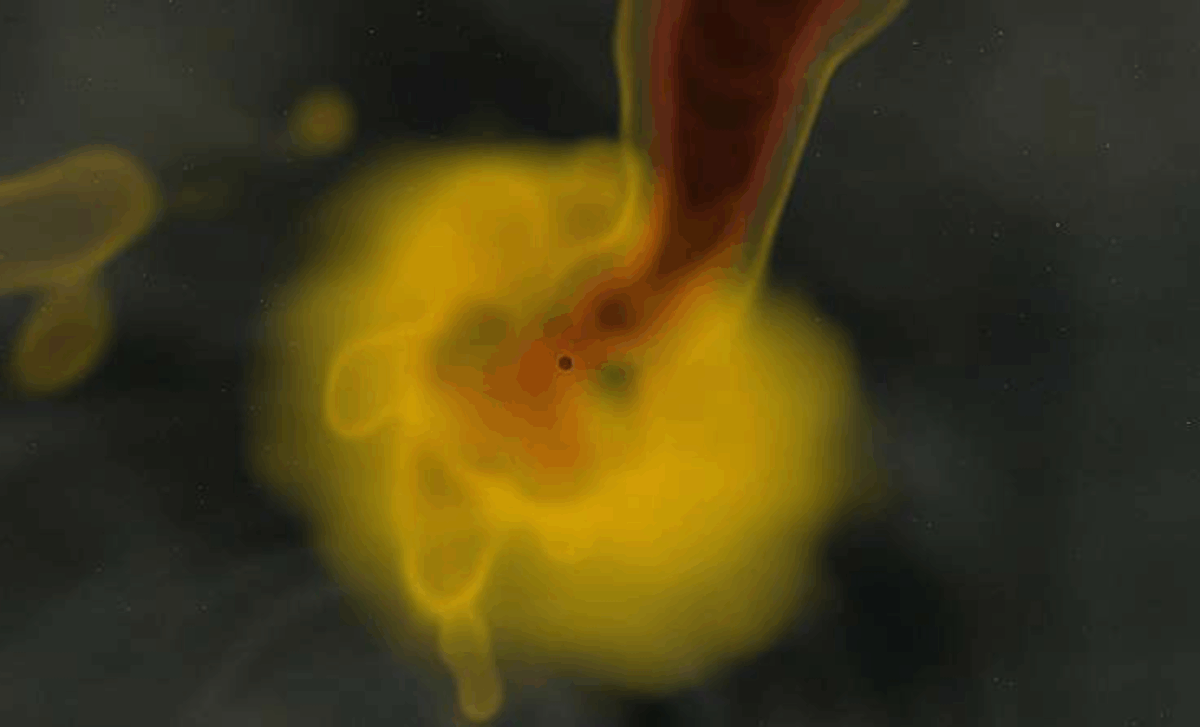
In 2023, scientists detected a black hole merger that challenged existing scientific predictions. Two colossal black holes collided at speeds approaching that of light, generating gravitational waves observed from billions of light years distant. The real surprise was that these black holes shouldn't have existed according to current theories. A groundbreaking simulation has now provided a fresh perspective.
The Enigma of the Mass Gap in Black Hole Populations
Black holes resulting from supernova explosions are not anticipated to be found within a specific mass interval — approximately 70 to 140 solar masses. This gap is caused by pair-instability supernovae, which completely destroy stars, leaving no remnants behind. Yet the black holes involved in the 2023 event, known as GW231123, were right in this forbidden mass range, prompting astrophysicists to rethink established models of how stars die and black holes form.
Captured by gravitational wave observatories part of the LIGO-Virgo-KAGRA network, the event also exhibited another unusual trait: extreme spin. These black holes ranked among the fastest spinning ever recorded, twisting spacetime around them. Such spin rates typically should not survive a merger, deepening the mystery of their origins.

To address this puzzle, researchers at the Flatiron Institute’s Center for Computational Astrophysics (CCA) employed state-of-the-art simulations modeling the stars' entire evolutionary paths — a novel approach in this context. Their findings, published in The Astrophysical Journal Letters, introduced a critical element previously overlooked: magnetic fields.
“No one has considered these systems the way we did; previously, astronomers just took a shortcut and neglected the magnetic fields,” says Ore Gottlieb, lead author of the study. “But once you consider magnetic fields, you can actually explain the origins of this unique event.”
Magnetic Fields: A Key Factor in Black Hole Development
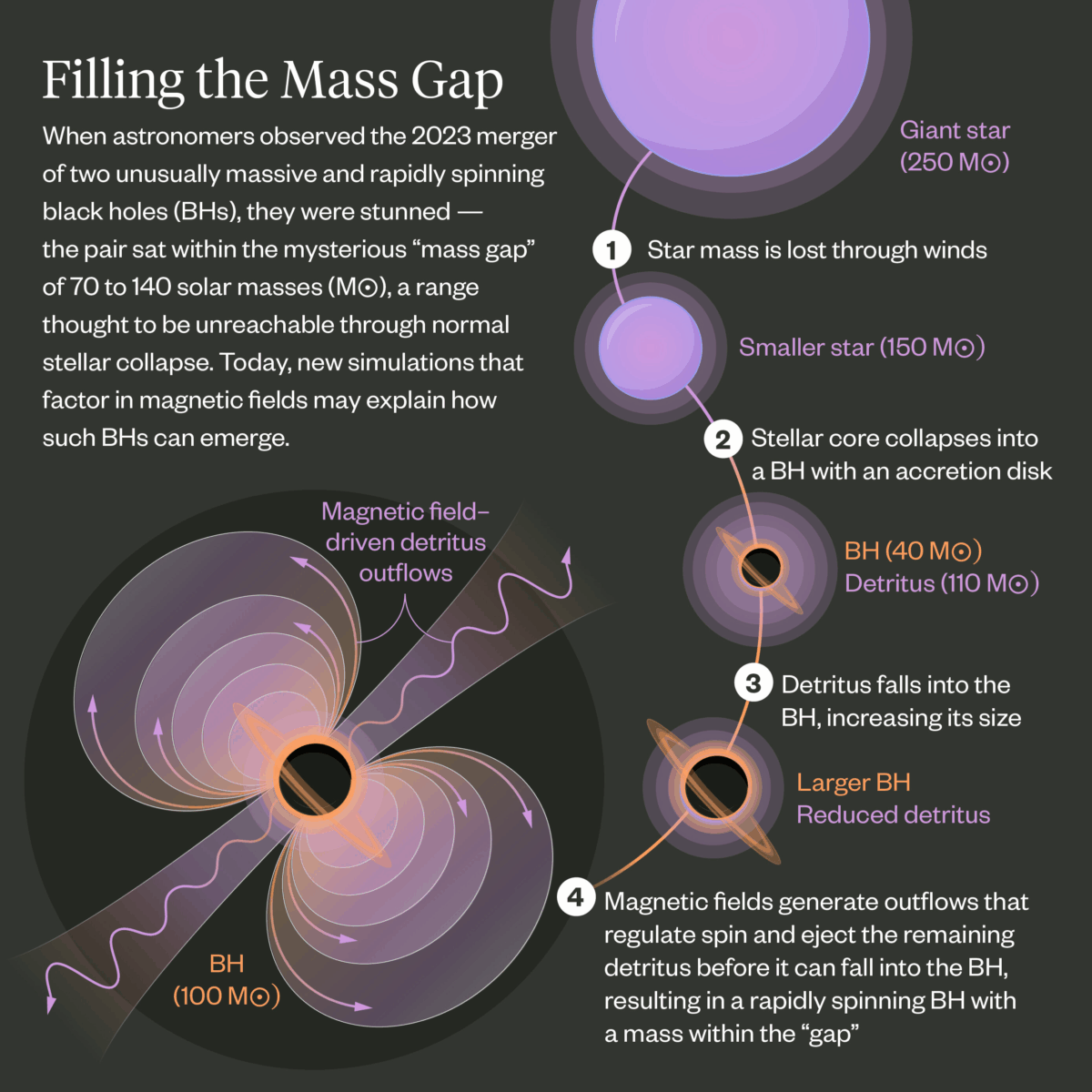
The team simulated the birth and collapse of an extremely massive star, roughly 250 times the mass of our Sun, from its hydrogen-burning phase through gravitational collapse. The results showed that, after burning through its fuel, the star’s mass would shrink to about 150 solar masses, slightly surpassing the theoretical threshold for black hole formation. Yet what happened afterward defied earlier assumptions.
Conventional wisdom held that all remaining material from the collapse would fall into the nascent black hole, increasing its mass accordingly. However, the simulation revealed that spin and magnetic forces alter this outcome drastically. When the remnants formed a rapidly rotating accretion disk around the black hole, magnetic pressures expelled huge amounts of stellar matter into space—some at speeds nearing that of light.
“Our findings indicate that rotation and magnetic fields can fundamentally modify the star’s evolution after collapse, resulting in black holes that are lighter than the total mass of the original star,” explains Gottlieb. This discovery suggests a novel route for forming black holes within the mass gap without conflicting with existing stellar evolution theories.
Linking Spin, Mass, and a Potential Cosmic Pattern
Beyond influencing mass, magnetic fields also govern how rapidly black holes spin. The research shows that stronger magnetic fields exert braking forces on the accretion disk’s rotation, decreasing spin rates and increasing material ejection. Weaker magnetic influences allow more matter to fall into the black hole, producing larger, faster-spinning black holes.
This connection between rotational speed and mass hints at a potential universal principle that might define black hole evolution across the universe. Though still hypothetical, the researchers propose that gamma-ray bursts linked to these rare collapses could serve as observational evidence. Tracking these energetic cosmic flashes could illuminate how widespread such events truly are.
“Typically, black holes aren’t expected to form in the 70 to 140 solar mass range because of supernova physics,” Gottlieb notes. “Observing black holes within this mass gap was puzzling, but our new model integrating rotation and magnetic feedback shows that their existence is plausible under certain conditions.”
- Categories:
- Space






0 comments
Sign in to Comment