
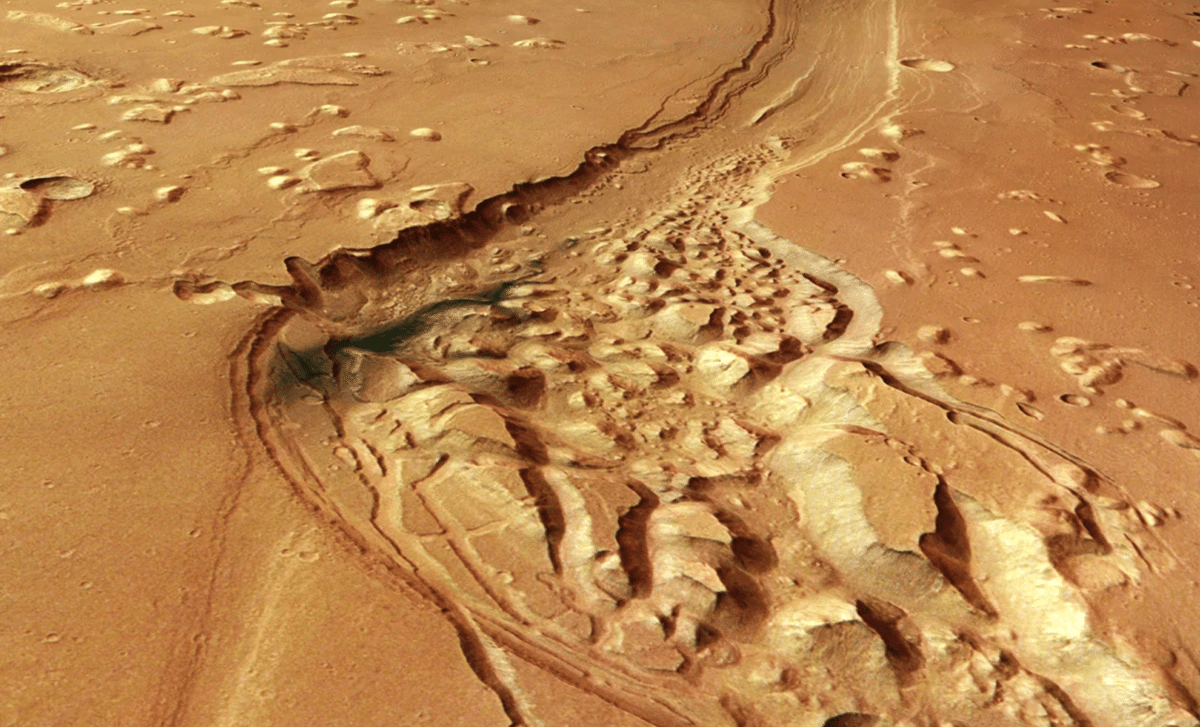
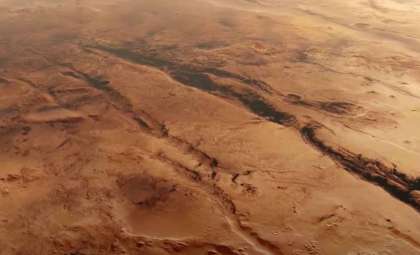
The European Space Agency (ESA) recently shared an intriguing photograph capturing dark patches scattered along a vast ancient waterway on Mars. Taken by the Mars Express probe, this image centers on the northern reaches of Shalbatana Vallis, a huge valley near Mars’ equator, believed to have formed approximately 3.5 billion years ago when liquid water shaped the planet’s surface.
Vast Ancient Waterways Sculpted the Martian Landscape
Spanning almost 800 miles (around 1,300 kilometers), Shalbatana Vallis is one of Mars’ most expansive valley systems. Scientists theorize it formed as torrents of water carved deep channels through solid rock in Mars’ wet era billions of years ago. The latest image spotlights an area where the valley reaches six miles in width and 0.3 miles in depth. Researchers also suggest this channel was once significantly deeper prior to gradual infill from sediments, dust, volcanic ash, and lava flows over geological timescales.
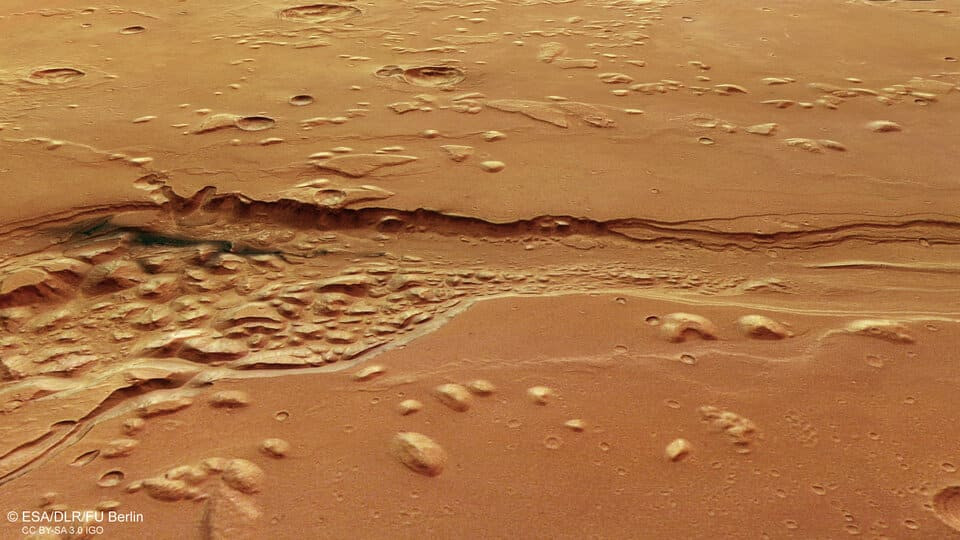
This valley is among the clearest evidence of Mars’ watery past. Decades of exploration by orbiters and rovers have firmly established that Mars once had flowing rivers, lakes, and likely vast oceans. Features like branching channels, water-formed minerals, and sediment layers have reshaped our comprehension of early Martian environments. Locations such as Shalbatana Vallis uniquely preserve direct geological imprints of catastrophic floods that dramatically transformed the planet’s surface.

Experts propose that these intense floods may have resulted from sudden releases of underground water reservoirs breaking through the surface. Such events could have unleashed vast quantities of water rapidly, etching the valleys we observe today. The winding patterns evident in the ESA imagery are testimony to the immense erosive forces of those ancient floods, locking in a snapshot of a once watery Mars.
Volcanic Ash Deposits Darken the Channel Floor
One remarkable feature in the image is the presence of dark bluish and black-hued substances distributed in some sections of the valley floor. Scientists studying ESA’s Mars Express data identify these materials most likely as volcanic ash spread by strong Martian winds. Although Mars no longer shows signs of active volcanism, it experienced vigorous volcanic activity in its past, with remnants still visible today.
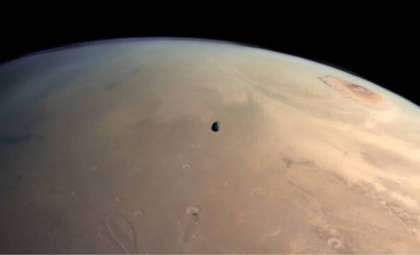
These ash layers remind us that Mars’ evolution was shaped not only by water but also by extensive volcanic activity. Home to Olympus Mons, the Solar System’s tallest volcano, standing nearly three times Mount Everest’s height, Mars’ past eruptions may have covered vast areas with ash and lava, preserving geological records that orbiters can detect.
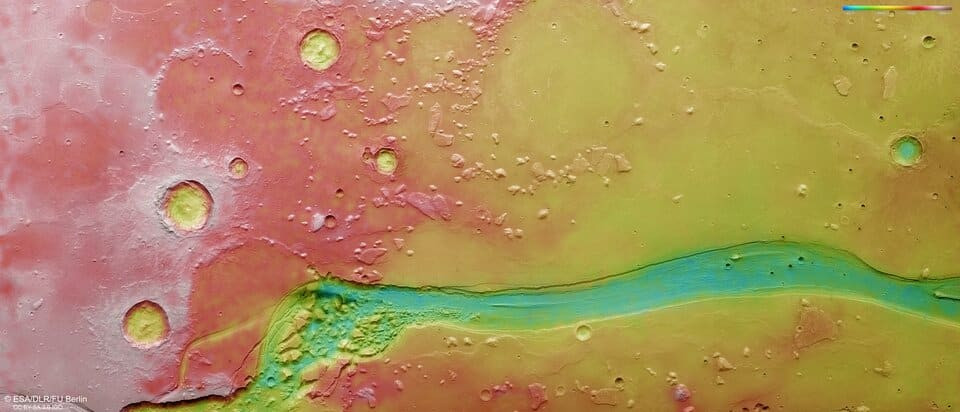
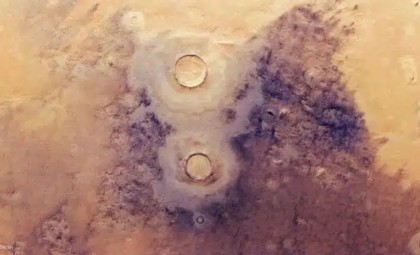
The dark deposits appear especially concentrated near a bulging formation along the channel. Researchers speculate this structure formed as subsurface ice melted, triggering a collapse of the terrain above, producing the distorted shapes visible today. This ‘subsidence’ is documented elsewhere on Mars, highlighting interactions between volcanic heating, buried ice, and geological shifts.
The coexistence of volcanic ash and evidence of ancient surface ice in this area provides crucial insights into Mars’ layered history. Scientists are continuing to investigate how these intertwining processes may have once enabled fleeting habitats suitable for microbial life.
Ongoing Discoveries from ESA’s Mars Express Orbiter
The detailed imagery originates from ESA’s Mars Express spacecraft, which has been monitoring Mars from orbit since 2003. Over its long mission, Mars Express has revolutionized our knowledge by thoroughly mapping Mars’ surface and atmosphere, and detecting minerals linked to past water activity. Its high-resolution cameras allow detailed study of geological features often missed by lower-resolution tools.
According to ESA, the land surrounding Shalbatana Vallis shows signs of extensive volcanic flooding, marked by smooth surfaces indicative of ancient lava flows. In some areas, the cooling lava contracted, forming ‘wrinkle ridges’ — ridge patterns still clearly visible today across the plains adjacent to the channel.
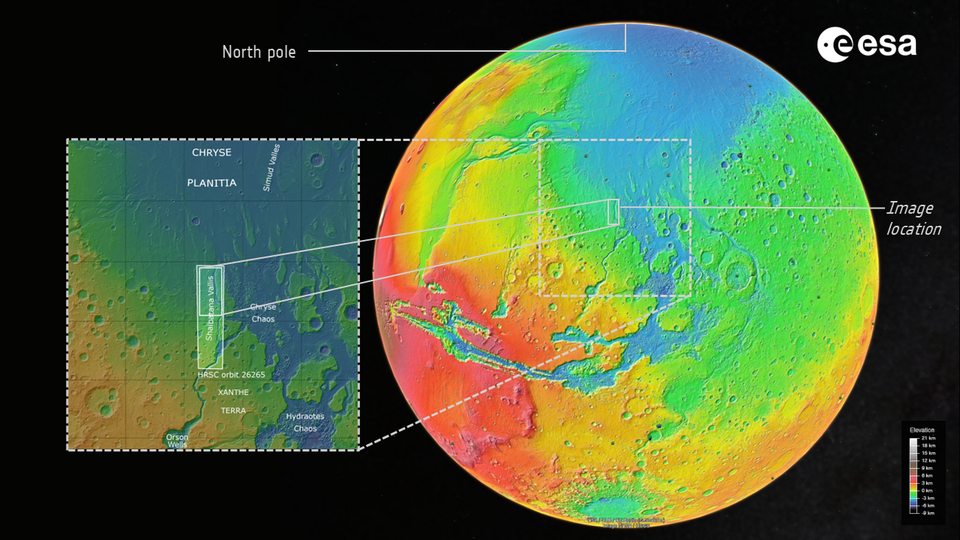
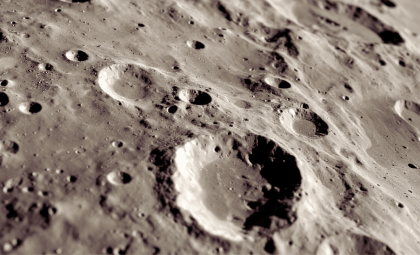
Additionally, numerous impact craters dot the area, chronicling billions of years of asteroid collisions. Unlike Earth, Mars’ lack of tectonic plates and thick atmosphere means many of these ancient craters remain largely intact, preserving a window into the planet’s violent past.
This latest imagery highlights how diverse geological phenomena—water erosion, volcanic eruptions, ice-related collapses, lava flows, and asteroid impacts—combined through time to sculpt Mars’ complex landscape. For scientists, this blend of processes presents an invaluable record for reconstructing environmental conditions on a planet once possibly resembling early Earth.
- Categories:
- Astronomy








0 comments
Sign in to Comment