
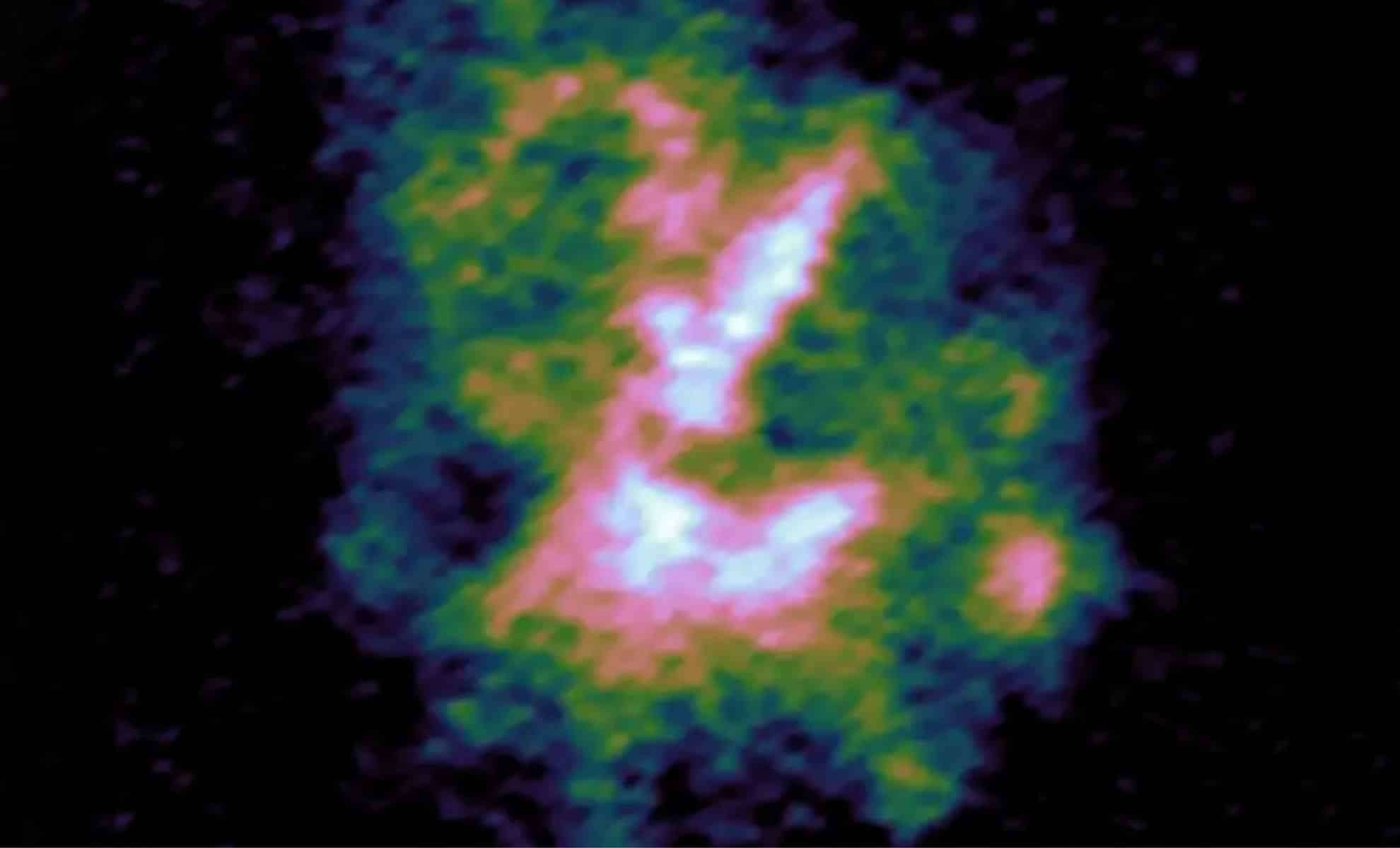
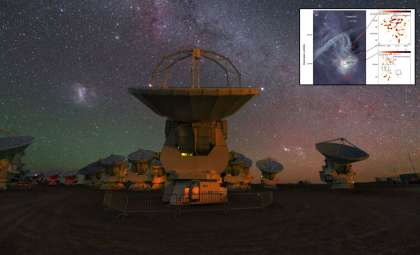
Researchers at Chalmers University of Technology have identified a remarkable cosmic event involving the red supergiant star DFK 52, which expelled a colossal bubble of gas more than 4,000 years ago—an occurrence that defies current models of stellar behavior. This finding, as reported on Arxiv, challenges prevailing notions of how massive stars evolve in their twilight years. Key to this investigation was the Atacama Large Millimeter/submillimeter Array (ALMA), which provided detailed mappings of the massive outflow, uncovering a structure unprecedented in scale and complexity.
Located within the Stephenson 2 cluster roughly 19,000 light-years from Earth in the constellation Scutum, DFK 52 produced a gas shell approximately 50,000 astronomical units (AU) in diameter. To put this in perspective, this bubble extends nearly 4.6 trillion miles, dramatically redefining our understanding of how red supergiants shed their outer layers late in life.
Unusual Mass Loss from a Red Supergiant
Red supergiants symbolize a late evolutionary phase for massive stars that have exhausted their core hydrogen and expanded greatly in size. These stars typically lose mass at rates between one ten millionth and one ten thousandth of the Sun’s mass annually. But the emissions from DFK 52 far surpass these standard values.

The research team was astonished by the vast dimensions of the expelled gas, whose radius is fivefold larger than any previously documented stellar outflow. Mark Siebert, leading the investigation at Chalmers University of Technology, remarked, “It remains a mystery how such an immense quantity of material could be ejected in such a limited time frame.” This phenomenon raises fundamental questions about the physics behind such extreme stellar mass loss.
Utilizing ALMA, the team detected cold molecules such as carbon monoxide, essential for tracing the full extent of the outflow. The detailed imaging revealed a network of complex structures including twisted filaments, layered loops, and a distinctive ring-like bar within the gas bubble. This sensitivity to cooler molecules offered unprecedented insights into nonstandard wind behaviors in massive stars.
Possible Origins of DFK 52’s Massive Ejection
The most puzzling aspect remains the extraordinary volume of gas expelled by DFK 52. Its outer envelope now holds about a tenth of the mass of the Sun, despite the star’s relatively subdued brightness at present. This magnitude of mass loss greatly exceeds what’s seen in comparable red supergiants and hypergiants, such as VY Canis Majoris, where expelled material extends only up to around 11,000 AU.
The study proposes two plausible mechanisms behind the massive gas ejection. One hypothesis suggests a brief but powerful superwind, potentially linked to a supernova precursor, may have driven the rapid expulsion of material, though the timing conflicts with current evolutionary expectations since DFK 52 now exhibits a calmer stage.
Alternatively, interaction with a nearby companion star could have supplied the necessary kinetic energy to expel the gas. Such stellar companionship during the star’s swollen phase might explain the tangled and chaotic structure observed in the gas shell. Understanding this interaction could unveil how binary partners influence each other during final stellar phases.
A Unique Window Into Stellar Demise
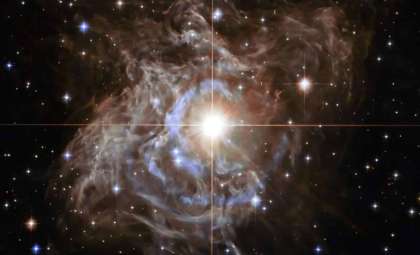
The irregular gas shell encompassing DFK 52 provides a rare glimpse into the violent final acts of a star’s life. Unlike most aging stars that lose mass steadily and smoothly, DFK 52 displays an erratic and dramatic expulsion. The notable ring-shaped structure, expanding at about 19 miles per second, points toward a sudden explosive event rather than a uniform outflow.
Such intense mass ejections resemble signatures seen in early type II supernova spectra, hinting many red supergiants may release material violently just before their demise. The shell surrounding DFK 52 acts as a frozen testament to such an outburst, preserving valuable information for scientists investigating stellar life cycles and death.
One especially intriguing facet of this event is that the gas shell’s chemical makeup remains intact after millennia. Cooling of the shell has allowed molecules like carbon monoxide and silicon monoxide to persist, despite typically being destroyed by harsh stellar radiation. This rare molecular preservation permits a more detailed chemical analysis of the expelled material than is usually possible for stars in advanced stages.
- Categories:
- News




0 comments
Sign in to Comment