
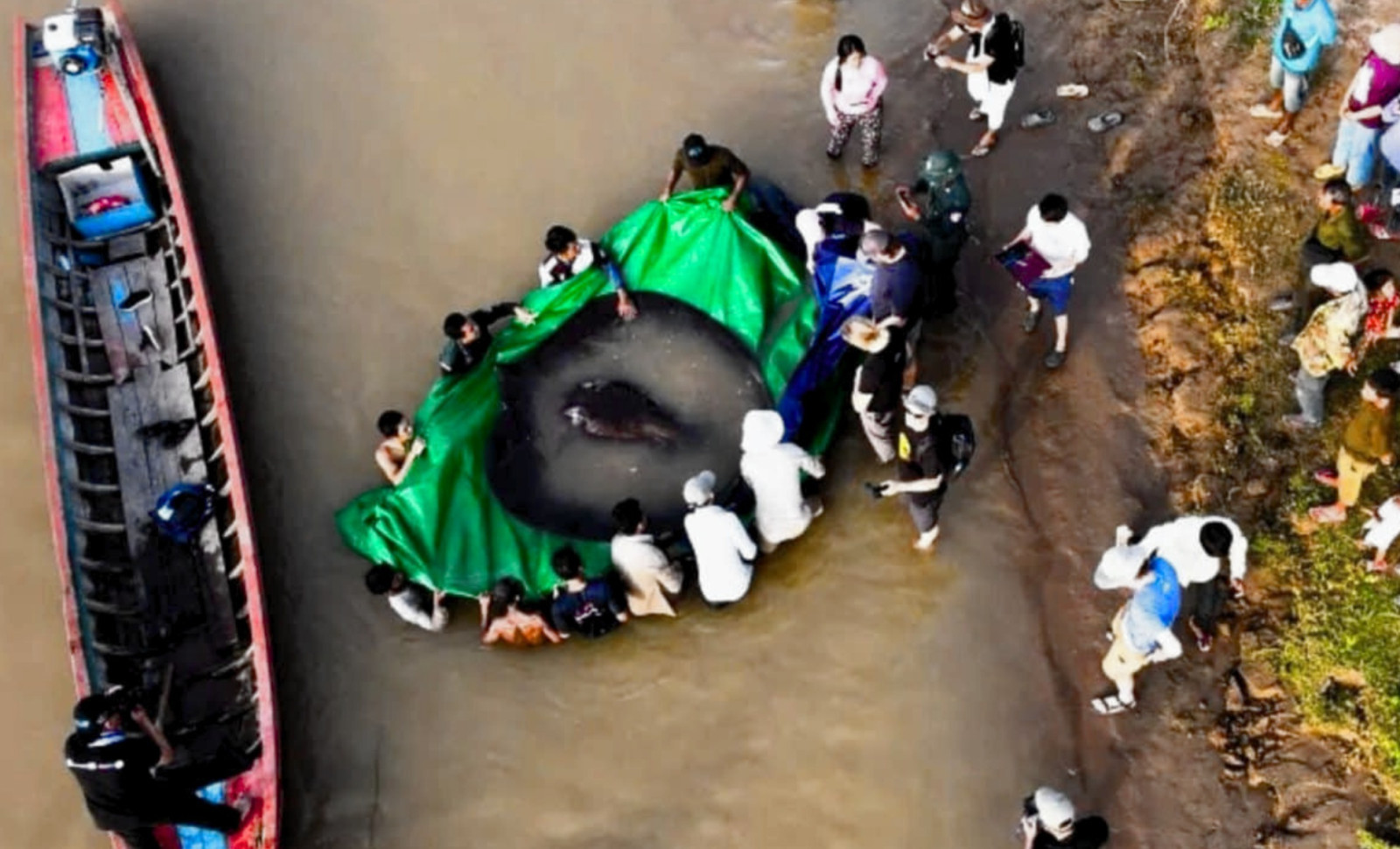
Cambodian fishermen experienced an unprecedented challenge when their net suddenly felt unnaturally heavy near Koh Preah island in June 2022. The creature they had caught resisted any movement, firmly anchoring itself to the muddy riverbed with immense strength, requiring over a dozen people to pull it free. When it finally surfaced, it defied expectations – resembling a wide, mud-colored disk much larger than a doorway, with a thick, sturdy tail trailing behind.
This remarkable disk was the body of a giant freshwater stingray. Scientists involved with the Wonders of the Mekong project arrived equipped with verified weighing instruments to quantify this extraordinary find. The stingray tipped the scales at a staggering 300 kilograms and measured nearly 4 meters (3.98 m) from snout to tail, setting a new world record as the largest freshwater fish officially recorded. What began as a routine fishing effort on one of the world’s busiest rivers quickly turned into a landmark scientific discovery.
Guinness World Records has now validated this individual, identified as Urogymnus polylepis, as the heaviest freshwater fish ever documented. This breaks the previous record of 293 kilograms held by a Mekong giant catfish caught in Thailand in 2005, a record that stood for close to twenty years.

Documenting and Releasing a Giant
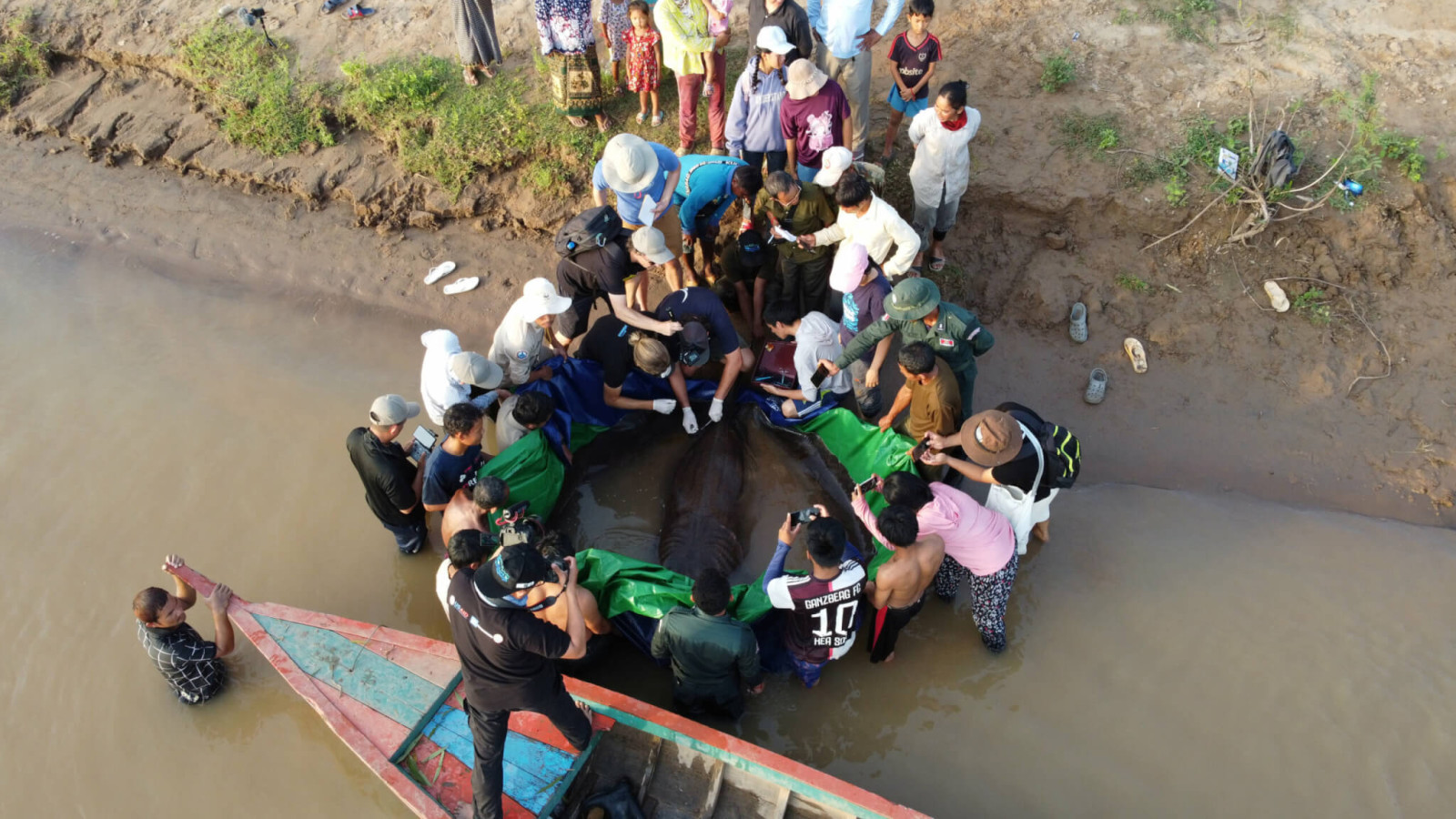
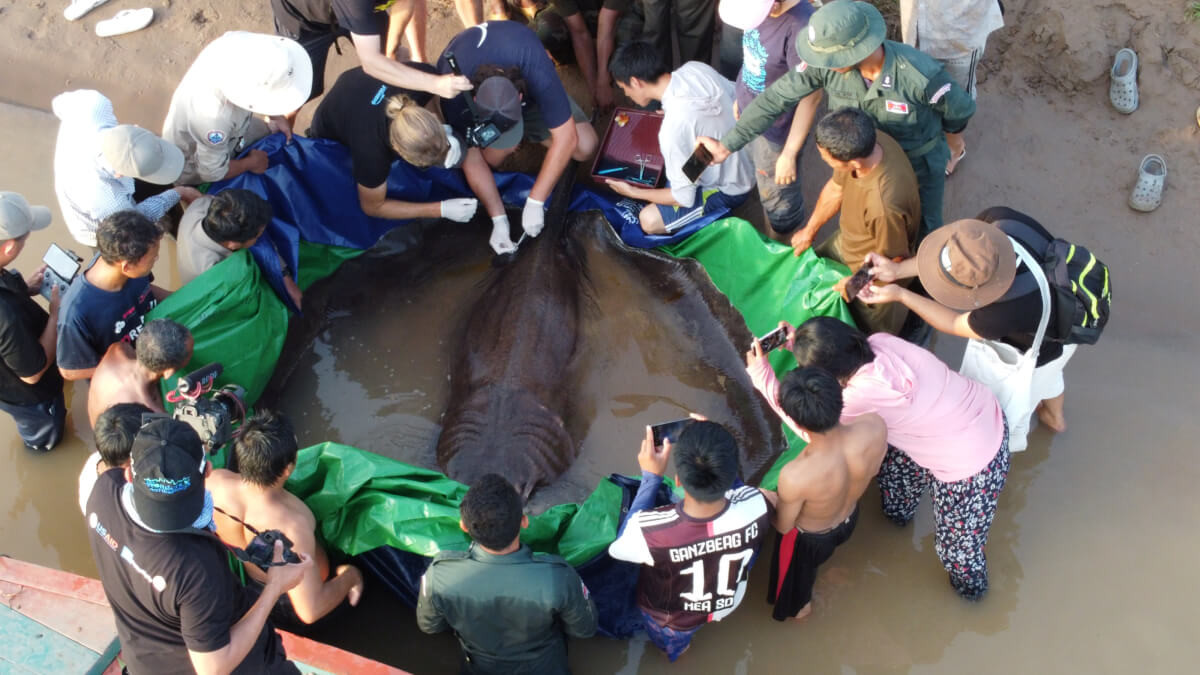
The impressive catch was made along the Mekong River in northern Cambodia. After local fishers secured the giant stingray on a reinforced tarp by the riverside, researchers associated with the project — supported by the University of Nevada, Reno — moved in to assess the specimen. They meticulously recorded the stingray’s dimensions, including a disc width measuring 2.2 meters and total length just shy of four meters. Certified scales confirmed its 300-kilogram weight right on site.
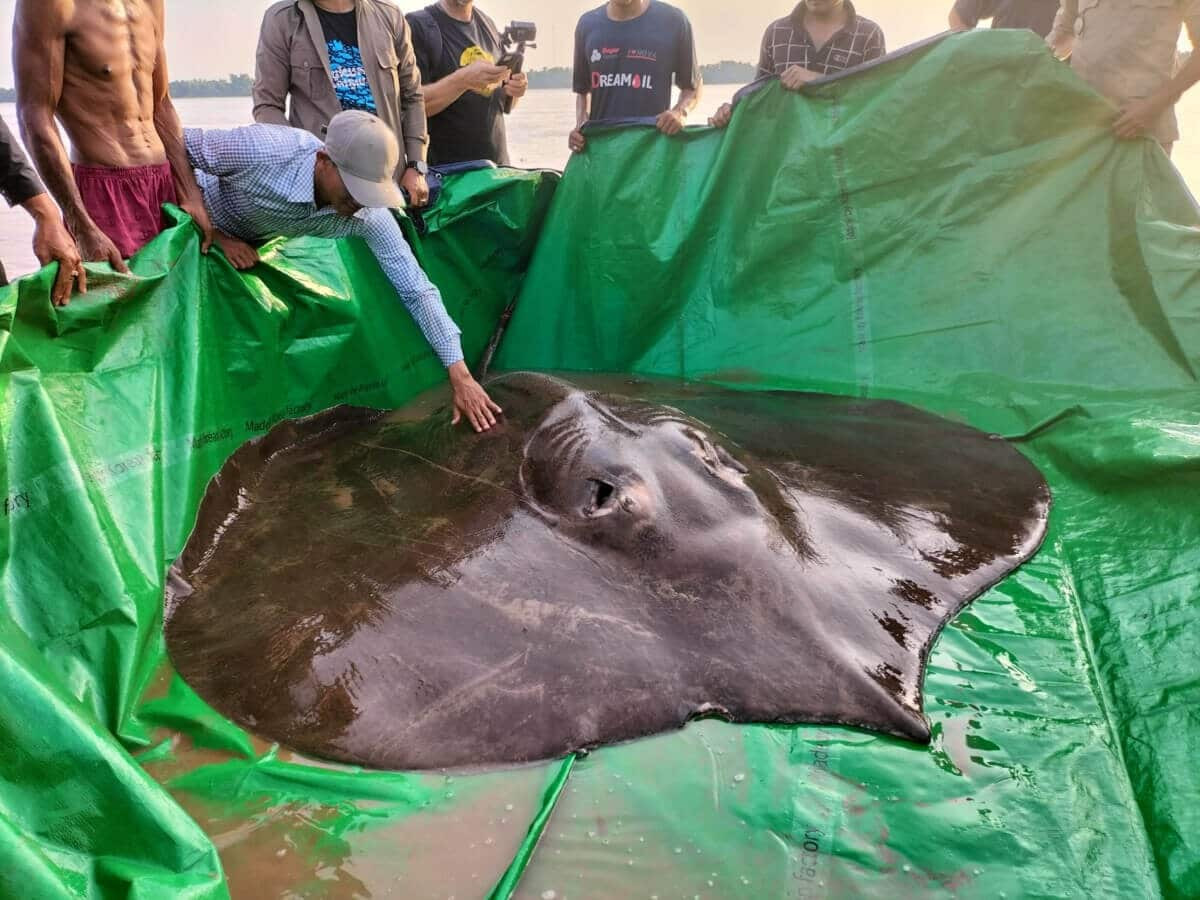
Choosing conservation over collection, the researchers fitted the stingray with an acoustic tracking tag before gently releasing it back into the river’s turbid waters. The team took great care to reduce stress and disturbance, allowing the creature to resume its natural bottom-dwelling lifestyle.
Tracking data derived from the acoustic tag is invaluable for this elusive species, as giant freshwater stingrays spend most of their existence clinging to muddy river channels, making conventional observation methods ineffective. By monitoring the tagged stingray’s whereabouts, scientists aim to build the first comprehensive understanding of its movements, including whether it travels between deep river pools or remains confined to a specific habitat.
A Mysterious Bottom-Dweller Facing Threats
The giant freshwater stingray remains one of Southeast Asia’s most enigmatic large fish species. Its secretive habits and the challenging environment of deep, sediment-rich rivers hinder extensive study. Verified sightings of individuals exceeding 300 kilograms are exceptionally rare, making each documented encounter crucial for biologists studying their ecology and population health.
Scientists believe this record-setting specimen was likely several decades old. Freshwater stingrays grow slowly, gradually adding mass over many years when environmental conditions are stable and fishing pressures remain low. The sheer size of this individual indicates it found a safe refuge abundant in food.
This fragile existence is reflected by the species’ conservation designation. The International Union for Conservation of Nature classifies Urogymnus polylepis as endangered. Habitat disruptions including dam construction, intensive sand mining, and overfishing have significantly altered the lower Mekong basin.
Why the Mekong Supports These Giants
The Mekong River’s unique ecological characteristics enable fish species to grow to extraordinary sizes not typically found in other freshwater habitats. Annual monsoon floods greatly expand feeding grounds, allowing fish to access nutrient-rich floodplains. After floodwaters recede, deep pools carved into the riverbed provide essential refuge during dry seasons.
Upstream sediments bring an abundant supply of nutrients that support dense food webs throughout the basin, from tiny invertebrates to the large fish that prey on them. The combination of deep, oxygen-rich refuges with seasonal surges in food availability enables species like the giant freshwater stingray and the Mekong giant catfish to achieve impressive body mass.
The survival of a 300-kilogram specimen suggests that pockets of the Mekong still preserve the critical habitats required by large, long-lived freshwater fish. Despite ongoing ecological threats, some parts of this ancient river maintain their natural productivity.
Sharing the Crown of Freshwater Titans
The Guinness World Records recognizes both the giant freshwater stingray and the Mekong giant catfish as co-holders of the title for the world’s heaviest freshwater fish. The recent stingray exceeds the catfish’s typical maximum weight, but the two species remain close rivals. The record notes that while the South American arapaima can surpass four meters in length, it generally weighs around 200 kilograms, meaning it doesn’t hold the top weight record.
This record also offers historical perspective. The Chinese paddlefish, once confirmed to grow to weights around 300 kilograms, was officially declared extinct in January 2020. Authorities estimate it disappeared between 2005 and 2010 due to overexploitation and habitat degradation.
The distinction between entirely freshwater species and those that migrate to the sea is important. While certain sturgeon species grow larger, they are anadromous and do not hold the purely freshwater weight record. The 300-kilogram giant freshwater stingray retained this title, supported by verifiable measurements and continuously transmitting tracking data from the depths of the Mekong River.
- Categories:
- News










0 comments
Sign in to Comment