
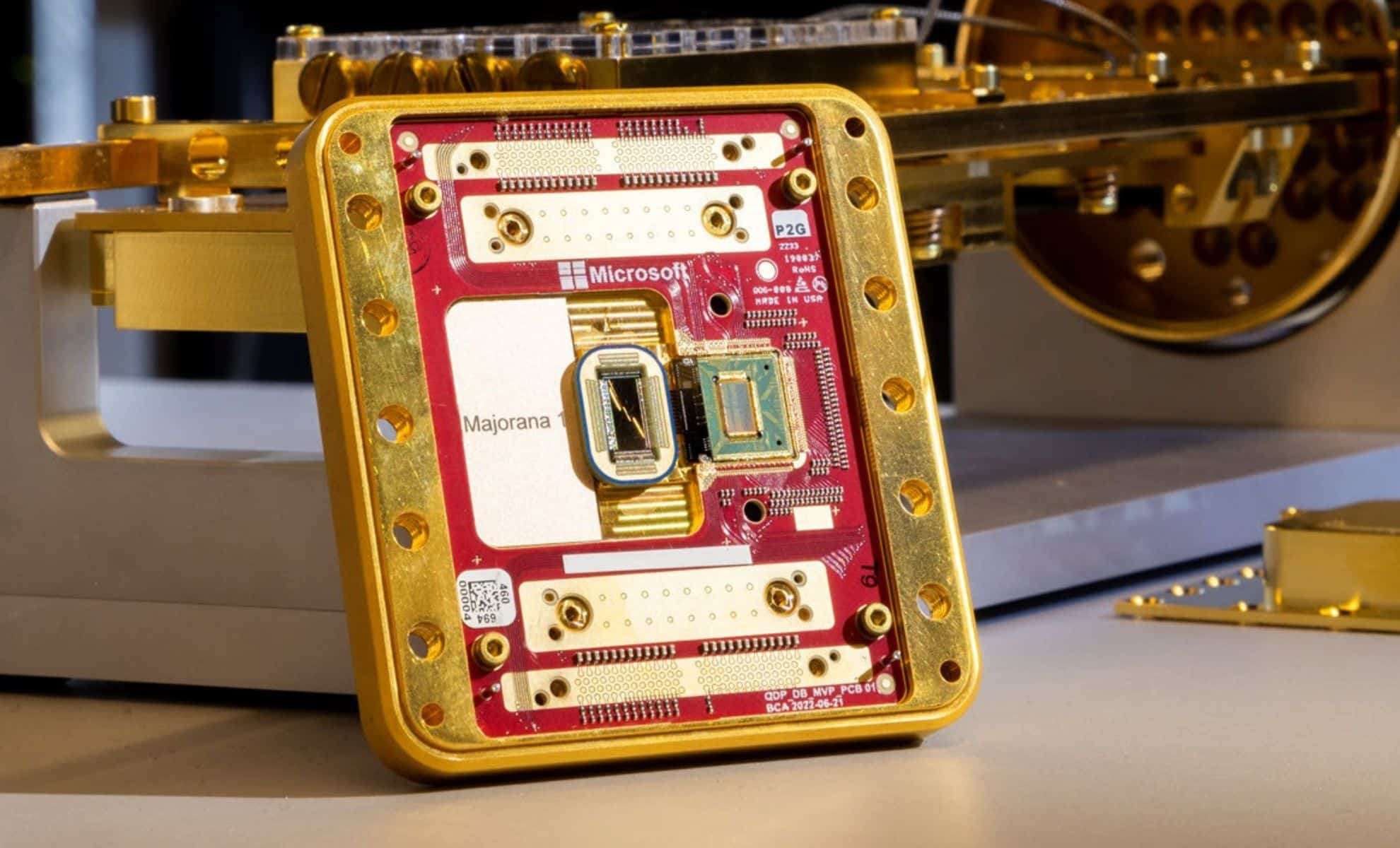
After nearly two decades of development, Microsoft has announced a groundbreaking advancement in quantum computing with the debut of its latest quantum processor, named Majorana 1, featuring an innovative qubit design.
If this new technology performs as expected, it could fast-track the development of robust fault-tolerant quantum computers. Yet, some experts in the field remain unconvinced.
A distinct approach to quantum computing
Contrasting the conventional reliance on superconducting qubits favored by industry leaders like IBM and Google, Microsoft is pursuing a novel strategy with topological qubits. These qubits, rooted in the enigmatic Majorana particle, are theorized to offer superior stability and reduced error rates, essential for scaling quantum systems to unprecedented qubit counts.

First theorized by Ettore Majorana in 1937, this particle uniquely serves as its own antiparticle. Microsoft’s scientists claim to have exploited this rare phenomenon to develop a new generation quantum chip using a bespoke material dubbed a topoconductor, which blends semiconductor and superconductor properties.
Ambitions of scaling to a million qubits
Microsoft envisions expanding from the eight topological qubits of Majorana 1 to an astounding one million qubits. Achieving this milestone could mark a turning point, enabling quantum computers to outperform classical machines on tasks once deemed unsolvable.
Such powerful quantum processors would allow researchers to simulate complex chemical structures, innovate next-generation materials, and decrypt highly secure information at unprecedented speeds.
Microsoft asserts that these quantum systems could eventually make physical experiments obsolete by providing equally trustworthy simulation results.
Scientific doubts linger
Despite the buzz, skepticism persists among researchers. Several physicists emphasize that Microsoft has yet to conclusively demonstrate the creation of durable topological qubits.
An article in Nature notes that while early readings on superconducting nanowires are promising, definitive proof of functional topological qubits remains absent.
The success of this innovation depends largely on whether the Majorana quasiparticles involved act as the theory predicts.
Steven Simon, a theoretical physicist at Oxford University, expresses a cautious viewpoint:
“Would I bet my life that they’re seeing what they think they’re seeing? No, but it looks pretty good.”
Collaboration with DARPA pushes urgency
In its quantum pursuits, Microsoft is collaborating with DARPA, the US Defense Advanced Research Projects Agency, aiming to develop a prototype for a fault-tolerant quantum computer within a few years.
This partnership could position Microsoft ahead of competitors such as Google, IBM, and Intel if the accelerated timeline is met.
Meanwhile, rivals continue refining their own quantum designs: Google's Sycamore and IBM's Eagle and Condor processors utilize superconducting qubits, while IonQ and Honeywell explore trapped ion systems.
The timing of the quantum revolution
Microsoft’s Majorana 1 chip might represent the dawn of a new phase in quantum computing, but significant challenges remain. Success will depend on the practicality of topological qubits and the company's ability to scale and validate the technology.
The question remains: will Microsoft’s approach ignite the next quantum leap, or will it turn out to be an overstated promise? The forthcoming advancements will reveal whether their qubits can meet the high expectations.






0 comments
Sign in to Comment