
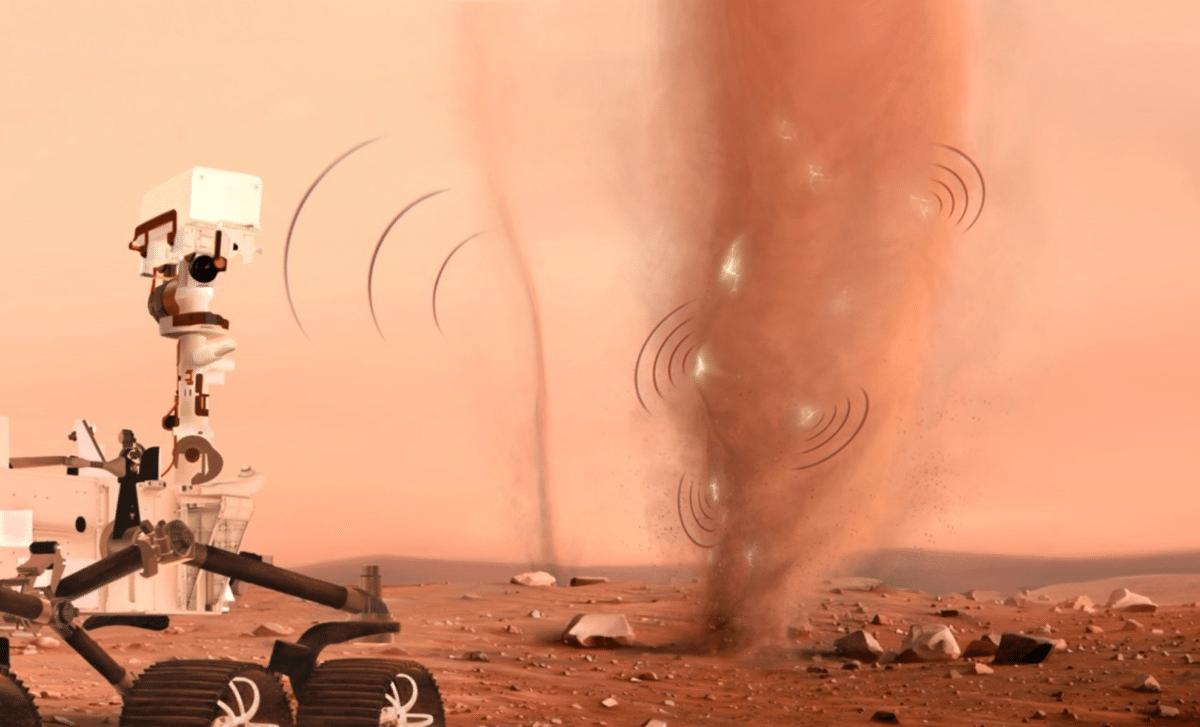
Mars is often viewed as a quiet, lifeless planet. Yet beneath its dusty surface and frigid atmosphere, a fascinating phenomenon has arisen that no previous mission had detected. While exploring the ancient landscape of Jezero Crater, NASA’s Perseverance rover captured an unusual and unexpected signal embedded in the Martian wind. Initially dismissed as a technical error, the anomaly repeated multiple times, unveiling a scientific enigma with implications extending well beyond earlier expectations.
Perseverance Discovers Electrical Activity Within Martian Dust Storms
When NASA’s Perseverance rover landed in Jezero Crater in 2021, it carried a range of advanced tools to investigate Mars’ geology and climate, along with the search for signs of past life. Unique among them was the SuperCam, equipped with the first microphone designed to capture sounds directly from the Martian surface.
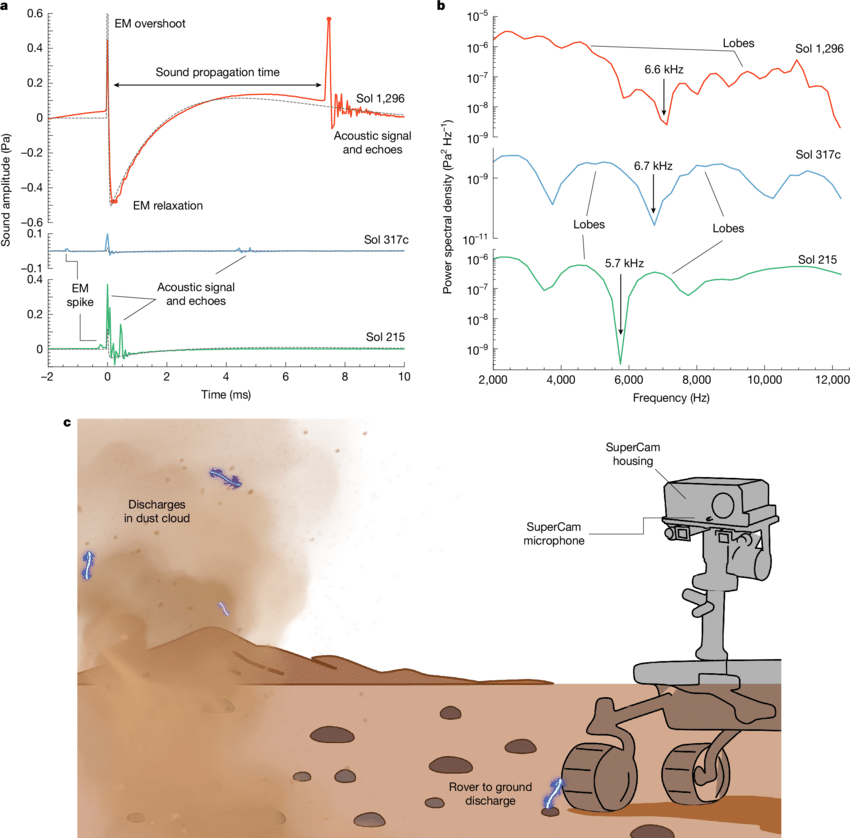
Shortly after landing, this microphone detected irregular acoustic signals coinciding with the activity of dust devils—small whirlwind storms common on Mars. Closer examination revealed these sounds were paired with electromagnetic emissions, evidence of electrical discharges within these mini-storms. This marked the inaugural confirmation of electricity present in Mars’ atmosphere, a phenomenon long hypothesized but never before observed.

Mechanisms Behind Martian Dust Charging
Martian dust devils resemble those on Earth but with distinct differences. As they sweep across Mars, tiny dust grains collide and rub together, generating electrical charges through friction. The separation of positive and negative charges within the vortex creates an electrically unstable region.
Because Mars’ atmosphere is extremely thin and mainly composed of carbon dioxide—with only about 1% of Earth’s atmospheric density—electrical discharges occur more easily. Micro-scale sparks a few centimeters long can ignite with minimal energy input. These sparks release shock waves that the SuperCam microphone is sensitive enough to detect. On Earth, a denser atmosphere inhibits such sparks, making these discharges rare in terrestrial dust devils; on Mars, they appear to be a common occurrence.
Significance of the Electrical Sparks: Atmosphere and Methane Breakdown
These electric phenomena are more than intriguing sounds; they could significantly influence Mars’ atmospheric chemistry. When dust particles electrically discharge, they produce highly reactive oxidizing chemicals capable of breaking down complex organic molecules, impacting the stability and lifetime of methane and other compounds in the atmosphere.
One longstanding puzzle on Mars—the rapid disappearance of methane—may find explanation in these findings. Methane detected in the atmosphere often vanishes much quicker than expected based on current models. The electrical sparks generated inside dust devils may accelerate the destruction of methane, providing a plausible mechanism behind this mystery.
Published research in Nature reinforces the importance of considering electrochemical processes in modeling Mars’ climate and habitability conditions.
Consequences for Upcoming Mars Exploration
Charged dust and electrical discharges pose significant practical challenges for the next generation of Mars missions. Dust already threatens the performance of electronics and optical devices on Earth. Mars intensifies these risks through its electrically active storms.
Understanding that Martian dust storms carry an electric charge means future crewed missions will need to prepare for electrostatic hazards that might disrupt sensitive instruments. For robotic missions, enhanced insulation and shielding could be vital to prevent failures and signal interference. Additionally, electrical discharges may reduce the efficiency of solar panels or degrade scientific tools over time.
These insights enable engineers and mission planners to develop more resilient systems, paving the way for safer exploration as humans aim to walk on the Red Planet.
Mars’ New Soundscape: A Planet That Speaks Through Perseverance
Before the Perseverance rover, studies of Martian weather were reliant on images and indirect atmospheric measurements. Its unique audio recordings have opened a novel channel for planetary science. From gentle Martian breezes to Ingenuity’s helicopter whirs, and now faint electric crackles, Mars has unveiled an unexpected audible dimension.
With more than 30 hours of audio captured by the SuperCam microphone, researchers are unlocking real-time insights into atmospheric events and detecting phenomena like dust devils and wind gusts—factors crucial to mission planning.
The work led by the Institut de Recherche en Astrophysique et Planétologie (IRAP) illustrates how integrating sound, electromagnetism, and chemistry provides a richer, deeper understanding of Mars’ environment.
- Categories:
- Astronomy






0 comments
Sign in to Comment