
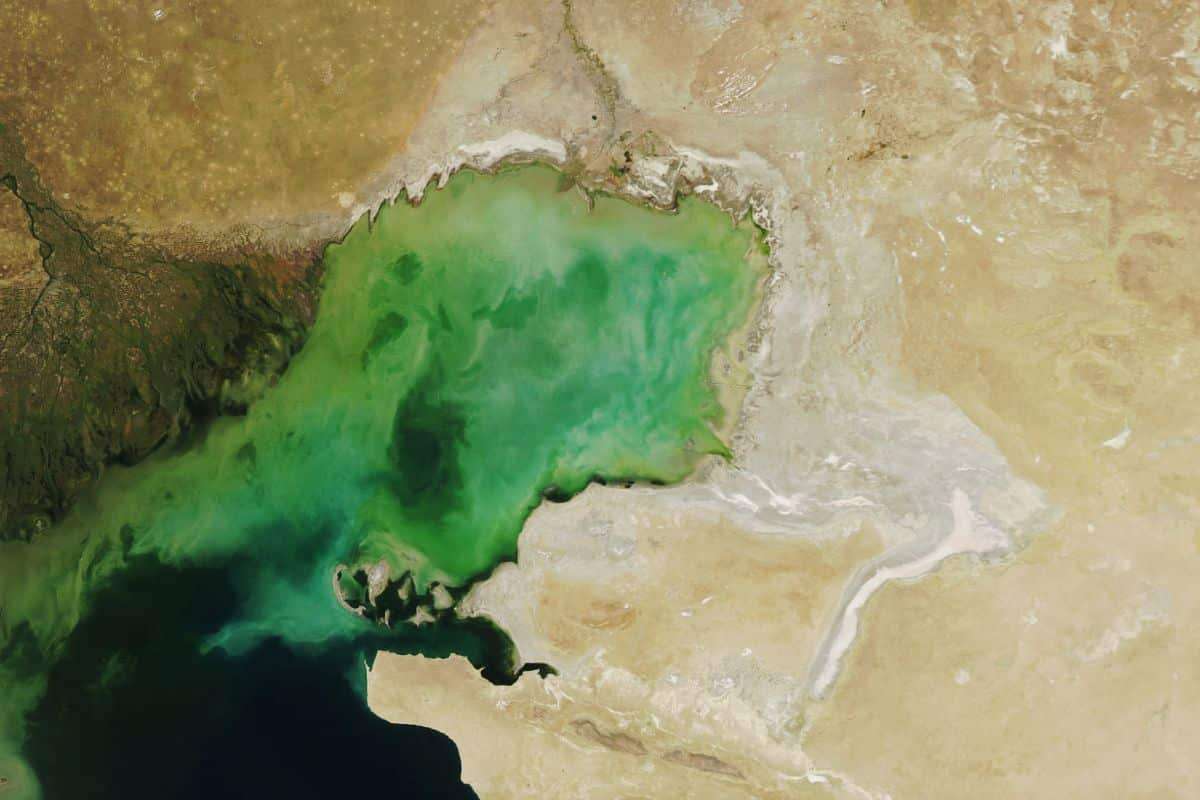
The Caspian Sea, the largest enclosed inland water body on Earth, has long faced ecological pressures. However, it recently caught attention for a different phenomenon—a temporary island emerged and then vanished within a span of less than two years. NASA’s orbital satellites tracked this unusual occurrence, which scientists attribute to the activity of an underwater mud volcano.
An Unexpected Volcanic Event Under the Caspian
NASA’s Earth Observatory announced that the ephemeral island was initially spotted in early 2023. Measuring approximately 400 meters across, it was situated about 25 kilometers from Azerbaijan’s shoreline. By the conclusion of 2024, this landform had been reclaimed by the sea.
The phenomenon was driven by a mud volcano known as Kumani Bank, also referred to as Chigil-Deniz. Unlike conventional volcanoes that expel molten rock, mud volcanoes push up water-laden sediments due to underlying seabed pressure. This action occasionally creates temporary landforms like the island NASA observed.

Kumani Bank has been active since at least 1861, periodically generating short-lived islands as sediments rise and then erode back into the water. This activity isn’t uncommon; the Caspian basin contains over 400 mud volcanoes, ranking it as one of the planet’s most geologically vibrant regions.
The Birth and Demise of a Transient Island
Researchers analyzed the timeline of the island's emergence using satellite data from Landsat 8 and 9. In November 2022, the mud volcano’s peak was submerged. However, between January 30 and February 4, 2023, eruptive sediment discharge formed the island. It remained for close to two years, but by late 2024, imagery revealed its near-total erosion.
Kumani Bank has generated similar features in the past. Its 1861 eruption led to a 97-meter-wide island that disappeared within one year. In 1950, a significantly larger island spanning 700 meters and rising six meters above sea level appeared after a potent eruption but eventually eroded away as well.
Factors Behind the Island’s Disappearance
Islands produced by mud volcanoes are ephemeral because they consist of loosely compacted, easily degradable materials such as clay and silt instead of solidified lava. Compared to volcanic islands made from consolidated rock, these formations are fragile and frequently succumb to:
- Wave erosion: Currents in the Caspian Sea steadily erode the unstable mud deposits.
- Gravity-induced collapse: The loose sediment eventually compacts and sinks under its own mass.
- Gas discharge: Gas escapes from beneath can weaken the structure’s integrity.
The swift erosion leading to the 2023 island’s vanishing stands as a reminder of the Caspian region’s ever-changing geological dynamics.
Insights Into Earth’s Geological Mechanisms
Although the ephemeral island from 2023 has disappeared, NASA’s data shed light on the geological forces sculpting our planet’s landscapes. The Caspian’s mud volcanoes, with their repeated cycles of island formation and erosion, act as a natural environment to study the interplay between sediment, subsurface pressure, and tectonic activity.
Currently, Kumani Bank lies quiet below the waves, but its history indicates that it will likely erupt again. A new island could be in the making, destined to vanish once more, adding another chapter to the mysterious transformations beneath the Caspian Sea.
- Categories:
- Science










0 comments
Sign in to Comment