

Researchers examining data from NASA have identified seven stars within our galaxy that exhibit unexplained infrared emissions, which might hint at the existence of Dyson spheres—hypothetical megastructures built around stars to capture their energy output.
Published in the Monthly Notices of the Royal Astronomical Society, this investigation analyzed infrared observations from over 5 million stars. While the data does not confirm extraterrestrial life, it opens intriguing avenues for studying phenomena that evade straightforward scientific explanation.
Examining Over Five Million Stars, Identifying Seven Peculiar Cases
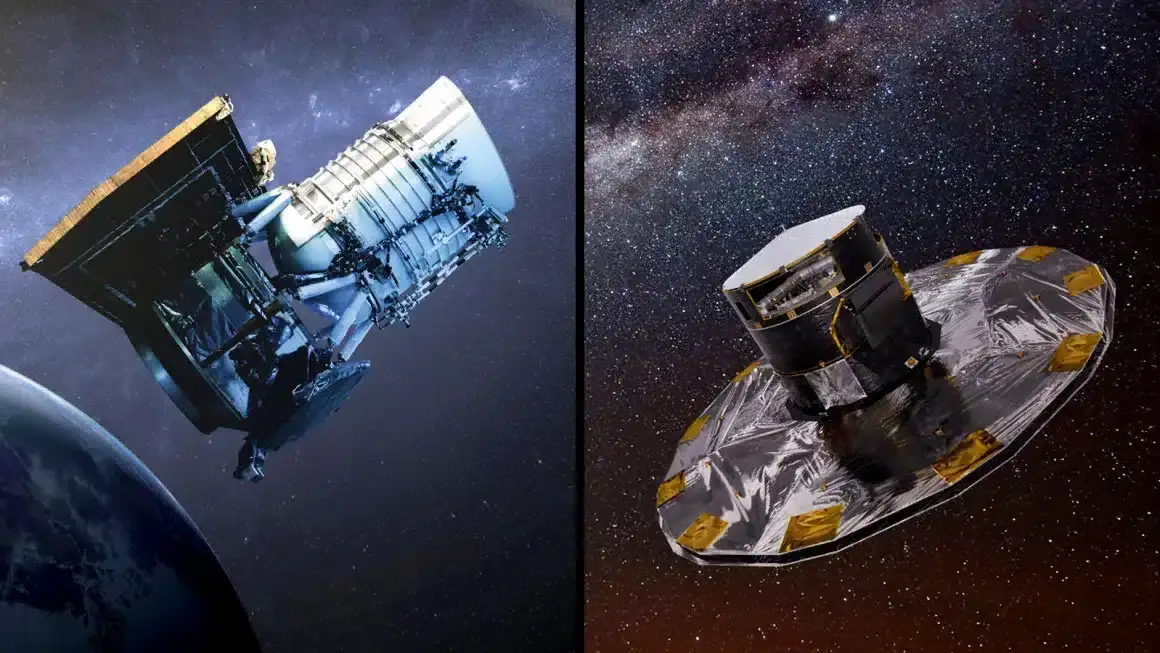
The study focused on stars situated within 1,000 light-years of Earth, utilizing data from NASA’s WISE telescope, the ESA Gaia mission, and the 2MASS infrared sky survey. After filtering out noise and misleading signals, the team isolated seven red dwarf stars emitting infrared radiation inconsistent with known stellar behavior.

“We don’t know why they’re glowing like this,” said Matías Suazo, the lead researcher from Uppsala University in Sweden. “They could be Dyson spheres, because they behave like our models predict, but they could be something else as well.”
Red dwarfs represent the most prevalent stellar classification in the Milky Way. Their small size and low brightness make them challenging targets for study, especially since their planetary systems remain largely unconfirmed.
No Definitive Evidence of Extraterrestrial Engineering—Yet
It’s important to note that there is no definitive evidence suggesting that these stars are enveloped by artificial structures. Numerous natural causes could account for the unusual infrared emissions, such as overlapping background galaxies, residual hot dust from recent planetary impacts, or youthful stars still surrounded by circumstellar material forming planets.
Additionally, a recent publication posits that three of the seven candidates may have been misclassified and could actually be "hot DOGs" (hot dust-obscured galaxies), which produce infrared signatures similar to those observed.
Still, the fact that these objects are so rare makes them interesting no matter what. “Whatever they are, they are rare and interesting objects worthy of further study,” said Jason Wright, an astronomer at Penn State who co-authored the study.
Potential for Deeper Insights with the James Webb Space Telescope
Researchers aim to conduct more detailed observations using the James Webb Space Telescope, which offers unprecedented sensitivity for characterizing infrared emissions from distant stars. However, time on JWST is highly sought after, and securing observation slots remains competitive.
Even if these mysterious emissions ultimately have natural causes, the pursuit itself is scientifically valuable. As physicist Freeman Dyson once remarked, investigating signs of extraterrestrial technology often leads to new discoveries about the cosmos.
Experts emphasize the need for careful scrutiny. Zaza Osmanov from the Free University of Tbilisi notes that attributing such radiation to artificial origins should only be considered after all natural scenarios have been thoroughly ruled out.
- Categories:
- News








0 comments
Sign in to Comment