
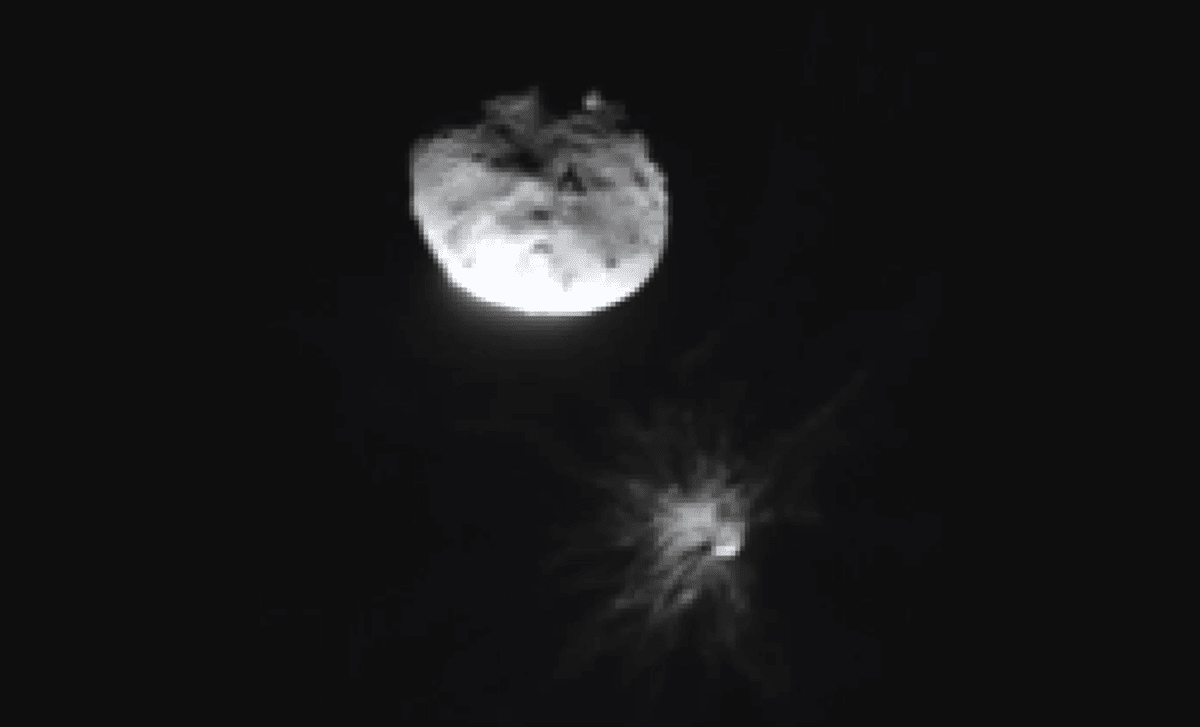
NASA’s groundbreaking DART (Double Asteroid Redirection Test) mission has successfully altered the trajectory of an asteroid system, marking a milestone in planetary defense. Newly published research in Science Advances confirms that the impact with Dimorphos, the smaller asteroid in the binary pair, not only changed its orbit around its larger companion Didymos but also slightly modified their collective orbit around the Sun. This represents the inaugural instance where a human-made spacecraft has measurably influenced an asteroid system’s solar path, highlighting the promise of kinetic impact strategies to safeguard Earth from asteroid hazards.
Minuscule Orbital Shifts Yield Significant Outcomes
The DART endeavor centered on a deliberate collision between the spacecraft and Dimorphos, the smaller member of the binary asteroid duo. The mission’s objective was to validate whether a spacecraft impact could redirect an asteroid’s motion. Post-impact, scientists measured a 33-minute reduction in Dimorphos’ orbital period around Didymos, a notable alteration given its original 12-hour cycle. More strikingly, recent findings reveal the impact also subtly adjusted the orbital period of the binary system around the Sun.
Thomas Statler, NASA’s lead scientist on solar system small bodies, highlighted,

“This is a tiny change to the orbit, but given enough time, even a tiny change can grow to a significant deflection.”
The observed shift in the system’s orbital velocity around the Sun, though merely 0.15 seconds, is monumental in the context of space exploration. Over prolonged intervals, such minute modifications can cumulate to significantly alter an asteroid’s trajectory, potentially averting future Earth impacts.
Published in Science Advances, the study reinforces the effectiveness of kinetic impactor technology—spacecraft designed to physically collide with asteroids—as a viable planetary defense mechanism. If a threatening asteroid is detected well ahead of time, this method might be employed to shift its course away from Earth. The DART mission thus stands as a pivotal advancement in Earth’s protective measures against extraterrestrial threats.
Using Stellar Occultations to Track Orbital Adjustments
To determine the influence of the DART impact on the binary asteroid system, scientists employed stellar occultation techniques. This method involves monitoring an asteroid as it passes in front of a remote star, momentarily dimming the star’s light. By meticulously timing these events, researchers can infer the asteroid’s velocity, position, and shape.
Capturing these fleeting occultations required global coordination among observers, including volunteer astronomers who recorded 22 occultations from October 2022 through March 2025. This comprehensive dataset, combined with other terrestrial observations, enabled precise confirmation of the changes in the orbital dynamics of the Didymos-Dimorphos system, enhancing understanding of how DART affected their solar orbit.
Key Role of Momentum Enhancement from Ejected Debris
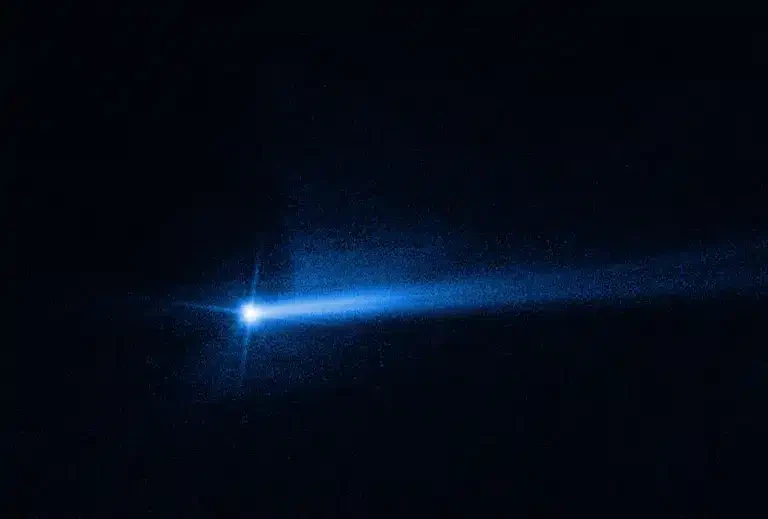
The impact released a substantial debris cloud from Dimorphos, reshaping the asteroid and contributing additional momentum. This effect, termed the momentum enhancement factor, significantly boosted the impact’s efficiency. The expelled debris essentially amplified the force exerted on Dimorphos, enabling a greater alteration of its path.
The research determined the momentum enhancement factor for DART’s collision was approximately two, indicating the debris doubled the momentum transferred by the spacecraft. This finding has profound implications for using kinetic impact techniques in planetary defense, demonstrating that the ejected material following a collision can critically augment deflection efforts.
Implications for Future Asteroid Deflection Strategies
Though the immediate orbital change is slight, the long-term effects hold immense potential for planetary defense. Rahil Makadia, the study’s lead author, noted that the binary system’s orbital velocity shift was around 11.7 microns per second, or 1.7 inches per hour. While minor, even such small deviations can accumulate over years, potentially diverting an asteroid from an Earth-bound trajectory.
The DART success highlights that mitigating asteroid impact risks may not require drastic interventions but rather early, modest orbital adjustments. This mission affirms humanity’s growing capacity to shield itself from one of nature’s most perilous hazards.
- Categories:
- Nasa





0 comments
Sign in to Comment