
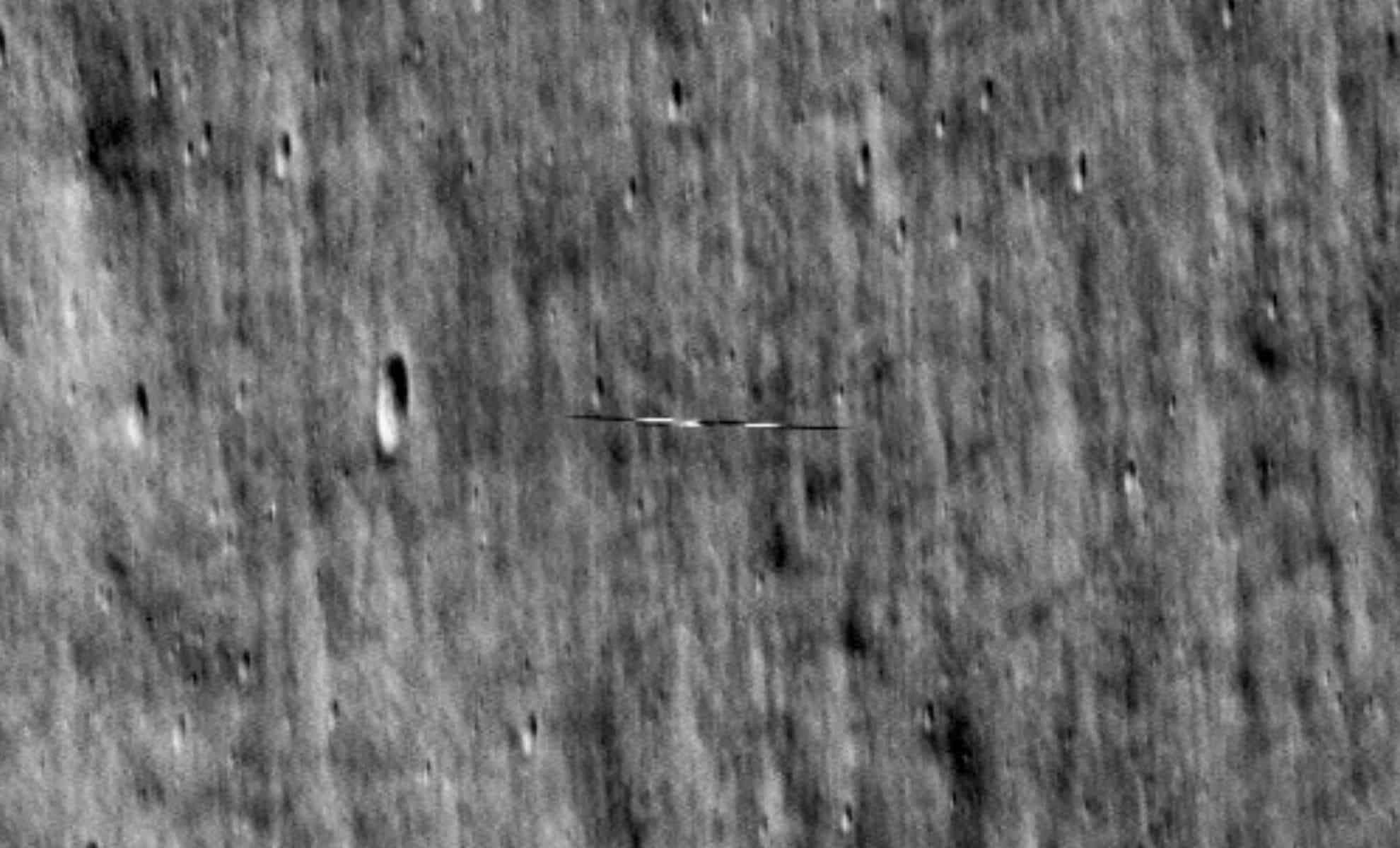
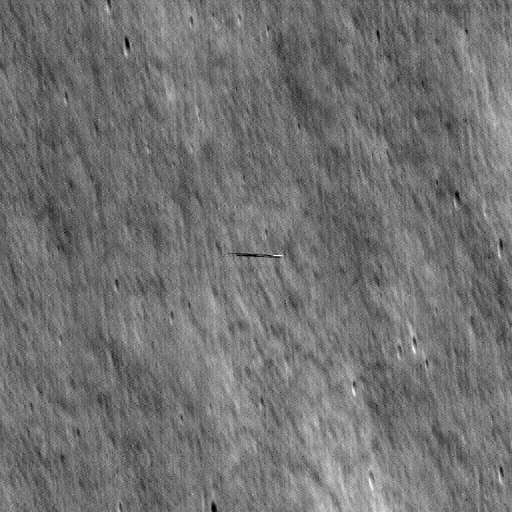
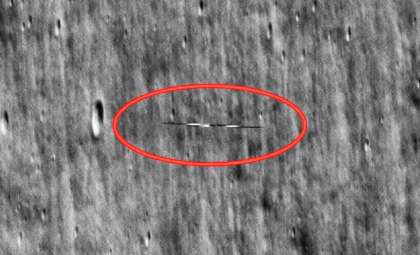
During a rare celestial event, NASA’s Lunar Reconnaissance Orbiter (LRO) managed to photograph South Korea’s Danuri lunar orbiter as both satellites swiftly passed each other in lunar orbit.
This close encounter took place between March 5 and 6, 2024, with the two spacecraft traveling on nearly parallel trajectories but moving in opposite directions.
Photos released by NASA’s Goddard Space Flight Center and Arizona State University showcase the remarkable precision and timing necessary to capture such challenging imagery.

The relative speed of the two craft was clocked at 11,500 kilometers per hour (7,200 mph), giving LRO only milliseconds to photograph Danuri within its view.
High-Speed Capture at 11,500 KM/H
Since June 18, 2009, LRO has orbited the Moon, cruising at around 80 kilometers (50 miles) above the surface, while Danuri was located about 8 kilometers (5 miles) beneath it.
Despite an extremely brief exposure time of just 0.338 milliseconds, the rapid motion caused Danuri to appear stretched—elongated to almost ten times its actual length—in the raw camera data.
The images were taken using the Lunar Reconnaissance Orbiter Camera (LROC), a highly detailed imaging instrument developed by Arizona State University.
Mark Robinson, the lead investigator for LROC, commented, “To catch Danuri traveling at such a tremendous relative velocity required impeccable timing and precise targeting of LROC.”
The LRO mission is managed by NASA’s Goddard Space Flight Center in Greenbelt, Maryland, under the agency’s Science Mission Directorate in Washington.
Understanding Danuri’s Mission and Image Return
Danuri, or the Korea Pathfinder Lunar Orbiter (KPLO), marks South Korea’s inaugural mission to the Moon. Developed by the Korea Aerospace Research Institute (KARI), it achieved lunar orbit insertion in December 2022 after a four-month voyage from Earth.
The mission aims to create detailed maps of the lunar surface and locate water ice in permanently shadowed craters near the Moon’s poles.
Danuri carries a NASA-provided instrument named ShadowCam, which boasts sensitivity 200 times greater than LRO’s narrow-angle camera. In April 2023, Danuri directed its ShadowCam at LRO and took photos of the NASA spacecraft from 18 kilometers (11 miles) above.
Overcoming Challenges of Imaging Fast Lunar Orbiters
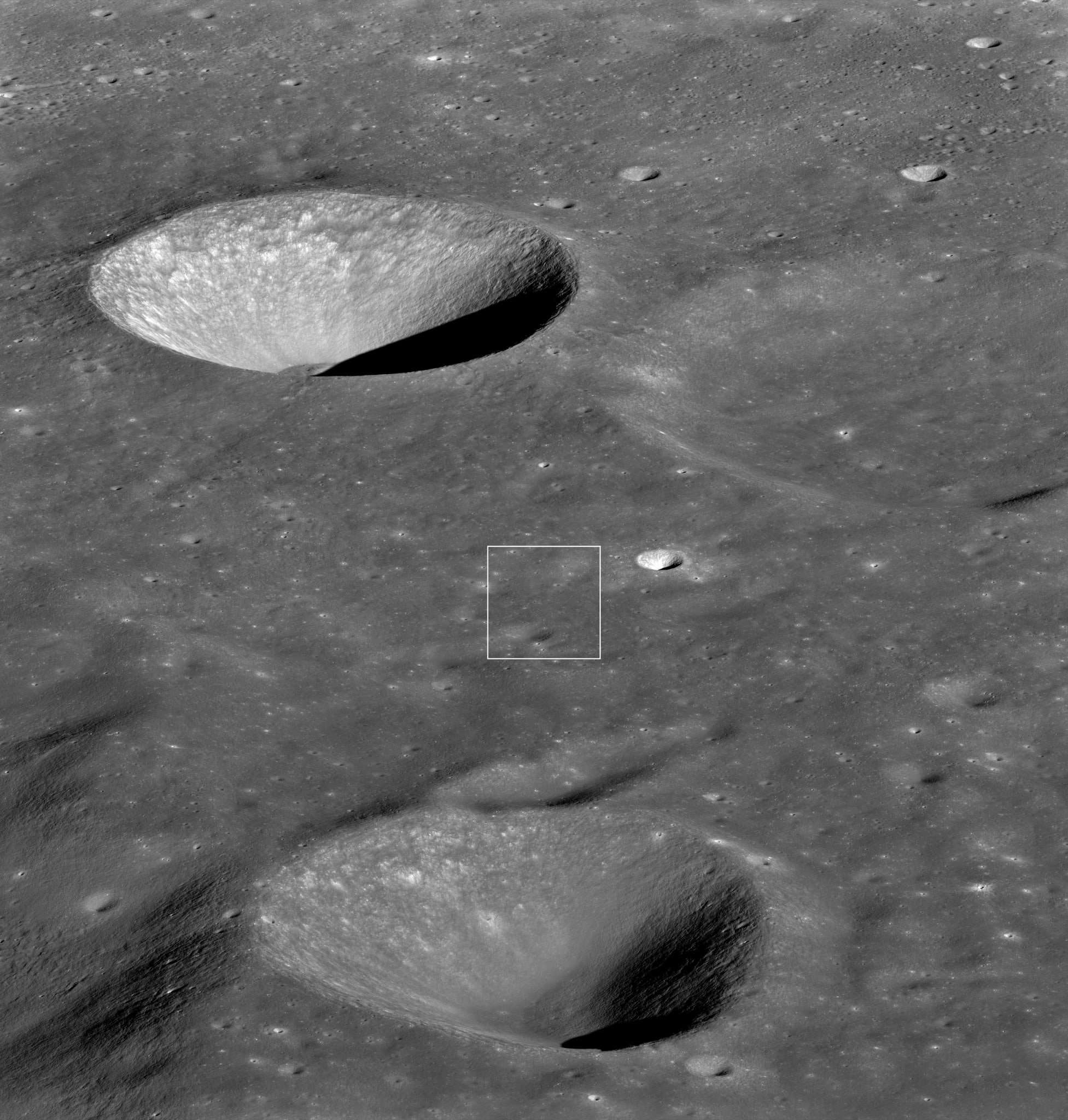
Photographing orbiting spacecraft around the Moon is an intricate operation. The accomplishment of capturing LRO and Danuri passing each other demonstrates NASA engineers’ meticulous preparation.
In one attempt out of three, LRO’s camera was tilted 43 degrees downward from its usual angle to align the shot with Danuri’s path. At another pass, the two were 2.5 miles (4 kilometers) closer, demanding even greater precision.
Despite these measures, NASA recognizes the resulting photos exhibit noticeable motion blur, an inevitable result when imaging objects moving at such high speeds.
Implications for Upcoming Lunar Exploration
This close flyby emphasizes the increasing global activity around the Moon, with countries including the USA, South Korea, India, China, Japan, and private companies ramping up lunar exploration efforts.
NASA’s Artemis program, focused on returning astronauts to the lunar surface, depends on comprehensive lunar mapping from missions like LRO and Danuri. South Korea plans to progress with a lunar lander launch by the early 2030s.
What was once a rare event—smaller spacecraft passing within sight of one another—could soon become a frequent occurrence as more satellites and crewed missions join the growing lunar orbit fleet.
- Categories:
- Space







0 comments
Sign in to Comment