
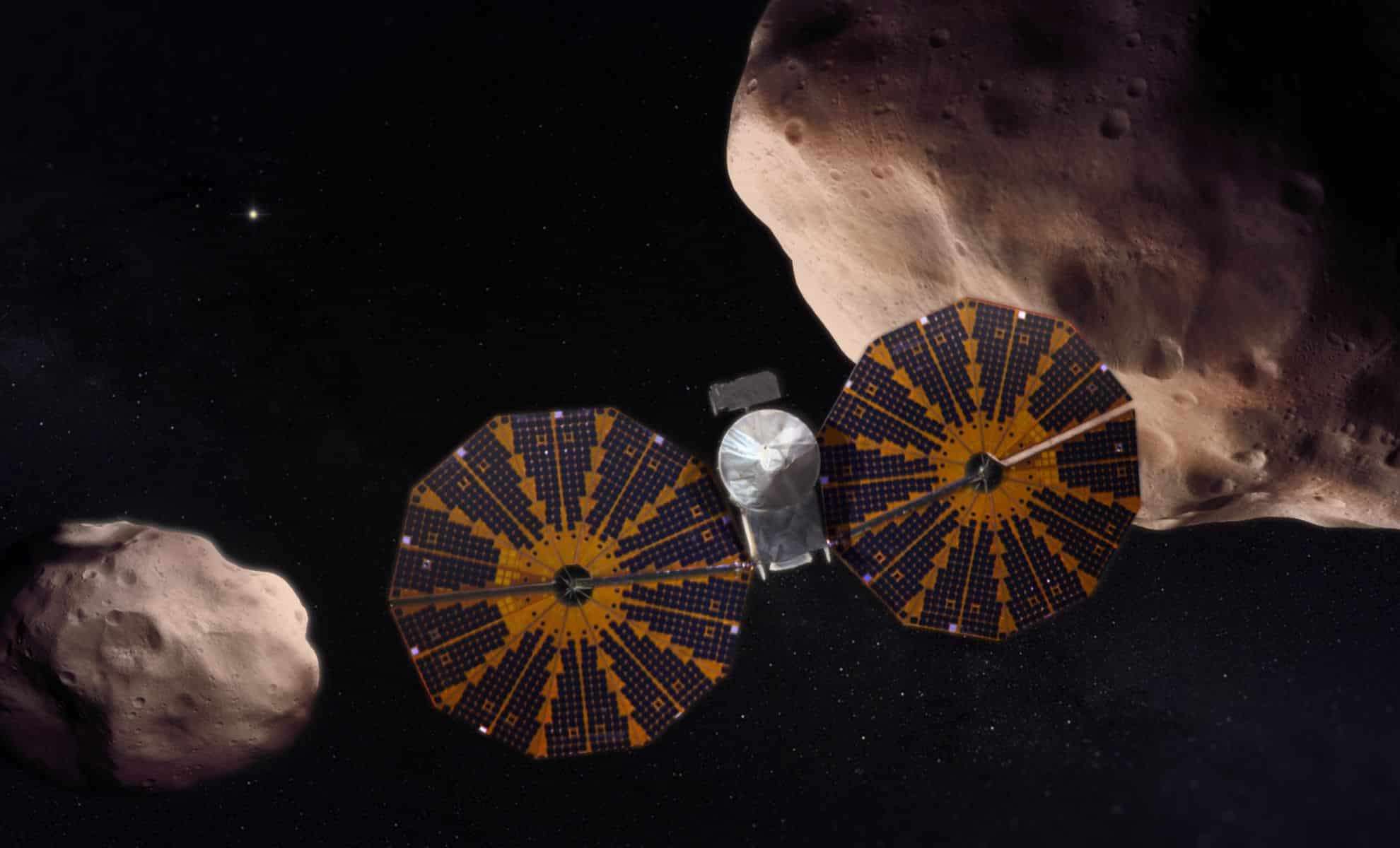
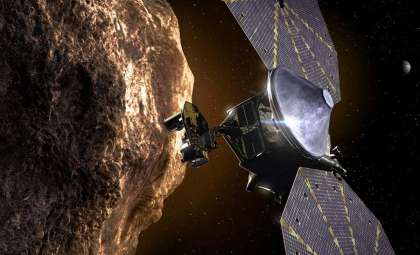
NASA’s Lucy spacecraft is nearing a significant milestone with its upcoming second close approach to an asteroid. Scheduled for April 20, 2025, Lucy will fly past Donaldjohanson, a small body situated within the main asteroid belt. This event is a vital component of Lucy’s broader mission to examine Trojan asteroids that travel alongside Jupiter’s orbit. As detailed in NASA’s Lucy mission, the team is using this encounter to sharpen observation techniques and ensure all systems perform optimally for future visits to the Trojans.
Launched in 2021, the Lucy mission has already advanced our knowledge of early solar system formation by investigating these ancient celestial bodies. Donaldjohanson is particularly interesting as one of the younger objects in the asteroid belt, offering a chance to deepen insights into the solar system’s beginnings.
A Preview of Trojan Asteroid Exploration
On April 20, 2025, at about 1:51 PM EDT, Lucy will pass within 596 miles (960 km) of Donaldjohanson. This maneuver acts as a rehearsal before the more detailed studies planned for the Trojan asteroids in upcoming years. Beginning roughly 30 minutes prior to closest approach, Lucy will position itself for an extensive observation sequence.

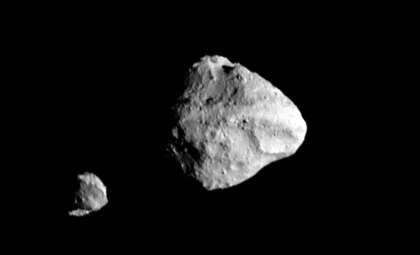
Lucy’s suite of scientific tools—the L’LORRI grayscale camera, L’Ralph color imager combined with an infrared spectrometer, and the L’TES far-infrared spectrometer—will capture high-detail images and analyze the asteroid’s makeup. This observation is more detailed than its first asteroid flyby over Dinkinesh in 2023, which tested the spacecraft’s instruments and procedures.
Instrument Safeguards and Autonomous Operation
During the approach, Lucy will temporarily pause communications with Earth, as its high-gain antenna will turn away to enable focused observation of Donaldjohanson. This encounter involves a more complex use of all three instruments compared to the previous asteroid visit.
The instruments will be protected from direct sunlight exposure while passing the asteroid. Michael Vincent, the encounter phase lead at the Southwest Research Institute in Boulder, Colorado, explains, “If you were sitting on the asteroid watching the Lucy spacecraft approaching, you would have to shield your eyes staring at the Sun while waiting for Lucy to emerge from the glare. After Lucy passes the asteroid, the positions will be reversed, so we have to shield the instruments in the same way.” Protecting sensitive equipment from intense sunlight is critical since these instruments capture images of objects lit by sunlight far dimmer than what we experience on Earth.
Communication Lag in Deep Space
After completing the flyby, Lucy will realign itself to transmit data back to Earth. Due to its distance—approximately 12.5 light minutes away—the round-trip signal time totals about 25 minutes, meaning commands and data exchanges occur with significant delay. Vincent highlights this challenge: “One of the weird things to wrap your brain around with these deep space missions is how slow the speed of light is.” Engineers will verify the spacecraft’s status before downloading the collected scientific data, a process that will span several days.
The Path Forward for Lucy
Following its encounter with Donaldjohanson, Lucy’s focus will shift to its main objective: detailed exploration of the Trojan asteroids entwined with Jupiter’s orbit. These ancient space rocks offer a unique window into planetary formation and solar system history. Through this mission, Lucy aims to deepen humanity’s grasp of the primordial materials that shaped our cosmic neighborhood.
This second asteroid flyby demonstrates Lucy’s critical role in uncovering the early chapters of our solar system. Each new observation brings researchers closer to understanding the asteroids’ contributions to planetary development and the origins of life.
- Categories:
- News





0 comments
Sign in to Comment